Trump’s National Security Strategy, a blueprint for hegemony
Author: Carlos Martinez
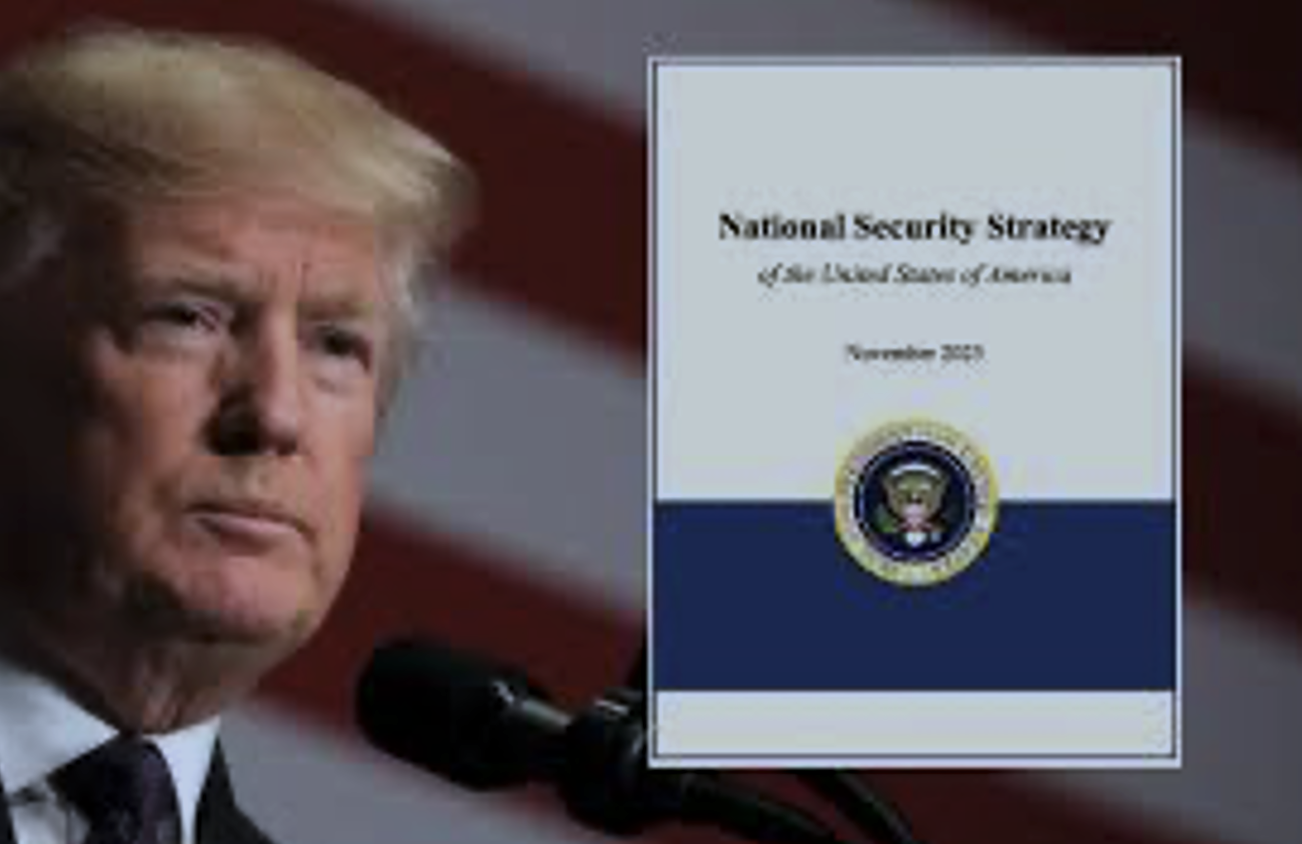
The Trump administration’s new National Security Strategy (NSS), released in late November, has inspired widespread comment and a diverse array of interpretations.
The most striking feature of the document is its explicit re-assertion of the Monroe Doctrine, shifting the focus of US military strategy towards “defending our hemisphere”, with “more troops, bases and military operations” in the Americas. Hegemony over the Western Hemisphere is of course a constant of US foreign policy, but previous administrations have at least made some pretence at multilateralism and respect for international law. The NSS does away with any such niceties:
“After years of neglect, the United States will reassert and enforce the Monroe Doctrine to restore American preeminence in the Western Hemisphere, and to protect our homeland and our access to key geographies throughout the region. We will deny non-Hemispheric competitors the ability to position forces or other threatening capabilities, or to own or control strategically vital assets, in our Hemisphere“.
Such language implies that the current reckless – and entirely illegal – aggression against Venezuela is only the beginning of a broader strategy to re-establish the Washington’s naked imperial domination of the American supercontinent. The White House, the State Department and the Pentagon are committing to an escalation of their hybrid war against all those Latin American and Caribbean countries that resist US domination and that enjoy close relations with China and other supposed enemies of the US.
The text states that “non-Hemispheric competitors have made major inroads into our Hemisphere, both to disadvantage us economically in the present, and in ways that may harm us strategically in the future”. Thereby the US has committed to a policy of disrupting the close trade and diplomatic relations that exist between Latin America and China, Russia, Iran and others.
Europe spurned
Running parallel to this hemispheric pivot is the document’s hostile posture towards Europe, which is portrayed as a declining civilisation beset by demographic crisis, economic stagnation and political fragmentation.
Trump’s cold shoulder is fomenting considerable anxiety in European capitals. The Cold War consensus that bound Western Europe to US leadership is coming to an end. That consensus emerged after the Second World War under very specific historical conditions. The Soviet Union, having borne the brunt of the fight against Nazism, emerged with enormous prestige. Socialism was gaining ground across Europe and Asia, winning real gains for working-class and oppressed peoples. In this context, the imperialist powers of Western Europe sacrificed a considerable portion of their sovereignty in exchange for US military protection, economic reconstruction under American leadership, and the NATO security umbrella.
That Cold War world no longer exists. The central strategic challenge facing Washington today is China: a rising socialist power that is already overtaking the US in key areas of science, technology and industrial capacity; which is the largest trading partner of around two-thirds of the world’s countries; and which is playing an indispensable role in constructing a multipolar world order based on sovereign equality, mutual benefit and peaceful cooperation. By any definition, this is a serious threat to the US-led imperialist system and likely an insurmountable obstacle to any Project for a New American Century.
Europe is not on the front line against China in the same way that it was against the Soviet Union. The US ruling class no longer sees Europe as its primary strategic partner, but rather as a potential liability.
The NSS outlines the US’s vision for Europe’s role in the coming period.
First, the US wants European countries massively to increase their military spending. The document repeats calls for NATO members to spend 5 percent of GDP on militarisation – a staggering transfer of public wealth from European taxpayers to the US military-industrial complex, dovetailing neatly with Washington’s domestic re-industrialisation strategy: i.e., “America requires a national mobilisation to innovate powerful defences at low cost, to produce the most capable and modern systems and munitions at scale, and to re-shore our defence industrial supply chains. In particular, we must provide our warfighters with the full range of capabilities, ranging from low-cost weapons that can defeat most adversaries up to the most capable high-end systems necessary for a conflict with a sophisticated enemy.”
Second, the document demands an even deeper level of geopolitical subservience, sacrificing Europe’s needs for those of the US: fully aligning with US sanctions regimes, technology controls, and anti-China containment efforts – even though these will have (indeed are having) a disastrous impact on European industry and living standards.
The countries that toe the line will be rewarded with preferential trade treatment, most obviously lower tariffs. Those that refuse to comply will be punished. If the ‘centrists’ currently in power in London, Paris and Berlin get out of line, the Trump administration and its backers are busily cultivating far-right nationalist alternatives that can ‘correct’ Europe’s current trajectory.
Target China
A pivot to the Western Hemisphere does not, as some wishful thinkers have suggested, reflect an acceptance of China’s rise and the inevitability of a multipolar world order. On the contrary, the purpose of building up hemispheric hegemony is to establish a stronger base from which to confront China – and Russia, and Iran. As Cameron Harrison and CJ Atkins put it in recent article in People’s World, any strategic reorientation is designed to “crush rival powers, slow China’s growing international influence, and maintain US global hegemony”.
We don’t have to read between the lines; the NSS is blunt about its objectives: “to ensure that America remains the world’s strongest, richest, most powerful, and most successful country for decades to come”.
The NSS makes relatively few direct references to China, but its strategic intent is nonetheless clear. The US is preparing for a long-term confrontation with China, seeking to mobilise its allies to isolate Beijing economically, technologically and militarily.
This is not limited to Europe and Latin America; the document emphasises the importance of “keeping the Indo-Pacific free and open, preserving freedom of navigation in all crucial sea lanes, and maintaining secure and reliable supply chains and access to critical materials”. It further calls on Japan, South Korea and Australia to increase their military spending in order to help the US “deter adversaries and protect the First Island Chain” (i.e., Japan, Taiwan, Philippines and Borneo). Meanwhile the US will “harden and strengthen our military presence in the Western Pacific” and “build a military capable of denying aggression anywhere in the First Island Chain”. The US military will work closely with separatist forces in Taiwan Province, “partly because of Taiwan’s dominance of semiconductor production, but mostly because Taiwan provides direct access to the Second Island Chain [i.e., Bonin Islands, Marianas/Guam, Palau and New Guinea] and splits Northeast and Southeast Asia into two distinct theatres”.
All of which is a reiteration of, and doubling down on, the US’s longstanding strategy of containment and encirclement of China, which has been a constant of US foreign policy since the founding of the People’s Republic in 1949.
To conclude, Trump’s National Security Strategy lays bare the imperialist ambitions of the US ruling class. While it includes some demagogic rhetoric about the need to avoid “forever wars”, in reality it commits the US and its allies to the continued pursuit of precisely a forever war to maintain US hegemony, to counter the rise of China, and to prevent the emergence of a multipolar system of international relations in which all countries can assert their independence and define their own development path.