Agent Sonya – the heroine housewife
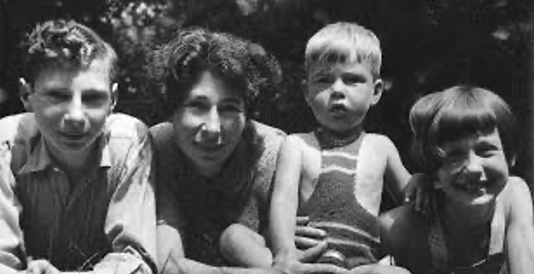
by Vikki Harper
Speech delivered at CPGB-ML Southall seminar on 28 Feb. 2026
It’s Munich, November 1923 and Germany is in deep crisis. Defeat in the First World War, the humiliation of the Treaty of Versailles and an economy on the verge of collapse gripped by hyperinflation and mass unemployment – the German working class is being crushed.
At this moment Adolf Hitler led a small but growing party calling itself the National Socialist German Workers’ Party. So named because then, as now, deceiving workers requires the language of socialism. Hitler believed the time had come to overthrow the Weimar Republic. Inspired by Mussolini’s March on Rome, he attempted to seize power by storming a beer hall where Bavarian leaders were meeting, declaring a ‘national revolution’ and hoping the army and police would fall in behind him. They didn’t.
The following day, Hitler and his supporters marched through Munich and were confronted by police. Shots were fired. Some nazis were killed. The coup collapsed. Politically, it was a failure; strategically, it was a lesson. Hitler was arrested put in prison, where he wrote Mein Kampf. He would return with new tactics, enabled by a ruling class whose real fear lay not with fascism, but with what workers to the east had already achieved through socialist revolution and what its own workers were understanding.
At this time, Ursula Kuczynski – later known as Agent Sonya, later still as Mrs Burton – was a 16-year-old middle class Jewess whose political views were being formed under the pressure of these real historical conditions. The misery of the German working class was visible and unavoidable, shaping her understanding of capitalism as a system in decay. At the same time, the Russian revolution showed that the working class could take power and open a new historical epoch.
It is against this backdrop we introduce Ursula Kuczynski, our focus for International Working Women’s Day 2026.
Ursula grew up in an intellectual, liberal Jewish household. Her father, an economist with one of the largest private libraries in Europe, and a close friend of Albert Einstein, encouraged serious study and discussion of social questions. This environment helped to shape her early political outlook and her ideology of revolution and working-class power.
In 1924, aged 16, Ursula joined the Young Communist League. At 17, she had her first taste of the strong arm of the state when she took part in a demonstration and was bludgeoned by a policeman. She returned home dishevelled and bruised, a concrete lesson in how bourgeois authority is enforced. Whilst the bruising would dissipate, her outrage remained lifelong.
Despite admiring her spirit, her father suggested she was too young to have fully formed political ideas. Ursula replied that if she was old enough to work and be exploited, she was old enough to fight against exploitation. It was not a theoretical argument but one rooted in lived reality — and impossible to refute.
Her mother disagreed. Convinced Ursula had had enough ‘intellectual education’, she insisted on her training in ‘womanly’ skills, and then marriage. Ursula was sent to trade school to learn typing and shorthand, and whilst her intellectual education may have been constrained; her imagination was not. She was an avid writer of fiction, always casting herself as the heroine: adventurous, central to the story, prepared to take risks. It would turn out to be less fantasy than preparation.
At 19 Ursula joined the KPD, the largest communist party in Europe after that of the Soviet Union. Whilst socialising with comrades from the KPD and the Social Democratic Party she met Rudi Hamburger. Rudi was a kind, funny and gentle Jewish boy but no communist. Ursula hoped he would be persuaded to communism, he hoped she would be persuaded to marriage.
After a stay in America to visit her brother she returned to Germany, acknowledged her love for Rudi, and when she was 21, they married. They travelled to Shanghai where Rudi was to be employed as an architect. Ursula worried about leaving her comrades on what she was sure was the eve of German revolution but declared that as communism was international, revolutionary work could be done anywhere.
What do we glean about the young Ursula at this point? She is loyal to working-class politics – not geography – and she shows a willingness to uproot, adapt, and to act. For a 21-year-old woman, in an era of precarious travel and slow communication, these were no small things.
While leafleting in my community recently I spoke with a woman who described how frightened she felt about the world: the violence, the uncertainty, the sense that there is no real future. “But what can we do?” she asked, genuinely and without cynicism.
Ursula’s life offers an answer to that question. She didn’t try to carry the whole weight of the world on her own, and she didn’t act in isolation. As we will see, she maintained a focused steady and conscious contribution as part of a wider network of people all working towards the same aim – socialism. On its own, her effort would have meant little, but connected to others, it helped produce consequences that were genuinely world changing. That’s how history moves — through ordinary people, men and women collectively taking responsibility for one piece of a much larger task and trusting that together, their efforts add up.
Expat life in China bored Ursula rigid. Servants, cocktail parties, mini-golf – all empty distractions. So she took a secretarial job at a telegraphic agency organising press cuttings and was introduced to Agnes Smedley: American writer, Marxist, and intelligence operative. Agnes introduced Ursula to intellectual leftist circles and crucially, to Richard Sorge – described by Ian Fleming as the most formidable spy in history – and the man who would inimitably change the course of her life.
Sorge teaches Ursula to listen, to analyse and to report; through his instruction and mentoring, clandestine behaviour becomes second nature. Ursula would host dinner parties of municipal council dignitaries, socialites, journalists, military officers, businesspeople, academics, and of course Agnes; all of whom would chat freely not realising there were spies within their midst. The table talk related by Ursula formed part of Sorge’s regular reports to Moscow and it was during this time he gave her the code name, Sonya.
Much happened during her tenure in Shanghai. The arrest of another Soviet intelligence officer, Yakov Rudnik, took place in a climate of mass repression, known as the White Terror. Led by Chiang Kai-shek and the Kuomintang (KMT) against the Chinese Communist Party and organised workers, the KMT’s counter-revolutionary crackdown didn’t distinguish between Chinese communists and international revolutionary networks operating in solidarity with them. Arrests, torture and executions were routine tools used to smash communist organisation and Ursula was now a cohesive part of that resistance movement. When Rudnik was arrested, tortured and killed, the network was compromised but, luckily for Sonya, her cover, and that of her cell under Sorge, remained intact.
Sonya housed weapons, secret papers and in one instance even a young communist, putting her and her family, for she now had a baby son Michael, at great risk, but she was a committed revolutionary.
Since we are talking about committed revolutionaries and great women, I cannot avoid mentioning my own mother, a life-long, active communist. In preparation for this talk I read Ben Macintyre’s Agent Sonya, and what irked me was his constant critical insinuation that Ursula placed her political commitments above her family.
As a child, I moaned at my mother’s absence from activities other mothers attended. She told me she was fighting for a better world, not just for me but for all children, which was true. Socialists do not pursue private solutions for their own families; they fight to change the social conditions that shape every family.
Ursula Kuczynski did not choose politics or ideology over her children; like my own mother, she understood that the future of her children was bound up with the future of the working class as a whole and it was that clarity that made her effective as a revolutionary. As a spy, it also made her invisible to a capitalist system that could not imagine a mother as a conscious political actor. That’s why she belongs here, on International Working Women’s Day — not as an exception, but as proof of women’s capacity to act consciously, collectively and decisively in history.
In 1933, Ursula was invited to the Soviet Union to train as an intelligence officer. She learned Russian, became a skilled wireless operator, and was trained to assemble radios and build transmitters, receivers, rectifiers and frequency meters. Accepting this training meant leaving Michael with family for six months. As a toddler, if he learned to speak Russian while living with her, her cover would be blown. Ursula didn’t describe this as a tragedy but as the logical consequence of her political conviction. Her duty as a mother was to her son, Michael — and of course she felt guilty and missed him dearly every day – but she understood she had a broader responsibility.
After seven months of training, she accepted her next mission.
Manchuria, invaded by Japan in 1931, had become a live fault line of imperial expansion and resistance in east Asia, a place where decisions taken in secrecy would help shape the wider war to come. Ursula was sent to liaise with Chinese communist partisans, to provide material support, and, using her new skills, to transmit military and political intelligence to Moscow. She did so as a mother and married woman once again, but not to her husband Rudi, it was a marriage of pretence to an agent named Johann Patra.
Again her life became a dichotomy of constant threat and familial normality. The Japanese military had established a reputation across occupied China for systematic brutality, using terror, collective punishment and exemplary violence to crush resistance. Japanese surveillance aircraft searching for clandestine transmissions meant that if she was discovered, arrest, torture and death would inevitably follow. Yet within this permanent state of danger, life for agent Sonya and mother Ursula, continued.
Ursula lived in Manchuria as the wife of agent Patra, with whom she would eventually have a daughter, Nina. Happiness and heartache, love and fear, elation and exhaustion existed side by side. Relationships were formed under unbearable pressure, on the knife-edge of survival, where trust had to be absolute and time was compressed — friendships forged in days, lifetimes lived in moments. We can only admire such capable resolution.
When her comrades were arrested and tortured, it was only a matter of time before Ursula was outed. Her orders were to head for Peking – without Patra.
On the journey to Peking, Ursula developed a toothache which, by the time she arrived, had become unbearable and required immediate treatment. What followed was a brutal, two-hour root canal performed with pliers. Alongside the physical pain was a newfound affinity for what captured comrades were enduring elsewhere. Yet through it all she remained calm and silent, refusing to cry out or display any emotion, so as not to leave her young son Michael with a lifelong fear of the dentist. I include this not as an anecdote, but to convey the full breadth of her humanity —restraint, nurture and emotional intelligence — qualities so often dismissed as feminine weakness, yet essential to her effectiveness as a spy and a mother.
Ursula was reassigned to Warsaw, Poland, which in 1936 was decidedly anti-Soviet. It was also becoming increasingly antisemitic. Back with husband Rudi who despite his finally becoming a communist she no longer loved, pregnant with faux husband and current love Patra’s child, accompanied by her now six-year-old son Michael and her childhood nanny, Olga, for domestic support, our German Jewish, Russian spy, Ursula, aka agent Sonya, was once again thrust into the arms of danger.
She was also bestowed the Order of the Red Banner, the highest Soviet military award for courage and heroism on the battlefield. Sonya received the award in person in 1937 when she returned to Russia for five months for further training in how to blow up bridges and run undercover agents, again without her children who remained in Poland with Rudi and Olga,
Ursula’s life becomes one continuous movement between fronts of struggle. In Warsaw, she was operating under constant threat from Polish security services and German intelligence. It was isolating, disciplined work: maintaining radio contact, moving information, remaining invisible. Arrest was a constant possibility and her survival depended less on luck than on skilled professionalism, determination, durability, precision, and emotional control – all under the cover of an ingenuous mother.
Following promotion to major of the Red Army, Sonya was redeployed to ‘neutral’ Switzerland in 1938, the country with the world’s highest per capita quotient of spies. Without Rudi (from whom she was divorced in 1939) but with Olga and the children, her role was to feedback intelligence about the military build-up of the Third Reich.
Sonya ran a highly effective radio network linking agents across Europe directly to Moscow. Radio operators were among the most hunted figures in the underground; detection usually meant execution. She transmitted for years without being caught, often with children nearby, exploiting the state’s inability to imagine a mother at the centre of an intelligence operation.
Just as crucial as her technical skill was her ability to form relationships — to earn trust, command respect and bind people into a functioning network. She easily moved between different social worlds, made people feel at ease, and secured loyalty without coercion – again, qualities often associated with femininity but that underpinned her success as a spy.
It was during this period she was teamed up with Leon ‘Len’ Burton, a committed communist and fellow intelligence officer. Together they crossed borders, identities and assignments, sustaining a network built on reliability, discretion and mutual confidence.
On Feb 23 1940, the anniversary of the founding of the Red Army, and after Olga compromises Sonya’s position, Ursula marries Len providing her with a lawful route out of Switzerland and into Britain.
And so begins her next chapter, as Mrs Burton.
After an arduous journey to Britain with her two children, Mrs Burton begins her new life without Len, who was stranded in Switzerland, unable to secure a Spanish transit visa. She was lonely, broke and, for the first time in her life, without clear purpose and despite feeling dislocated, she arduously attended to her responsibilities: caring for her children, reuniting with her husband, and remaining ready for work.
In June 1941, the Nazis launched Operation Barbarossa, invading the Soviet Union with the largest military force ever assembled. Overnight, Britain and the USSR become allies — sort of – for while claiming partnership, Britain was participating in a race to develop the most destructive weapon humanity had ever known, the atom bomb, without informing its ally in Moscow.
By this point, the wider Kuczynski family was established in England, having escaped Germany before it was too late. Whilst Ursula’s brother Jürgen Kuczynski was under MI5 surveillance, Ursula herself appeared unremarkable. That was precisely her strength.
Living in England, Mrs Burton embedded herself in ordinary life. She was polite and innocuous, riding her bike around Oxford, digging for victory in the back garden and making do like all good housewives of the time. Len finally joins her in July 1942 and in the autumn of 1943, she gives birth to her third child, Peter, and within hours is back at work conducting espionage.
The family integrated perfectly into local Oxfordshire life. The children attended local schools, Nina was a member of the Girl Guides and life appeared normal. Through family, neighbours and social contacts, Ursula used her exceptional talent to make people feel at ease, to form genuine friendships, and to earn trust and respect across class and professional lines. These relationships were not mere operational façade — they were real — and that authenticity allowed her to sit quietly at the centre of an espionage network that functioned efficiently and invisibly.
It was through these connections and her brother that Ursula became the handler for Klaus Fuchs, the German communist and physicist working first on Britain’s atomic research and later on the US Manhattan Project. Fuchs.like Ursula, rightly knew that a US monopoly on nuclear weapons would place the world in permanent danger. And they were of course correct.
When in 1949 the USSR tested its first nuclear weapon, shock rippled through the intelligence community. The US had estimated it would not be until 1953 at the earliest, while MI6 estimated even longer, but overnight America’s assumed nuclear monopoly and advantage had evaporated.
US Airforce General, ‘Iron Pants’ Lemay, had suggested the US nuke the USSR before they could develop the bomb, to ensure American global hegemony but once Russia had ‘the bomb’, all bets were off. We know it’s true too because we have seen the same pattern playing out since. Libya conceded development of nuclear weapons and was destroyed. The DPRK, recognising their long-term survival relied upon them, survived.
The intelligence provided by Ursula enabled the Soviet Union to break the US nuclear monopoly far earlier than would otherwise have been possible and the balance that emerged decisively and positively shaped the post-war world. The consequences of her contribution, as part of a collective effort, were genuinely world-changing.
Ben Macintyre’s book, Agent Sonya, which I used as the basis of my research, is around 130,000 words long so my meagre 3900+ words can only paint an impression of the woman and her contribution. I shall finish her story with a brief insight into Mrs Burton’s detection and the return of Ursula Kuczynski.
Jim Skardon was one of MI5’s most experienced and psychologically adept interrogators. He was the man MI5 relied on to break spies once they were in custody. His forte was in long-form interrogation, using patience and preparation, making suspects underestimate him by cultivating an image of the reasonable civil servant: polite, persistent, unthreatening.
His method was to lull suspects into talking, returning to the same points repeatedly over weeks or months, cross-checking statements against documentary evidence and intelligence intercepts. He believed most spies were undone not by pressure but by fatigue, overconfidence, and the need to be understood. He avoided drama, rarely raised his voice, and let silence do much of the work.
Skardon interrogated Mrs Burton and famously underestimated her, describing her dismissively in his report as “a somewhat unimpressive type with frowsy unkempt hair, perceptibly greying, and of rather untidy appearance” who was nonetheless “a very tough nut.” He came a cropper because he unconsciously shared the ideological belief that a middle-aged woman, a mother, and an apparently unremarkable housewife could not be a central political actor.
Agent Sonya stonewalled him completely, revealing nothing and left Britain undetected to live out the remainder of her long life as Ursula Kuczynski once again, with loving husband Len and her children. She became Ruth Werner, a famous children’s author, the Enid Blyton of the German Democratic Republic.
Ursula, Agent Sonya, Mrs Burton was able to pass undetected not because of individual brilliance alone, but because bourgeois ideology systematically underestimated revolutionary capacity when it appeared in the unexpected social form of a wife and mother.
So, from highlighting the story of one amazing woman we now address all the remarkable working-class women listening to our celebration today. Ursula wasn’t unique. She was simply passionate and driven by an ideology she knew would free all working-class people and build a just, peaceful fruitful world for them to live in and thrive.
So this International Working Women’s Day, I invite you to reflect on what you now know of our Western world and the corrupt forces that shape it. Many of the assumptions we were raised with — about power, justice, war and inequality — have not held up to our experience. Again and again, history shows us that the people dismissed as evil, authoritarian, unrealistic, marginal or out of step, like anti-imperialists, like communists, are the ones who have understood it most clearly.
The world view expressed by communists, by Marxist-Leninists, may have seemed uncomfortable or unfamiliar, not because they were wrong, but because they challenged what we had been taught. Capitalist society works hard to narrow what we imagine is possible. When that grip loosens, even slightly, a clearer picture of the world begins and possibilities for a brighter future emerge.
The ideas that guided Ursula — of solidarity, collective responsibility and shared futures — are not abstract theories but practical ways of making sense of the world and acting within it. It’s time to go beyond trite sentiments capitalist leaders proffer about women’s equality and decide if their words are matched by material action. We know from our living experience, our material reality, they are not!
Joseph Stalin stated plainly that “the position of women is a sure index of the cultural level of society.” In the Soviet Union this was not treated as rhetoric. Under socialism, women were drawn into education, industry, science and political life on an unprecedented scale, supported by state childcare, maternity protections and legal equality embedded in the constitution. International Working Women’s Day — note how the word ‘working’ has since been quietly dropped — was marked not as a token celebration, but as a reminder that women were builders of socialism, and that their emancipation depended on transforming society itself. Stalin’s words were backed by structural change that altered women’s real conditions of life.
Today, International Working Women’s Day exposes a sharp contrast. Under socialism, women’s equality is understood as a question of power, production and social organisation. Under liberal and conservative capitalism, it is reduced to slogans, symbolism and individual success.
The lesson we want you all to take away from IWWD 2026 is not simply to celebrate women, but to ask which social system is capable of making equality real.
The truth is that women have much to gain from revolution but it’s also true that extra pressures within capitalist society make it harder for us to think about it and be involved, but our example sets the tone for the next generation. A busy political mother, like my mum, is not the norm in our society and she can be made to feel guilty for her involvement. But there is much to be gained by the children of such an example. Everything their mum does, that my mum did, doesn’t have to conform to what is seen on the TV. Their reality is that mothers can have an independent existence and a purpose in life outside of the home and the family, that there are some things that matter more than the immediate family unit. Political mothers beget politically conscious children; I am proof of that.
On this IWWD 2026 I will leave you with a quote from a man, a great man, one of the greatest who ever lived. And now that your eyes are open to the lies, duplicity and depravity of those who control the very fabric of our society, perhaps you will begin your education with a re-examination of Joseph Stalin who did more for the emancipation of women than anyone before or since.
That understanding — that women’s liberation is not symbolic but social, not individual but collective — was expressed plainly and without ornament by him, speaking at the very beginning of International Working Women’s Day as a political tradition.
“Working women are a great force. If the working class wants to win, it must draw women into the struggle. The proletariat cannot achieve victory without the active participation of women.” — Joseph Stalin, Speech on International Working Women’s Day, March 8, 1921