The imperialist debt trap
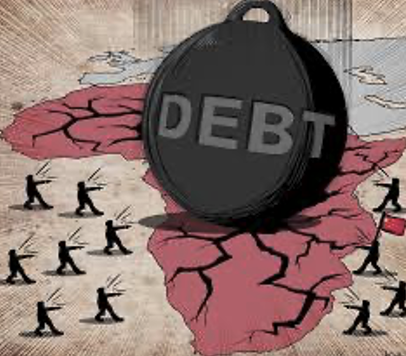
It is to a considerable extent through debt that imperialism exploits and oppresses the countries of the Third World. Purchase and control of critical assets such as mines, land, and major businesses, also facilitates imperialist looting. Chapter 13 of Harpal Brar’s book Imperialism – decadent, parasitic, moribund capitalism focused on debt and gave the truly astounding statistics regarding this debt as it was in 1997 when his book was published 28 years ago. What has been happening in the meantime?
In 1994, third world debt stood at $1.7 trillion, the equivalent of $3.7 trillion today. As of 2024, public debt in developing countries stood at approximately $31 trillion! This accounts for nearly a third of global public debt ($102 trillion) and it has grown since 2010 at twice the rate of debt in richer countries (see UNCTAD, ‘Developing countries face record-high debt burdens. Now is the time for reform’, 26 June 2025). Since 2010, the external debt of all low and middle-income countries has risen by more than 80%.
The annual debt servicing costs for low and middle-income countries (LMICs) hit a record $1.4 trillion in 2023 (UNstats, ‘Partnerships for the goals’, UN.org). 3.4 billion people (around half of the human race) live in countries where interest payments exceed spending on health and education. Lenin gave the definition of a police state as one in which the police are paid more than the teachers. What can we say of the states whose payments to the Western banks and billionaires is greater than the entire state spending? Truly that they are debt colonies of imperialism.
According to the Global Sovereign Debt Monitor 2024, “Since 2010, total external debt service payments of low- and middle-income countries increased from about USD 465 billion to USD 1.257 trillion in 2022… In 2024, it is estimated that governments in the Global South will have to pay around USD 487 billion in interest and principal payments to external lenders. This is more than USD 1 billion PER DAY.
“… since the build-up of the new debt crisis since 2010, debt service has not only risen in nominal terms. Rather, economic development and the development of government revenue in particular could not keep up with the increase of the debt service, especially since 2015. In 2024, it is estimated that governments in the Global South will have to spend an average of 14.7% of their public revenues on interest and principal payments to external creditors. By way of comparison: under the HIPC debt relief initiative of the 1990s and early 2000s, a maximum debt service to revenue ratio of 15% was aimed for, as a higher value was no longer considered sustainable. Forty-five countries will have to raise more than these 15% of their government revenue to service their debt to external creditors in 2024 … Laos and Angola will even have to raise around 60% of their tax revenue to pay external creditors – which will severely restrict their fiscal room for manoeuvre for domestic spending.”
In 1993, according to Susan George writing in the New Internatonalist in May 1993, third-world debt repayments more-or-less equalled spending on health and education. Today the debt repayments exceed them.
Partners in Health, in an article entitled ‘Financing the right to health: how the global debt crisis impacts global health’, shows how the parasitic billionaire financiers have continuously expanded their expropriation of world wealth at the expense of the masses of working people, not only in the third world but also in the rest of the world:
“Governments around the world get into debt by borrowing money from sources such as investors and pension funds, international organizations, and banks or asset managers to help fund expenses that exceed their revenue. These expenses include public services that rely on government funding, such as education and health care…
“In many of the world’s developing countries, public debt and rising interest rates have become a massive burden, threatening many of the programs they were intended to build up.
“Compared to 2011, governments are now allocating twice as many resources toward paying public debt, leaving less money for sustainable development as they are forced to prioritize debt spending over public spending. The International Monetary Fund (IMF) has estimated that over 70 countries are either currently in or near debt distress. In 2023, approximately 60% of critically indebted countries cut their public spending by an average of 2.4% of their GDP.
“Global debt levels have recently exploded:
• Public debt levels have more than doubled since 2008, with global public debt reaching a record $97 trillion in 2023.
• 2024 is the costliest debt service year this century, estimated to top $400 billion,
• And in 2024, countries will have to pay almost 10 percent more in debt service than in 2022, when payments reached $365 billion.
“According to UN Trade and Development:
• Developing countries’ net interest payments on public debt reached $847 billion in 2023, a 26% increase compared to 2021.
• On top of that, developing regions borrow at significantly higher rates, with interest payments 2 to 4 times higher than those of the United States, and 6 to 12 times higher than Germany.
• And 48 developing countries, with a total of around 3.3 billion people, spend more on interest payments alone than on either education or health.
“Often, countries will end up paying their original loan many times over through principal and interest payments.
“These crushing debt conditions also make it impossible for countries to invest in climate adaptation and mitigation. The same countries that are overburdened by debt are often the ones hardest hit by the climate crisis. Many citizens of developing countries are impoverished, living in precarious housing environments, and may rely on farming for survival. When floods, cyclones, earthquakes, hurricanes, and other natural disasters destroy the existing infrastructure and many people’s livelihoods, a country’s relief efforts are often funded by loans—which will eventually have to be paid back, plus interest. It’s a double burden.”
And the Miserior Global Sovereign Debt Monitor from Germany adds: “…spending on domestic and external interest and principal payments by countries in the Global South is already on average 11 times higher than spending on social benefits, 4 times higher than health spending, 2.5 times higher than spending on education and 12.5 times higher than spending on climate adaptation measures. For example, the debt service obligations in Lebanon, a very critically indebted country, exceeded education expenditure tenfold and in Ghana, another very critically indebted country, they were more than 11 times higher than healthcare expenditure.”
Unless such a country is able dramatically to increase production to satisfy local needs and to raise much more money through exports, it must – regardless of whether its government is civilian or military, left-wing or right-wing, democratic or fascistic – slash government expenditure, be it on measures designed to increase production levels, or on the benefits such as health and education, or nutritional support that much of the population depend on.
The governments of these countries that fail to obey the orders of their imperialist exploiters to the letter will find themselves blamed for imperialism’s depredations, accused of incompetence and/or corruption, and pilloried around the world. There is often truth in these allegations, since the persons at the head of such governments can do little to lift the burden of imperialist debt, or imperialist looting through control of national assets, so they might as well take advantage of their situation at least to benefit themselves and their friends and family! Their role is to take the flak when the population begins to resist, the idea being to defuse public anger by popularising the illusion that a change in government would make all the difference. But of course, so long as imperialist interests remain intact, no change of government can make any difference at all.
Latin America
Harpal Brar continues by giving details of the increasing level of poverty in Latin America resulting from their domination by imperialism. Curiously, while the percentages of people living in poverty and in extreme poverty in the area have both decreased, the absolute numbers living in poverty have increased. This is explained by increases in the size of the population.
Whereas Comrade Brar documents that in the countries covered by ECLAC (i.e. the UN Economic Commission for Latin America and the Caribbean) the number of the population living in poverty rose from 136 million to 196 million (41% to 46%) between 1980-1990, and those living in extreme poverty rose from 62.4 million to 93.5 million (19% to 22%), an ECLAC press release of 12 November 2024 tells us that the numbers living in poverty and extreme poverty respectively are 172 million and 66 million, (27.5% and 10.6% of the population respectively).
It is probable that what mostly accounts for the improvement is the fact that various Latin American countries have had extensive periods since 1990 when they were governed by left-leaning governments that focused on channelling more of the country’s wealth towards the welfare of the population than had ever been done previously.
Brazil, Bolivia, Ecuador, Venezuela, Mexico and Nicaragua in particular have or have had such governments. Measures taken have sometimes included nationalisation of sources of raw materials. The Venezuelan oil revenue streams, nationalised under Hugo Chavez, were used to grant loans and concessions to the countries that subscribed to the ALBA (Bolivarian alternative for the Americas), but the increasingly crushing sanctions regime and US fracking that brought the shale gas boom both decreased the price of oil, and prevented Venezuela from benefiting from her national resources. The message was clear: if the US imperialists cannot benefit from the looting of Venezuela’s resources, no one can – certainly not the impoverished masses of Latin America.
“Speaking to reporters at Joint Base Andrews [on 13 December 2025], Trump said: “They [the Venezuelans] took it away because we had a president that maybe wasn’t watching. But they’re not going to do that again.”
“We want it back,” he added. “They took our oil rights — we had a lot of oil there. As you know they threw our companies out, and we want it back.”
Consequently, in the absence of domestic ownership of their great resources, or under extreme sanctions that prevent them trading with the world on equal terms, most oppressed countries have taken on debt to pay the cost of improving living standards, subjecting them to ever increasing costs of debt servicing that ultimately pushes them back into the tender embrace of the world’s usurers who demand the imposition of austerity and further privatisation of assets – essentially looting – as a condition of restructuring debt to manageable levels. The austerity duly causes disaffection among the people who typically turn against the left-leaning government in question, encouraged by imperialist controlled media to place the blame on the supposed corruption of the government. In ensuing elections the people vote for the preferred candidates of imperialism, imagining that this is the ‘least worst’ option!
How debtor countries are treated by their imperialist creditors is well illustrated by the following case study on Suriname (formerly Dutch Guyana) by the German organisation Miserior in its ‘Global Sovereign Debt Monitor 2024):
Treatment of Suriname – How private creditors profit from Suriname’s debt crisis
“In the face of its external debt burden and in the context of the economic crisis following the COVID-19 pandemic, Suriname had to suspend its payments to external creditors in late 2020. In its debt sustainability analysis dated December 2021, the IMF calculated that private creditors would have to accept a haircut (i.e. a cancellation of nominal claims) of 40% in order to reach a sustainable debt level and assumed that an agreement could be reached by no later than the end of 2022. In reality, however, the Surinamese government was not able to conclude a deal with the private creditors until November 2023. The main reason for the protracted negotiations was that the investors – contrary to the IMF – first wanted to price in the economic perspectives of the potential extraction of oil and gas before agreeing to a restructuring of the debt.
“On paper, private creditors ultimately agreed to a haircut of 25%, i.e. a much lower percentage than the 40% originally deemed necessary by the IMF. In actual fact, the investors have cancelled only 1.2% of their original nominal claims.
“There are two reasons for this: firstly, because the negotiations lasted for over three years, high penalty interest rates of almost 13% were applied to the suspended payments, which were capitalised and absorb a major part of the cancellations. Secondly, Suriname had to pay USD 10 million in fees for the restructuring of its debt. The private creditors refused to extend loan periods or lower interest rates for the restructuring to compensate for the low level of cancellation of nominal claims: Even when considering the present value, which accounts for changes in interest rates and loan periods, they do not offer the level of debt relief originally deemed necessary by the IMF. Despite this, the IMF approved the agreement and declared Suriname’s debt situation to be sustainable – without transparently clarifying how this conclusion was reached.
“If Suriname services the claims until 2033 as agreed in the restructuring negotiations, private creditors will receive an average annual interest rate of 7.1% on their loans granted in 2016 despite the restructuring and the temporary suspension of payments and will thus make considerable profit amidst the country’s economic crisis.
“In the end, private creditors even succeeded in including a clause in the debt restructuring agreement which will make sure that they are more than compensated for their ‘concessions’ should oil and gas be extracted in the future: while private creditors cancelled around USD 262 million of their original claims and capitalised interest, they can receive up to USD 787 million in compensation from future oil revenues.
“Moreover, the restructuring deal stipulates that the compensation payments increase automatically unless the Surinamese government passes a legislative amendment on the sovereign wealth fund by the end of 2024. It is not publicly known what this legislative amendment is to comprise. It is assumed, however, that it could be associated with the establishment of a foreign escrow account onto which oil revenues are transferred and to which investors have access under certain conditions.”
If Suriname presents a worst-case scenario, we can be sure what happens to other indebted countries runs along the same lines.
The currently heavily indebted countries of South and Central America that are or are likely to become involved in restructuring negotiations are: Argentina and Suriname, whose debts are already unsustainable, and Brazil, Colombia, Peru and Mexico which are in trouble.
Some relief to South and Central American countries has also been afforded by China since Cde Brar’s book was published: “Since 2005, the country’s two main policy banks — China Development Bank and China-Export Import Bank — have provided more than $141bn in loan commitments to LAC countries and state-owned enterprises; this is more than the World Bank, the Inter-American Development Bank or the Latin American Development Bank. These mainly concern four countries (Argentina, Brazil, Ecuador and Venezuela), which account for almost 93% of the total commitment. Most of these loans were spent on energy (69%) and infrastructure (19%) projects….
“Unlike the international financial institutions, Beijing does not attach governance and project feasibility standards to its loans. China thus acts as a lender of last resort for countries that have lost the confidence of traditional international lenders” (Sophie Wintgens, ‘China’s growing footprint in Latin America’, FDI Intelligence, 26 June 2023).
Since it is providing new money to countries that are indebted to imperialist financiers, China makes provision in its contracts to ensure that the export earnings arising from its new investments do not go straight into the maw of earlier creditors but are made primarily available for repayments to China.
With regard to Foreign Direct Investment (FDI), “In Latin America, Chinese companies invested around $160bn in about 480 transactions between 2000 and 2020, mainly through mergers and acquisitions and, to a lesser extent, greenfield projects and other non-financial direct investments. However, these transactions represent only 5.74% of the total FDI received by the region over that period. Beijing’s weight in Latin America’s FDI remains small compared to that of the EU and the US, which together account for around 70–80% of the FDI received by the region between 2010 and 2020” (ibid.).
It must be understood that loans from China cannot help the lenders out of the debt trap. The loans enable them to build modern infrastructure and generally help lay the basis for independence, but independence itself has to be grasped by the masses of the country themselves. It cannot be bestowed from abroad.
In Venezuela bold steps have been and continue to be taken to empower the masses through the creation of communes to build economic independence and safeguard the country’s sovereignty. It is measures such as these that are necessary for any country’s emancipation from the stranglehold of imperialism. This is why imperialism rages against Venezuela and the country’s progressive government. It explains why US imperialism is committing acts of open warfare against Venezuela, violently abducting its President, sinking fishing vessels, under the false pretext of their smuggling drugs, and illegally arresting oil tankers on the high seas carrying Venezuelan oil to China and Cuba. It is why US imperialism is threatening invasion. It is why the Venezuelan people are mobilising to defend their homeland and why all progressive people must do everything in their power to support their just struggle.
The fact that the various governments of Latin American countries in which China has invested, be it in the form of loans or FDI, have nevertheless been forced some time later on to resort to austerity measures in order to service their various debts requires serious reflection. Hard experience suggests that the more countries have tried to escape the noose of debt slavery by borrowing more for the purpose of building up their economy, the tighter the noose has been drawn. This leads to the replacement in elections of people-friendly, China-friendly, governments by right wingers committed to serving imperialist interests. It is clear that support from China provides only a respite, not a cure, from the problem of debt slavery – a problem that can only be cured by refusing to pay debt, or to incur any new debt, which in turn requires economic self-sufficiency that is impossible to build and sustain under the conditions of capitalism. The only solution therefore lies through revolution.
Africa
Africa’s debt slavery is if anything worse than Latin America’s. Africa’s external debt rose from £164 billion in 2008 to £588 billion in 2023. …
According to a London School of Economics blog authored by two prominent African economists, “African governments now spend on average 16.7 per cent of their revenue on interest payments, the highest ratio among developing regions. They use nearly 15 per cent of export earnings to service debt, compared with less than 5 per cent in 2011. In Egypt, Ghana, Malawi and Nigeria, interest outlays already exceed expenditure on education or health” (Erastus Mwencha and Joseph Atta-Mensah, ’The G20 must understand that Africa is defaulting on its development because of debt’, blog.lse.ac.uk, 20 November 2025).
However, simply looking at the average is misleading, since the majority of countries are not only paying above the average, but are paying at a level quite incompatible with good governance. According to the Institute of Economic Justice, “Egypt tops the list, where over 70 cents of every dollar paid by taxpayers goes toward servicing interest payments. It is followed by Nigeria, where nearly 40 cents is allocated to interest payments, and Malawi with 33 cents. Even after restructuring, Zambia and Ghana continue to face high burdens, with 32% and 25% of government revenues, respectively, going toward interest payments. A recent study by Standard & Poor’s (S&P 2024) highlights that one of the early warning signs of sovereign debt default is when interest payments approach 20% of government revenues. While several countries are nearing this benchmark … most African nations continue to service their debt. This is a choice not to default on debt but leads African countries to default on their development” (‘SOVEREIGN DEBT WORKING PAPER SERIES #1 – Diverting Development: The G20 and External Debt Service Burden in Africa’, April 2025).
In Africa the countries which, according to the World Bank, are already in debt distress are: Chad (which reached a debt restructuring agreement in November 2022), Republic of Congo (heavily debt-ridden owing to reliance on volatile oil revenues), Ethiopia (which defaulted in 2023 and is negotiating debt restructuring with China and Western creditors), Ghana (defaulted on most of its external debt in December 2022 and is currently undergoing debt restructuring), Malawi (in debt distress and has sought a restructuring agreement), Sao Tome (prolonged unsettled arrears equivalent to about 13% of GDP), Sudan (which faces an extreme debt burden amid a devastating civil war and economic collapse), Zambia (which defaulted in 2020 and has since been in protracted negotiations with creditors to restructure its debt), Zimbabwe (also defaulted in 2020 and has also since been in protracted negotiations with creditors to restructure its debt). Many other African countries are classed as highly indebted, albeit not yet regarded as being in actual distress even if they are getting close, i.e., Burundi, Cameroon, the Central African Republic, Comoros, Gambia, Ghana, Guinea Bissau, Kenya, Mozambique, Niger, Sierra Leone, South Sudan, and Uganda. One only has to look at the above study on Suriname to realise what the future is likely to hold for these countries.
The following is a translated quotation from Alassane Grior, ‘Imperialism as terrorism: deciphering the permanent war against Africa’, published by Hojas de debate, 27 November 2025:
“Debt as a chain: financial imperialism and sovereign alternatives
“Contemporary imperialism is fundamentally based on financial mechanisms. The external debt of African countries, which reached $1.13 trillion in 2023, is not the result of African mismanagement but of a system designed to perpetuate dependency. Most of this debt is inherited from dictatorial regimes imposed by the West during the Cold War, or is the result of IMF and World Bank ‘loans’ conditioned on structural adjustment policies that have devastated African economies.
“The debt mechanism as an instrument of domination works cyclically:
“1. Debt accumulation: African countries receive loans under predatory conditions, with high interest rates and short terms.
“2. Neoliberal conditionality: To receive loans, countries must implement policies that open their economies to foreign capital, privatize public services, reduce social spending, and liberalize trade.
“3. Debt crisis: The policies imposed generate economic recession, reduction of tax revenues and inability to pay the debt.
“4. Restructuring with more conditions: Creditors offer ‘relief’ in exchange for more neoliberal reforms, deepening dependency.
“Permanent wealth transfer: Interest and principal payments far exceed new loans, creating a permanent net transfer of wealth from Africa to the Global North.
“The structural adjustment programs imposed by these international financial institutions starting in the 1980s required African countries to: privatize essential public services (water, electricity, health, education), dismantle national industries that competed with imports, eliminate subsidies for local agriculture, open their markets to unequal competition with Western multinationals, and brutally cut social spending on health and education. The result has been predictable but deliberate: mass poverty, structural unemployment, the collapse of public services, increased dependence on Western imports, and an extreme concentration of wealth in the hands of a comprador minority.
“Thomas Sankara: ‘Debt is a cleverly orchestrated reconquest of Africa. It is a reconquest that turns each of us into a financial slave.’
“Sankara called for African unity to repudiate these illegitimate debts, understanding that paying them would condemn Africa to perpetual poverty while the West grew rich. His analysis was prophetic and revolutionary, but it was silenced by the assassin’s bullet orchestrated by imperial interests that continue to operate with the same logic today.”
There are nevertheless signs that the countries of the Sahel, including Thomas Sankara’s Burkina Faso, Niger and Mali are organising themselves to shake off the burden of debt slavery, as they steadily defeat the proxy armies of self-styled jihadis mobilised by imperialism to defend its interests.