Stalin’s Library by Geoffrey Roberts – a resumé and review – Part 7
Stalin on Russian history
Stalin also objected to Russia’s history being reduced to that of revolutionary movements:
“In school textbooks, Stalin complained, history was replaced by sociology and class struggle by periodisation and the classification of economic systems. Also unacceptable to him was that Russian history was reduced to that of revolutionary movements.
“We cannot write such history! Peter was Peter, Catherine was Catherine. They rested on certain classes, expressed their moods and interests, but they acted, they were historical figures. While they were not our people, it is necessary to present the historical epoch, what happened, who ruled, what sort of government there was, the politices that were conducted and how events transpired” (p.131).
In the end the Politburo resolved to establish a group of historians to work on new textbooks. The history of the USSR interested Stalin above all. The progress on the book being so slow that the leadership resolved on the organisation of a public competition and invited submission of several textbooks. As a guide to the contestants, Pravda published two sets of notes, jointly authored by Stalin, the late Kirov and Andrei Zhdanov, the Party’s chief ideologist, which commented on the previously submitted outlines of proposed books. The main criticisms of the outline for a book on the history of the USSR were, first, that it was not a history of the Soviet Union and all its peoples but of Great Russia and the Russians; second, it did not emphasise sufficiently that on the home front Tsarism was a ‘prison of people’ and in its foreign policy a reactionary ‘international gendarme’; and, third, the authors had “forgotten that Russian revolutionaries regarded themselves as disciples and followers of the noted leaders of bourgeois revolutionary and Marxist thought in the West” (see Roberts, p.132).
In the end, a twelve-strong group headed by Andrei Shestakov, an agrarian historian, was awarded a second-class prize (worth 75,000 roubles at the time). The result was announced in August 1937, just in time for the 20th anniversary of the October Revolution. As a result, Shestakov’s book became a designated secondary school text on the history of Russia and the USSR. Millions of copies of the 223-page book, Short course history of the USSR, were printed.
This book was aimed at third- and fourth-grade pupils. Textbooks with like approaches were subsequently produced to be used by older people and university students.
Stalin edited a dummy of the book. “As he habitually did, Stalin toned down and reduced the coverage and adulation of him and his life. Finding his date of birth in the book’s chronology of important events, he crossed it out and wrote beside it ‘Bastards’” (p.133).
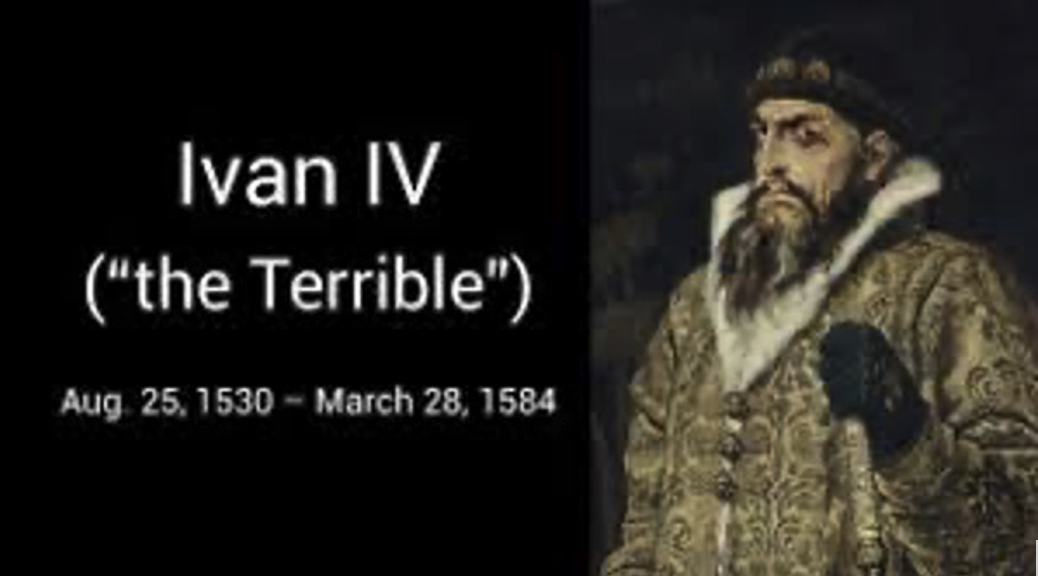
His most important changes were to the book’s treatment of Ivan IV (Ivan the Terrible, 1530-1584) but he approved of the authors’ view that Ivan had established the autonomous power of Tsarism by destroying the aristocratic boyars, but with the addition that in doing so he had completed the task of forging a scattered collection of principalities into a single strong state that had been set in motion by Ivan I in the fourteenth century. The verdict was that under Ivan his “kingdom became one of the strongest states in the world” (p.135).
The final result was a “stirring story of a thousand-year struggle by Russia and its Soviet successor to build a strong state to defend its population from outside incursions” (ibid. p.134).
While Stalin never stopped criticising the Tsars, his view of the state created by them was summarised during the course of a toast to the twentieth anniversary of the October Revolution:
“The Russian Tsars did a great deal that was bad. They robbed and enslaved the people. They waged wars and seized territories in the interests of land-owners. But they did one thing that was good – they amassed an enormous state, all the way to Kamchatka. We have inherited that state. And, for the first time, we, the Bolsheviks, have consolidated and strengthened that state as a united and indivisible state, not in the interests of the landowners and the capitalists, but for the benefit of the workers, of all the peoples that make up that state. We have united the state in such a way that if any part were isolated from the common socialist state, it would not only inflict harm on the latter but would be unable to exist independently and would inevitably fall under foreign subjugation” (p.135).
In the same anniversary year, Alexander Pushkin was lionised as a revolutionary writer. “For the new masses conquering the heights of culture, Pushkin is an eternal companion, declared the magazine ‘Contemporary Literature’. A 1931 piece by the late Anatoly Lunacharsky was reprinted.
“’It is Pushkin who, among others, must become a teacher of the proletarians and peasants in the construction of their inner world … Every grain that is contained in Pushkin’s treasury will yield a socialist rose or a socialist bunch of grapes in the life of every citizen’. Also revived was the heroic reputation of Peter the great in a biopic based on Alexei Tolstory’s 1934 novel. Peter was lauded as ‘a strong national figure who won territory through war and defended it through diplomacy’ and praised for ‘the achievement of raising Russia to the status of a great power in the European arena” (p.135).
Although a historian of the ancient world and of early Christianity, Robert Vipper’s most influential book was Ivan the Terrible (Ivan Gozny). It challenged the prevailing view that Ivan IV was a bloodthirsty tyrant.
“Vipper’s Ivan was fearsome and menacing towards the Russian state’s domestic and foreign foes. Strengthening the monarchy was necessary to empower the Russian state and external threats and pressures motivated his harsh internal regime. His struggle for power against Russia’s barons was just and his security apparatus – the much-maligned ‘Oprichnina’ – as honourable as it was effective. He was also a great warlord and diplomat who had built Russia into one of the greatest states in the world” (p.136).
Vipper’s book played a significant role in turning opinion in Ivan’s favour, with him getting an approving mention in the 1939 Great Encyclopaedia. The renowned film director, Sergei Eisenstein (1898-1948) was commissioned to direct a film about Ivan IV and Alexei Tolstoy to write a play.
This was just the right time for Vipper, who had emigrated to Latvia in the early 1920s, to return to Moscow in May 1945. Upon his return he sent Stalin a telegram expressing his “fulsome thanks for helping him and his family’s joyful return to the land of socialism and pledging his eternal loyalty to the country’s ‘great leader’” (pp. 137-8).
He was given a post at the Moscow Institute of Philosophy, Literature and History before being evacuated to Tashkent where he joined other historians. In 1942 he published a second edition of Ivan Grozny, to which he added a new chapter entitled ‘The struggle against treason’, in which Vipper stated clearly that the traitors Ivan had put to death were real, not imagined, enemies of the state (see p.138).
To the common perception of Ivan as a cruel tyrannical figure, Vipper’s view was that Ivan was a majestic and powerful figure and the greatest statesman of his time; that to understand his harsh actions, people needed to appreciate the extent of domestic opposition to his endeavours to create a centralised state, as well as opponents who had allied themselves with foreign enemies.
Vipper was elected a member of the Soviet Academy of Sciences. In 1944 he was awarded the Red Banner of Labour and in 1945 the Order of Lenin.
The aesthetic rehabilitation of Ivan the Terrible turned out to be more problematic than the historical. There were three parts to Alexei Tolstoy’s projected play. Tolstoy’s version was criticised along these lines:
“’Ivan IV was an outstanding political figure of sixteenth century Russia’, wrote Shcherbakov. ‘He completed the establishment of a centralised Russian state … successfully crushing the resistance of representatives of the feudal order’. Tolstoy’s ‘confused play’ had numerous historical inaccuracies and had failed ‘to rehabilitate the image of Ivan IV’. The main flaw was not showing Ivan as a major, talented political actor, the gatherer of the Russian state and an implacable foe of the feudal fragmentation of Rus’ and of the reactionary boyars” (p.139).
In response to criticism, Tolstoy rewrote part one and carried on working on part two, using Vipper’s book. Part one premiered in Moscow’s Malyi Teatr (little theatre) in October 1944, but was not a success. So it was restaged to great acclaim. Part two was staged by the Moscow Arts Theatre in June 1946. The final part of the trilogy, dealing with Ivan’s last years, apparently remained unwritten.
Part one was again printed in November 1933 when Stalin took a more active interest and marked a few passages from Ivan’s dialogue, especially this:
“They want to live in the old way, each sitting in a fiefdom with their own army, just like under the Tatar yoke … They have no thoughts or responsibility for the Russian land … Enemies of the state is what they are, and if we agreed to live the old way, Lithuania, Poland, Germans, Crimean Tatars, and the Sultan would rush across the frontier and tear apart our bodies and souls. That is what the princes and boyars want – to destroy the Russian kingdom” (p.139).
Eisenstein’s part one of Ivan the Terrible was premiered in January 1945, and in 1946 he too was awarded a Stalin prize.
Stalin did not like the part 2 film and in March 1946 its screening was banned on the grounds that it was historically and artistically flawed. Stalin gave the following reason for his dislike of part two at a meeting of the Central Committee’s Orgburo in August 1946:
“The man got completely distracted from the history. He depicted the ‘Oprichniki’ as rotten scoundrels, degenerates, something like the American Ku Klux Klan. Eisenstein didn’t realise that the troops of the ‘Oprichnina’ were progressive troops. Ivan the Terrible relied on them to gather Russia into a single centralised state, against the feudal princes, who wanted to fragment and weaken it. Eisenstein has an old attitude towards the ‘Oprichnina’. The attitude of old historians towards the ‘Oprichnina’ was crudely negative because they equated the repression of Ivan the Terrible with the oppression of Nicholas II … In our era there is a different view … Eisenstein can’t help but know this because there is a literature to this effect, whereas he depicted degenerates of some kind. Ivan the Terrible was a man with a will and character, but in Eisenstein he’s a weak-willed Hamlet” (p.140).
At Eisenstein’s request, Stalin met him in February. After that meeting, Eisenstein and Nikolai Chekasov, the film’s lead actor, reported their conversation with Stalin to the writer, Boris Agapov, and his notes constitute the only known record of their conversation with Stalin. Ivan, said Stalin, “was a great and wise ruler … His wisdom was to take a national point of view and not allow foreigners into the country, protecting it from foreign influences … Peter I was also a great ruler but he was too liberal towards foreigners, he opened the gates to foreign influences and permitted the Germanisation of Russia. Catherine allowed it even more … Was the court of Alexander I a Russian court? Was the court of Nicholas I a Russian court? They were German courts.
“Stalin made the same point again later in the conversation. ‘Ivan Groznyi was a more nationalist Tsar, more far-sighted. He did not allow foreign influence into the country. Unlike Peter, who opened the gate to Europe and allowed in too many foreigners.
“On Ivan’s cruelty, Stalin had this to say:
“’Ivan the Terrible was very cruel. One can show this cruelty but it is also necessary to show why he had to be so cruel. One of his mistakes was not to finish off the five big feudal families. If he had destroyed these five boyar families there would not have even been a Time of Troubles…’
“At this point Molotov interjected that historical events needed to be shown in their correct light using the negative example of Demyan Bedny’s comic operetta, ‘The Bogatyrs’ (1936), which had made fun of Russia’s conversion to Christianity. Stalin agreed: ‘Of course, we aren’t very good Christians, but we can’t deny the progressive role of Christianity at a certain stage. This event had a major significance because it meant Russian state turning to close ranks with the West, instead of orienting itself towards the East. We can’t just toss history” (pp.141-2).
After talking to Stalin, Eisenstein and Chekrasov were keen to rework the film. Although given a few pointers, Stalin was happy to leave the matter in their artistic hands, insisting only that they be as historically accurate as possible.
In the event, Eisenstein, who had suffered from ill health for some time, died of a heart attack in February 1948. The film remained unrevised and was not released until 5 years after Stalin’s death.
TO BE CONTINUED