OBITUARY – Saif al-Islam Gaddafi
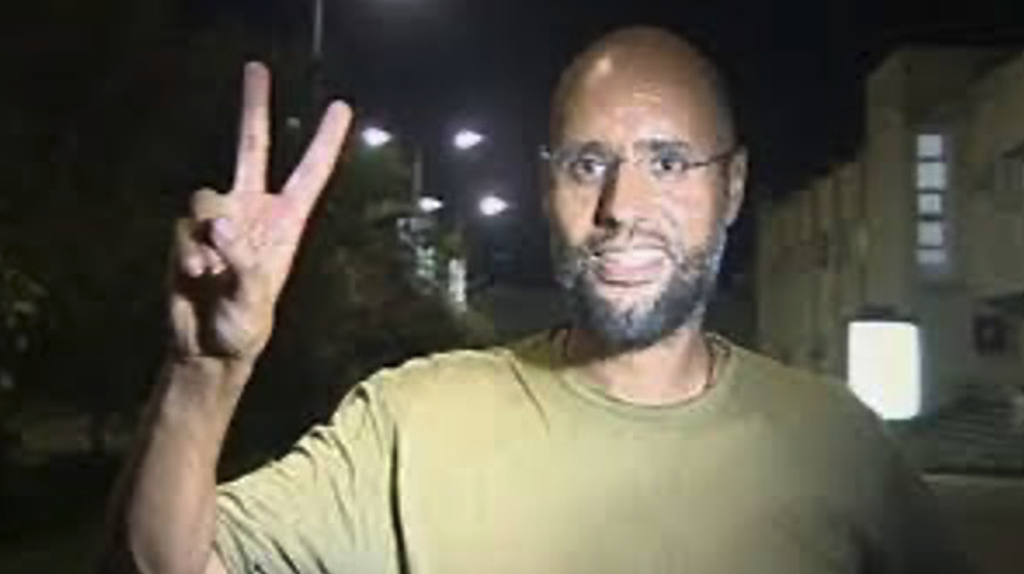
Saif al-Islam Gaddafi, son of the martyred president of Libya Colonel Muammar Gaddafi, was on 3 February 2026 himself assassinated at his home by four gunmen who had disabled the security cameras. Although he tried to fight them off, they succeeded in killing him. He was 53.
On Friday 6 February many thousands of mourners gathered in the western Libyan town of Bani Walid for his funeral, mourning not only his death but the loss of the well-being that was enjoyed by all citizens of Libya during the presidency of his father, overthrown and murdered in 2011 by a minority of fundamentalist reactionaries organised by imperialism that supplied them with lethal armaments and backed them with bombing raids in order to destroy their country’s sovereignty and bring about regime change.
In fact, according to France 24, “Each year, Bani Walid celebrates the anniversary of a 1969 coup that brought [Colonel] Gaddafi to power, with people parading through the streets with portraits of the ex-leader and Libya’s [former] green flag ….
“Ahead of the burial on Friday, locals also carried those portraits and flags while chanting pro-Gaddafi slogans and declaring that ‘the martyrs’ blood will not be shed in vain’”.
Saif during his father’s presidency never accepted any official position but nevertheless was trusted with many important government and diplomatic functions and was widely recognised as his father’s second-in-command and heir apparent (although he himself said that Libya was not a private property that could be inherited). It would appear that he thought Libya would benefit from introducing more Western-style democracy and appeasement of the state’s Islamist critics than his father would consider safe, but he was nevertheless given plenty of leeway to exercise his diplomatic approach to resolving the problems facing the country, in particular in seeking the removal of Western sanctions.
Saif was mobilised to represent Libyan interests in negotiations with the West, including over dismantling Libya’s weapons of mass destruction, and over compensation for the families of the victims of the Lockerbie plane bombing – and these negotiations were concluded to the West’s satisfaction. Libya undertook not to develop nuclear weapons – thus leaving it vulnerable to the Nato aggression that was to be unleashed in 2011; and it accepted ‘responsibility’ for compensating the families of the Lockerbie victims. Saif insisted, however, that accepting ‘responsibility’ did not mean that any Libyan was guilty of that act of terrorism. Later on Saif was involved in getting the Libyan citizen accused and convicted of orchestrating the atrocity, Abdel Basset Ali El Megrahi, freed from jail on compassionate grounds. LALKAR has always been of the view that no Libyan was in any way involved in the Lockerbie incident but that it was used by imperialism to lay the grounds for justifying imperialism’s regime change operations and assault on Libya’s sovereignty.
If Saif had perhaps erred on the side of appeasement with imperialism, as soon as extremist fanatics were unleashed on his country, supposedly as a response to the Arab Spring uprisings (that had taken place in Tunisia and Egypt in protest at the hopeless poverty of the masses), he immediately recognised how necessary it was to protect the sovereignty of his country and the wellbeing enjoyed by its people by all means necessary. He made an important speech calling on insurrectionists to step down – a speech which is universally interpreted in bourgeois media as calling for violence to suppress dissent. The speech is notable for its precise prediction of what the future held for Libya if the terrorists did not retreat:
“We now demand [an end to anti-government violence], as a final solution, and before it’s too late, and before we all resort to weapons… Five million Libyans will take up arms. Libya is neither Tunisia nor Egypt. My brothers, we are made up of tribes and clans, and we will take up arms. Arms are now within everyone’s reach. Instead of mourning for 84 killed, we will mourn hundreds of thousands of deaths. Blood will flow, rivers of blood, across all of Libya’s cities. And you will leave Libya. Oil flows will stop.
“Tomorrow, foreign companies will leave Libya, foreigners will leave Libya, oil companies will leave Libya, oil facilities will stop, and by tomorrow, there will be no more petrol. There will be no more money and we will not be able to find bread. Today, bread in Bayda costs 1.5 dinars. In a week, it will cost 100 dinars. And in a year, bread will be worth the price of gold in Libya. So I appeal to you, and for the last time, before we invoke the rule of weapons, if things spiral out of control and we enter a civil war, secession and rampant chaos, as they want to happen in Libya. So before we resort to this, and every Libyan is forced to take up arms and defend themselves, and blood is shed, I say: Either prepare yourselves, Libyans, to enter into confrontations, for Libya to be divided piece by piece, to enter a civil war. Prepare to forget all about oil or gas. Gas and oil pipelines will be destroyed. There will be chaos. What is happening now in Barga will happen everywhere else in Libya. Forget all about education and healthcare for your children. Because what is happening today in Barga, in Bayda, in Shahat, in Benghazi, is very sad.”
Imperialist media, of course, presented Said’s speech not as the call for peace – that it was – but as a call for civil war! Said went in imperialist eyes from being the friendly face of Libya, who had been the highly educated and civilised guest of British royals and, as Margaret Thatcher might have said, the kind of perfect Arab gentleman one could do business with, into a bloodthirsty tyrant.
When a ‘civil’ war to defend Libya from imperialist-imposed regime change did indeed break out, those who sought to defend their country were categorised as criminals in the imperialist media, and after the murder of Colonel Gaddafi, his son was duly indicted by the International Criminal Court on two counts of crimes against humanity of ‘murder and persecution’ for his role in suppressing the Libyan opposition protests (i.e., the violence perpetrated by imperialist-backed fundamentalists) against his father’s regime during the 2011 Libyan civil war.
In 2015, a court in Tripoli, in the area of Libya taken over by the ‘internationally recognised’, i.e., imperialist-approved, Muslim Brotherhood aligned and misnamed, Government of National Accord (GNA), sentenced him to death by firing squad in absentia for ‘war crimes’ committed during his role in the crackdown. However, the Zintan Brigades who had been holding him since his capture in 2011 refused to hand him over as they did not recognise the authority of the GNA or its courts.
Although the Zintan Brigades, formed in 2011 by Libyan army commanders opposed to the Gaddafi government, were a major force mobilised to overthrow that government, they were fiercely opposed to the various Islamist outfits that were their de facto allies in that endeavour. As a result they opposed the Tripoli ‘government’ and were soon involved in major armed conflict with it. The Zintan Brigades soon found common cause with Khalifa Haftar’s Libyan National Army that today dominates eastern and central Libya, and together they engaged in several battles against the armed forces of the GNA regime in Tripoli.
Saif was released by the Zintan militia in 2017 after he was given full amnesty by Khalifa Haftar, seeking thereby to attract to his support the myriad of Gaddafi loyalists surrounding him. However any alliance between Haftar and Saif was never going to be a match made in heaven, given that Haftar was a traitor who had rebelled against the Gaddafi government.
Around this time, plans were being drawn up, under imperialist encouragement, between the GNA and Haftar’s so-called Government of National Stability (GNS) to establish a framework for holding nationwide parliamentary and presidential elections, obviously not an easy thing to arrange in a divided country where fighting between the two sides was still going on. An electoral commission was set up, involving representatives of both sides of the divide, to promote the electoral process. However, it was not until 2020 that the parties came anywhere near approving an actual date for a presidential election, that date being 24 December 2021.
Then on 14 November 2021 Saif put himself up as a candidate.
This gave rise to the utmost consternation! Surely after all Libya had gone through to get rid of the Gaddafi regime, how could another Gaddafi be put into power? Immediately it was announced that Saif was disqualified under Article 10/7 of the electoral law for having been convicted of a crime, and under Article 17/5 for not providing a certificate showing a clean criminal record. Gaddafi tried to appeal his disqualification, but on 25 November, gunmen aligned with Khalifa Haftar, under Haftar’s sons’ command, stormed the courthouse of Sabha and threatened judges and staffers to prevent them from ruling on Gaddafi’s appeal. However, on 2 December 2021, a Libyan court ruled that Gaddafi be reinstated as a presidential candidate, whereupon the proposed election was cancelled without further ado. Polling in 2021 placed Gaddafi as a leading candidate ahead of most other nominees (including Haftar), alongside Abdul Hamid Dbeibeh, then and now the leader of the GNA.
Clearly, Haftar saw Saif’s campaign to stand in presidential elections as a threat to his ambition to reunite Libya under his own control. In November 2025, it was announced that, after completing local elections in March this year, and provided that funding was available and a procedure was agreed on by the existing two Libyan governments, the electoral authorities would be “ready to begin implementing presidential and parliamentary elections in mid-April 2026“. It is difficult to avoid the conclusion that in these circumstances, Haftar must be seen as the prime suspect in the murder of Saif – which is not to say that Dbeibeh too no doubt had a strong interest in his demise. Unquestionably, the various imperialist governments and agencies would have smiled on, and if possible cooperated with, such an endeavour.
One way or another, it would seem that the longing of the Libyan people to return to the security and prosperity that they enjoyed during the over 4 decades of Colonel Gaddafi’s government is destined for the present to remain frustrated – that is at least the hope and expectation of all the reactionary actors in the region. However, it is the people who make history and in the long term what the people want, the people get – provided they can find a suitable political vehicle to pursue their cause. Without doubt moves are under way to put together a leadership able to mobilise effectively to restore Libya’s sovereignty and to ensure that the wealth generated by Libya’s productive forces is distributed in a manner wholly beneficial to the Libyan people – as was the case under Colonel Muammar Gaddafi. We must note that the ideal vehicle for the expression of the will of the masses remains a conscious and determined party guided not just by the outstanding charisma and dedication of a leader such as Muammar Gaddafi, or Saif Gaddafi, but able to harness the understanding of Marxism-Leninism and fuse it with a broad stratum of the best elements of the working masses themselves. Only such a party and such a movement will be crowned with lasting success in the struggle against the brigands of finance capital. The absence of such parties from so many arenas of struggle is the result of a long and conscious anti-communist campaign waged by the imperialists, and the source of the greatest misfortune and misery of the people.