Cuba and hope: the material expression of human resolve
The solidarity of friendly nations is helping the blockaded island to keep the lights on, but Western workers need to play their part.
Hope is not a vapour that lingers when everything else has failed, nor a substitute for strategy. It is the force that makes strategy possible – the impulse that compels the first step, sustains movement through adversity, and draws others into common purpose. Properly harnessed, hope is not passive; it is active, generative and enduring. It reveals the deeper currents of human resolve – and today, it is embodied in the people of Cuba.
After a 67-year bipartisan history of callously toying with the lives of Cuba’s people, the US economic blockade of the socialist island was ratcheted up in January 2026 with a new and brutal phase of energy asphyxiation that deprived Cuba of oil, with the strategic aim of finally destroying its independence and bringing down the first socialist state in the Americas.
As a result, Cuba has been experiencing the most acute economic, energy and systemic crisis in its history.
A history of brutal intimidation and steadfast resistance
Justifying its extreme and illegal action, the United States government produced an extensive list of lies and slanderous accusations against Cuba, the centrepiece being the absurd notion that a piece of land the size of Pennsylvania represents an “unusual and extraordinary threat” to the national security of the USA.
The stake for the States is much more fundamental. Its aim is to rid itself of a genuine and legitimate revolutionary socialist, anti-imperialist country that maintains full sovereignty and promotes peace and solidarity with the rest of the world, and which has had the temerity to exist just 90 miles away from the US coast.
As a beacon of hope (there’s that word again) for the oppressed of the world, Cuba’s commitment to internationalism, to finding alternatives to the US dollar, to joining alternative economic formations like Brics, represent a challenge to US authority that must be crushed.
This latest escalation of decades of US aggression and blackmail against the Cuban people is part and parcel of the broader US plan to impose its domination on Latin America and the Caribbean in the spirit of the Monroe Doctrine – a plan that also includes the recent military aggression against Venezuela with the kidnapping of its president, Nicolás Maduro, as well as threats against Colombia, Mexico and other countries in the region.
For six long decades, US sanctions have strangled Cuba economically. Estimates suggest they have cost the island at least $130bn in direct economic damage, according to figures cited by Reuters from United Nations sources. The real, cumulative cost will of course be far higher, especially once inflation and decades of sabotaged development opportunities are taken into account.
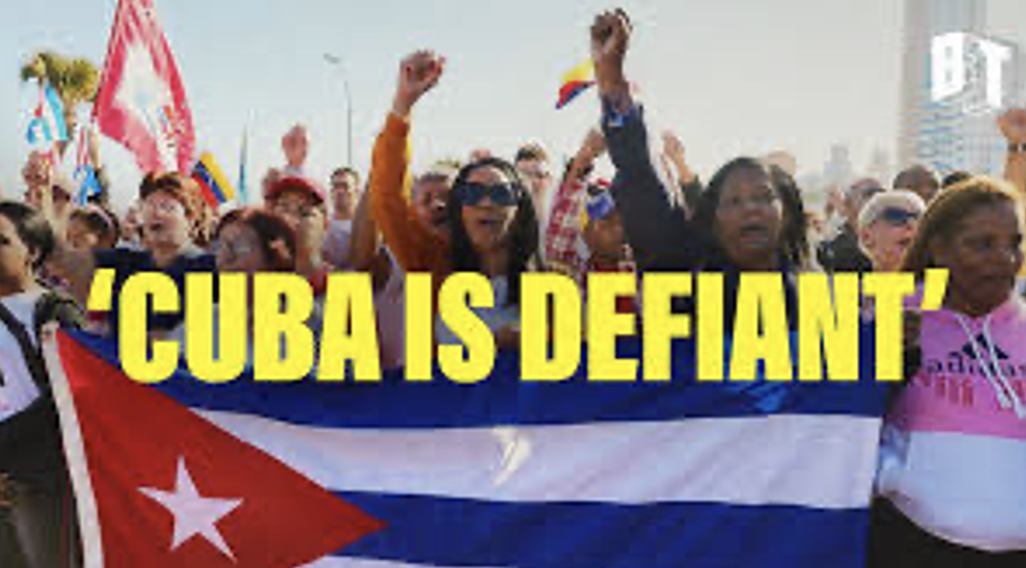
The economic and now energy blockade of Cuba represents the centrepiece of the US government’s war on the island, and is explicitly designed to bring about hunger, desperation, social breakdown and the overthrow of the Cuban government. Yet despite inevitable frustration with the hardships they face, the Cuban people remain defiant and determined.
Cuba is a nation of courageous and combative people, and if imperialism believes that economic pressure and the infliction of suffering will succeed in breaking their determination to defend their national sovereignty, imperialism will once again be mistaken.
We note that such misjudgements are being made ever more frequently as the global capitalist system spirals further into its deepest ever overproduction crisis and the imperialist financiers become ever more desperate to restore profitability and reassert their waning hegemony over the globe.
Let’s talk about distress
It is vital that workers in the West understand the harsh realities that our own imperialist ruling class inflicts on workers in other nations, and that we act in solidarity to prevent their continuing. The question before us is whether the genocidal military and economic actions of our governments are inevitable and unavoidable, or whether common decency, solidarity, and the rejection of arbitrariness, aggression and impunity can prevail.
We must understand how and why our capitalist system is failing us and the workers of the world.
Contrast the resolve of the Cuban people with that of relatively wealthy Australians, who after less than a week of increased fuel prices and panic buying were soothed by prime minister Anthony Albanese, who said: “If you go to your local petrol station and there is no fuel – that causes understandable distress because we understand this is a really difficult time.”
Many Western workers have no idea of real distress – yet!
Distress for Cubans is when US president Donald Trump announces to the world that “Cuba is next” when referencing his regime’s latest illegal wars of aggression against Venezuela and Iran.
Distress is when your government issues a civil defence emergency warning via SMS urging you to prepare for a nationwide electricity crisis, warning that remaining fuel reserves could be completely depleted within hours.
Distress is when your local ally (Venezuela) and main supplier of around 60 percent of your oil is unable to supply you any longer, paralysing your tourist industry (your main source of foreign exchange) and leaving you to contend with constant blackouts, mass closures of educational institutions, transport shutdowns and inadequate support for the sick.
Distress is knowing that your neighbours (Venezuela, Mexico, other Caribbean islands) are being coerced into distancing themselves from you despite the damage this will cause to their own people.
Under pressure from US imperialism, and facing the risk of being attacked themselves, the Guatemalan, Jamaican and Honduran governments reluctantly announced the termination of their medical collaboration agreements with Cuba, thus crippling the poorest workers in Latin America who will once again pay with their lives for US imperialism’s desperate attempt to crush all resistance – and especially to crush socialism.
In the short term, workers across the region are in for brutal times and much distress, but repression breeds resistance, and this is a region that has organised itself to resist many times already. The sooner workers in the rest of the world recognise that their strength lies in solidarity, the sooner the people’s will for liberation and hope’s human resolve will inevitably triumph.
Solidarity with Cuba is global
Despite the catastrophic position imposed by US imperialism, which literally plunged the island nation into darkness, Cuba is being illuminated by the solidarity of people and nations from across the globe.
An international humanitarian convoy, ‘Nuestra América’ (Our America) arrived in Havana in March 2026 with hundreds of activists, communists, trade unionists and solidarity groups, who delivered humanitarian aid to the island by air, sea and land. Over 20 tonnes of essential supplies worth more than $900,000 included food, baby food, hygiene products, medicines and critical equipment.
A key component of the aid were solar batteries and generators intended to provide energy to hospitals and essential services, which will help alleviate the acute shortage of electricity caused by the US-imposed fuel blockade.
Russia and China block US attempts to keep Cuba in the dark
The government, Communist Party and people of the People’s Republic of China have donated 22 new solar parks, adding 120 MW of clean energy to Cuba’s grid as part of an expanding cooperation programme. Amid the US-imposed energy crisis resulting from the oil embargo, Cuba has launched a nationwide solar programme with Chinese support, prioritising 2,600 systems for strategic institutions across its 168 municipalities.
Deployment is focused on hospitals, polyclinics, maternity homes, water pumping stations and telecommunications infrastructure. Havana has installed dozens of solar energy parks, so that the share of solar power in energy generation has risen from 5 to 20 percent in the last year.
A Russian tanker – the Anatoly Kolodkin – carrying 730,000 barrels of crude oil, enough to supply the island for several weeks, arrived at the end of the March. Unlike earlier shipments routed through vessels flying flags of convenience, the Anatoly Kolodkin was openly Russian-flagged and was briefly escorted out of European waters by a Russian naval frigate, signalling a shift in Moscow’s approach and a determination not to allow its ally to be crushed.
Interfering with this identifiably Russian vessel would have signalled an escalation from sanctions enforcement to a direct confrontation with Russia. If US forces had boarded the tanker, this would have been tantamount to an act of war. The Kremlin, meanwhile, reaffirmed its support for Havana and pointed out that the USA is trying to perpetrate a genocide against the Cuban people.
Everyone is Cuban
Solidarity is the basis of working-class invincibility. In its hour of darkness, Cuba has been surviving on the support it has received from the global community. Nevertheless, its situation remains precarious and distressing.
What Cuba demonstrates is vital: even under a 67-year-long siege, a socialist state was able to preserve sovereignty, mass literacy, public health, education, and a far higher level of social dignity than many formally ‘richer’ capitalist countries in the region. That fact alone is a devastating indictment on capitalism.
If Cuba had been allowed to trade and develop normally while keeping state power in revolutionary hands, the example would have been even more dangerous to imperialism. This is precisely why the blockade exists.
The lesson is not that socialism failed Cuba; the lesson is that a besieged socialist state survived decades of imperialist warfare and still preserved gains that capitalism even in the heartland of the imperialist USA routinely fails to deliver.
Hope is not a vapour that lingers when everything else has failed, nor is it a substitute for strategy. It is the force that makes strategy possible – the impulse that compels the first step, sustains movement through adversity, and draws others into common purpose. Properly harnessed, hope is not passive; it is active, generative and enduring. It reveals the deeper currents of human resolve – and today, it is embodied in the people of Cuba.
We stand in firm solidarity with socialist Cuba and call for the widest possible international support to defend its independence and sovereignty, and to uphold the right of its people to a decent and dignified life, and to determine their future free from external interference.
Cuba does not stand alone. Cuba will prevail.
Venceremos!