Obituary – Michael Parenti
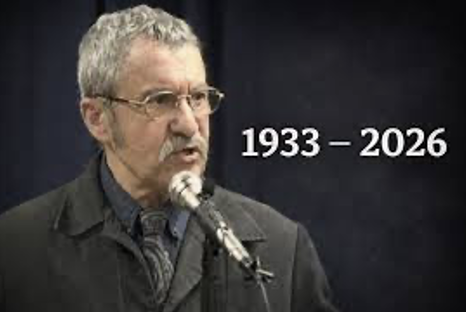
Editors’ note: We are pleased to print this obituary by Carlos Martinez of Michael Parenti, an outstanding critic of capitalism and imperialism, who was instrumental in opening the eyes of huge numbers of people to the gross iniquities of the capitalist system – an awakening that is crucial if the masses are to be mobilised to overthrow capitalism and establish socialism. The only cautionary note that we would add is that Parenti was not as consistent as he should have been on the role of the Communist Party in suppressing counter-revolution, and he criticised Stalin for killing too many people (no evidence given) and for fomenting a cult of the personality (which Stalin actually opposed). Apart from that he is deserving of all the praise that Cde Martinez accords to him.
by Carlos Martinez
Michael Parenti, who died on 24 January 2026 at the age of 92, was one of the most important – and most systematically marginalised – political thinkers of the 20th century. A true working class intellectual, Parenti remained true to the principles and positions of global class struggle, never watering down his analysis for the sake of respectability, popularity or a well-paid job.
He supported the socialist countries, he supported anti-imperialist struggle, he supported the oppressed and exploited everywhere. Importantly, and in contrast to many of his peers, Parenti wrote and spoke in order to communicate ideas of liberation, not to make himself look clever. He had an unparalleled ability to condense important ideas into accessible, easily-understood language.
A systematic Marxist analysis of fascism
Michael Parenti’s Blackshirts and Reds, published in 1997 — just a few years after Francis Fukuyama proclaimed “the end of history” — is a powerful and sweeping counter-history of the 20th century told from the standpoint of the global working class.
At its core, the book does three things. First, it provides a systematic Marxist analysis of fascism. Second, it tears down the edifice of Cold War anti-communist propaganda. And third, it dismantles the obscene notion — put forward not only by the right but by significant sections of the so-called liberal left — that fascism and communism are equivalent.
Parenti builds on the work of Marxist theorists such as Rajani Palme Dutt, Georgi Dimitrov and Palmiro Togliatti to show that fascism is not an aberration, not a mysterious eruption of evil, but rather a systematic response of the ruling classes to the chronic crisis of capitalism and the threat of socialism. As Palme Dutt wrote in his 1934 study Fascism and Social Revolution, “capitalism in its decay breeds fascism”.
Parenti demonstrates that while fascism often adopts populist slogans, and purports to represent the interests of the working class, in reality it always preserves existing capitalist property relations while violently suppressing labour movements, trade unions and left-wing parties. In his words: “If fascism means anything, it means all-out government support for business and severe repression of antibusiness, prolabour forces.” In this sense, fascism has functioned as a form of ‘rational’ class rule — brutal and authoritarian, but serving clear economic interests.
Parenti also exposes the relationship between fascism and racism. Fascist doctrine marshals genetics and biology to justify and protect the class dynamics of capitalism, deploying national chauvinism, racism and patriarchal values to divide the working class and legitimise oppression at home and abroad. It’s no accident that today we see a resurgence of racist pseudoscience and the popularisation of white supremacist ideas under the guise of so-called ‘conservative values’. As Parenti observed, Nazi ideology was “not unlike what academic racists today are doing with their ‘bell curve’ theories and warmed-over eugenics claptrap”.
Defending actually existing socialism
The second major contribution of Blackshirts and Reds is its unflinching defence of the socialist countries. Parenti — with no regard whatsoever for the respectability or indeed salary that academics typically chase — tears down the ‘victims of communism’ narrative, exposing the US-led imperialist system as the real perpetrator of mass slaughter and suffering around the world.
He writes: “in pursuit of counterrevolution and in the name of freedom, US forces or US-supported surrogate forces slaughtered 2,000,000 North Koreans in a three-year war; 3,000,000 Vietnamese; over 500,000 in aerial wars over Laos and Cambodia; over 1,500,000 in Angola; over 1,000,000 in Mozambique; over 500,000 in Afghanistan; 500,000 to 1,000,000 in Indonesia; 200,000 in East Timor; 100,000 in Nicaragua” – the list goes on, encompassing dozens of countries “in what amounts to a free-market world holocaust”. (These figures are actually under-estimates).
Meanwhile, the Soviet Union and the other socialist countries, in incredibly difficult circumstances, performed near-miracles in terms of economic development, social welfare and international solidarity – not to mention playing the decisive role in defeating Nazi Germany.
To say that ‘socialism doesn’t work’ is to overlook the fact that it did. In Eastern Europe, Russia, China, Mongolia, North Korea, and Cuba, revolutionary communism created a life for the mass of people that was far better than the wretched existence they had endured under feudal lords, military bosses, foreign colonisers and Western capitalists. The end result was a dramatic improvement in living conditions for hundreds of millions of people on a scale never before or since witnessed in history…
In the three decades after the Bolshevik revolution, the Soviets made industrial advances equal to what capitalism took a century to accomplish — while feeding and schooling their children rather than working them fourteen hours a day as capitalist industrialists did and still do in many parts of the world… During the years of Stalin’s leadership, the Soviet nation made dramatic gains in literacy, industrial wages, health care, and women’s rights.
In Cuba, “the Cuban Revolution brought sanitation, schools, health clinics, jobs, housing, and human services to a level not found throughout most of the Third World and in many parts of the First World. Infant mortality in Cuba dropped from 60 per 1000 in 1960 to 9.7 per 1000 by 1991, while life expectancy rose from 55 to 75 in that same period. Smallpox, malaria, tuberculosis, typhoid, polio, and numerous other diseases have been wiped out by improved living standards.”
Parenti exposes with devastating wit the absurdity of anti-communist propaganda, observing that within the Cold War ideological framework, literally any piece of data about the socialist countries could be twisted into hostile evidence:
During the Cold War, the anticommunist ideological framework could transform any data about existing communist societies into hostile evidence. If the Soviets refused to negotiate a point, they were intransigent and belligerent; if they appeared willing to make concessions, this was but a skilful ploy to put us off our guard. By opposing arms limitations, they would have demonstrated their aggressive intent; but when in fact they supported most armament treaties, it was because they were mendacious and manipulative. If the churches in the USSR were empty, this demonstrated that religion was suppressed; but if the churches were full, this meant the people were rejecting the regime’s atheistic ideology. If the workers went on strike (as happened on infrequent occasions), this was evidence of their alienation from the collectivist system; if they didn’t go on strike, this was because they were intimidated and lacked freedom. A scarcity of consumer goods demonstrated the failure of the economic system; an improvement in consumer supplies meant only that the leaders were attempting to placate a restive population and so maintain a firmer hold over them.
Against the ‘pure socialists’
Some of the most cutting passages in Blackshirts and Reds are directed not at the right but at sections of the left — what Parenti calls the “pure socialists”, who support every revolution except the ones that succeed.
Left critics of actually existing socialism “compare an ideal against an imperfect reality, and the reality comes off a poor second”. They “imagine what socialism would be like in a world far better than this one, where no strong state structure or security force is required, where none of the value produced by workers needs to be expropriated [! socialist societies do not ‘expropriate’ – they allocate to meet social need!] to rebuild society and defend it from invasion and internal sabotage”. These critics “do not explain how the manifold functions of a revolutionary society would be organised, how external attack and internal sabotage would be thwarted, how bureaucracy would be avoided, scarce resources allocated, policy differences settled, priorities set, and production and distribution conducted”.
A real socialism, it is argued, would be controlled by the workers themselves through direct participation instead of being run by Leninists, Stalinists, Castroites, or other ill-willed, power-hungry, bureaucratic cabals of evil men who betray revolutions. Unfortunately, this ‘pure socialism’ view is ahistorical and nonfalsifiable; it cannot be tested against the actualities of history. It compares an imaginary ideal against an imperfect reality, and the reality comes off a poor second. It imagines what socialism would be like in a world far better than this one, where no strong state structure or security force is required, where none of the value produced by workers needs to be used to rebuild society and defend it from invasion and internal sabotage.
Parenti asks bluntly: is an open, pluralistic, democratic socialism actually possible in a context of imperialist encirclement? The pure socialists blame every revolution for failing to meet their imaginary standards, but “seem unable to apply their own leadership genius to producing a successful revolutionary movement in their own country.”
He further points out that all socialist experiments to date have taken place within a context of imperialist hostility and sabotage, subjected from the very beginning of their existence to war, foreign invasion, economic blockade, political subversion, and relentless propaganda. The Russian Revolution was immediately met with a multi-national foreign military intervention and a devastating civil war. Cuba has faced an economic blockade for over six decades. Nicaragua was subjected to a US-backed terrorist war that killed tens of thousands. Millions were killed in Korea and Vietnam. China was surrounded by US military bases and subjected to decades of economic isolation – and today it faces an escalating campaign of containment and encirclement.
To evaluate the achievements and failures of the socialist countries without acknowledging this context is not analysis — it is anticommunist propaganda.
Against imperialist war
Parenti’s 1999 book To kill a nation: the attack on Yugoslavia offers a forensic account of the destruction of the Federal Republic of Yugoslavia and of the relentless propaganda campaign that accompanied it.
The book demonstrates, with extensive documentation, that the dismemberment of Yugoslavia was not, as it was painted, a humanitarian response to Serbian aggression, but rather a systematic and deliberate project to extend US and European hegemony to the Balkans. As early as 1984, the Reagan administration issued a classified directive calling for “a quiet revolution to overthrow communist governments while reintegrating the countries of Eastern Europe into the orbit of the world capitalist market”. IMF-imposed austerity deepened existing tensions between Yugoslavia’s republics. The US meanwhile funded and organised pro-Western separatist movements.
Then came the propaganda war, which was used to paint Serbia and the Serbian minorities in the other Yugoslavian republics as genocidal maniacs and rapists, mindlessly killing Bosnians, Croats, Kosovars and others. The Washington-based public relations firm Ruder Finn was paid handsomely to manage international opinion about the conflict. Its director James Harff boasted, without apparent shame, of how his firm had “masterfully” manipulated Jewish public opinion in the West to support Croat nationalists — despite the well-documented collaboration by these same forces with the Nazis in World War 2, including at the Ustashe death camp at Jasenovac where some 750,000 Serbs, 45,000 Jews and 26,000 Roma were murdered.
The parallels with the propaganda wars of our own time are impossible to miss. For example, NATO’s proxy war against Russia in Ukraine is portrayed as an epic struggle for democracy and against empire, and yet the forces on the frontline of this struggle are far-right, Ukrainian supremacist, russophobic, Nazi-collaborating Banderite thugs, and the purpose of the war is to weaken and destabilise Russia, and to punish it for its refusal to submit to US hegemony.
Meanwhile the Islamic Republic of Iran – a country which has maintained its sovereignty for 47 years, built an advanced welfare state, nationalised its natural resources and provided indispensable support for the cause of Palestinian liberation – has been demonised to the most absurd degree, in order to justify a criminal war in which the US and Israel are killing schoolchildren and bombing hospitals, apartment buildings, bridges, energy infrastructure and important cultural sites.
As Parenti wrote in To kill a nation: “Western leaders talk of peace, and perpetrate merciless wars. They call for democracy while supporting ex-Nazis and fostering despotic intercessions. They hail self-determination while exercising coercive colonial rule over other peoples. They denounce ethnic cleansing while practising it themselves.”
Parenti was clear that an effective anti-war movement must counter the propaganda war, debunk myths and dismantle false narratives aimed at justifying imperialist aggression and suppressing opposition to it.
Why Parenti matters today
Capitalism is in acute crisis, and its political representatives are hitting out in all directions. Basic democratic rights are under threat throughout the West. ICE functions as a modern-day stormtrooper force in the US. The US and Israel are waging a criminal war against Iran and Lebanon as well as Palestine and Syria.
Israel’s genocide in Gaza has claimed tens of thousands of lives and has laid waste to an entire territory. Venezuela’s elected president, Nicolás Maduro, has been kidnapped and subjected to false imprisonment along with his wife, First Combatant Cilia Flores. Cuba is being subjected to an all-out energy embargo designed to starve its people into submission.
While imperialist aggression has largely, in the post-World War 2 period, been carried out in the name of ‘democratic freedoms’ and ‘human rights’, the mask is now well and truly off. The Project for a New American Century increasingly requires what can only be described as the naked dictatorship of capital, both domestically and internationally.
Meanwhile, the Cold War propaganda that was once directed primarily against the Soviet Union is now directed primarily against China — and is echoed by many on the left who have revived the unlamented ‘Neither Washington nor Moscow’ as ‘Neither Washington nor Beijing’.
On the other hand, a clear multipolar trajectory is emerging. At a global and historic level, the socialist countries and the national liberation movements are gaining strength. Parenti’s analysis strongly supports the organising principle that our movement needs now more than ever: a global united front against imperialism.
What does that mean in practice? It means standing four square with Iran against imperialist war and in defence of its sovereignty. It means supporting Russia and China, supporting Cuba, supporting the Democratic People’s Republic of Korea and all the socialist countries. It means supporting national liberation from Palestine to Ireland. It means organising against fascism. It means supporting the forces of multipolarity and the defence of the United Nations Charter. And it means countering the propaganda wars, exposing lies, and building a powerful counter-hegemonic narrative.
Parenti showed that the choice facing humanity is not between capitalism and some imaginary perfect socialism, but between the actually existing struggle for a better world and the barbarism associated with a dying capitalism.