Fight the dismemberment of Sudan
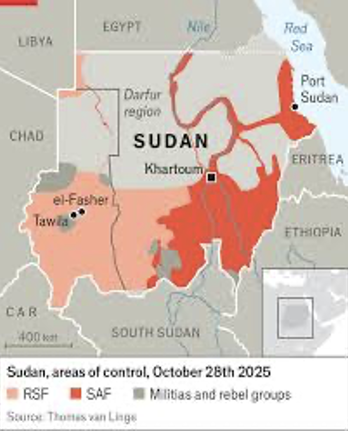
The following is the first part of an article based on a presentation made by Ella Rule in London on 3 April 2026 as one of the Southall Seminars series. She expressed reliance on two principal and invaluable sources of information, namely (1) Harry Cross’s book Undoing a revolution – Sudan and the politics of debt and (2) The Cardiff PhD thesis of Abdelwahab Himmat entitled The history of the Sudanese Communist Party, which is available online. Her text from time to time quotes verbatim from these texts but Ella Rule does not claim authorship. Equally, the views she expresses in this presentation should not be attributed to either author without verification.
The situation in Sudan is complex, making it difficult to distinguish between right and wrong in a civil war that has cost thousands of lives and displaced millions from their homes. In the early days of this war, it was all too easy to conclude that it was a war between an evil military regime, on the one hand, and those who opposed it, on the other. Such a conclusion, however, would have been disingenuous in the extreme, and this presentation aims to explain why that should be.
The economics
To seek the truth in this matter requires understanding of Sudan’s economic and political history. Sudan’s financial situation lies at the heart of all its woes, so we will start by looking at that.
In economic terms, Sudan is a failed state. And it is a failed state despite desperate efforts that have been made ever since independence in 1956 to bring its debt under control. The imperialist stranglehold over its economy, however, has meant that every attempt to break free has tightened the imperialist grip and worsened the financial situation.
When Sudan first fell under British control in 1898, the British, the better to exploit Sudan’s considerable resources, built railways.
When the British left as a result of the grant to Sudan of its independence in 1956, it also left Sudan with the outstanding bill for the cost of building and maintaining the railways and other infrastructure projects up to the date of independence. Nevertheless, at the time the debts were manageable, even if imposed by an occupying power.
It had also replaced much of Sudan’s largely self-sustaining agriculture with cotton plantations. By the time the British left, the world price of cotton had fallen considerably. In other words, Sudan started life with a huge interest bearing debt and with reduced means of paying it off.
The strategy of every government since 1956 has been to find the means of reducing the debt, not refusing to pay it. This could only be either increasing exports and/or by raising money from the population, e.g. by raising taxes, and/or reducing government spending. Any hope of increasing exports was always dependent on heavy expenditure on modernisation of production techniques, entailing further borrowing on imperialist terms, while raising taxes or reducing government spending impacted the already-low living standards of the masses, leading sooner or later to mass protests and revolt.
When oil was discovered in commercial quantities on Sudanese territory in 1979, this caused great excitement. People imagined that Sudan’s problems were all now going to be solved with the money that would be made from selling oil. But what happened? The oil was largely to be found in areas inhabited by non-Arab people, especially the south of Sudan, and, since the south Sudanese had long been discriminated against by an Arab chauvinist north, it was not difficult for imperialism to encourage the reigniting of the civil war waged by separatist movements in the south of the country (that had ended in 1972), and to arm it for a new war that lasted from 1983 until 2005. These wars were waged at massive cost to the Sudanese government, again requiring more borrowing from imperialist concerns on their terms. Not only did the war drain the national budget but obtaining any income from oil production was seriously delayed. Large-scale commercial production only started in 1999. As a result Sudan defaulted on its external debt in 1984, after which interest on arrears started to accumulate at 10% or more every year. By 2021, Sudan’s debt had ballooned to some $60bn, most of which was made up of arrears and unpaid interest accumulated from the 1980s. This left Sudan totally at the mercy of the imperialist money lenders as it constantly needed to borrow even to meet its everyday obligations. Naturally, every loan extracts its pound of flesh.
When oil was discovered in the western province of Darfur, this led to yet another civil war. On the face of it, the war was ignited by the conflict of interests between settled farmers (mostly non-Arab Muslims) and nomadic tribes (all Arabs). Had the government been able to afford it, the disputes could almost certainly have been resolved by a judicious distribution of cash. But the government could afford nothing. Imperialism therefore leapt in theoretically to support the rebels but in fact to lay claim to the oil of the region. Although the government was able to suppress the rebellion by creating and letting loose on the local population the Rapid Support Forces, with their excessively violent approach to pacification, the whole operation was of course extremely costly. And now history has been repeating itself with the current civil war being waged by the Rapid Support Forces (RSF) that has turned against the government that created it, this time with control of not only of oil but also of gold mines and agricultural land at its heart.
This time imperialism is again supporting the rebels but surreptitiously. Its ideologues are loudly condemning the genocidal activities of the RSF, which is supposedly supported only by the United Arab Emirates that is said to be seeking to expand its influence all over the Middle East for its own self-aggrandisement. Recently, however, in March 2026, US imperialism rather let the cat out of the bag by putting on its list of terrorist organisations not the RSF but the Muslim Brotherhood which happens for the moment to be supporting the Sudanese government! This allows the US to sanction any government or organisation that assists the Sudanese government in this war, although it’s OK to help the opposition. The truth of the matter is obvious: the UAE, like Israel, is just another extension of US imperialism to carry out its dirty work in the region. Like Israel it fully deserves the pounding that it is receiving from Iran as a result of its master’s unprovoked attack on that country.
The politics
In 1953 in preparation for Independence, self-government elections were held to establish Sudan’s first elected legislature in Sudan. The right to form a government was won by the National Unionist Party (NUP) and its leader, Ismail al-Azhari became the first prime minister. By the time of Independence in 1956, however, the NUP had split over the question of uniting with Egypt, a project dear to the heart of Ismail al-Azhari but which the party abandoned because it was unacceptable to the majority of the Sudanese people who were looking for full independence. Al-Azhari therefore abandoned the party, and its principal financial backers, the Khatmiya clan, withdrew their support, with many of its people forming a new party, the People’s Democratic Party that won large numbers of members away from the NUP . The result was that the NUP (a broadly nationalist party) lost a no-confidence vote, enabling its rivals, a coalition of Umma and PDP (both representative of comprador interests, the Umma being pro-British and the PDP pro-Egyptian), to form the first post-independence government. Obviously this coalition government was never going to satisfy the people’s desire for full independence.
The Umma Party had been formed prior to the 1940s, and was one of two major Sufi sects in the Sudan that influenced the political arena. Known as the Ansar, it was led by the Al-Mahdi family and dominated the west and central provinces of the Sudan. Its policies, however, had, under the leadership of the Mahdi’s son, evolved considerably from those espoused by the Mahdi who had been a religious fundamentalist with a coercive approach to religion, and whose support had come principally from the trading community rebelling against high taxes and attempts to suppress the thriving slave trade. The Mahdi fought a successful war against the British, and famously put to death the leader of the British troops, General Gordon. By the time of independence, however, his family, the financial supporters of the Umma party, were very pro-British, and much more inclined to make use of religious coercion, unlike their NUP al-Mighrani rivals from the Khatmiya tribe, who had a more purely Sufi, non-political, approach.
Class composition of Sudanese society
To say something of the composition of the society at the time of independence, it was a tribal feudal society with the overwhelming majority of the population being peasants. Different tribes dominated in different areas of the country and warlordism – attempts by tribal chiefs to extend the area of their domination – had been rife. Slavery had been eliminated only a few decades earlier by the British colonialists, but half the population of the capital, Khartoum, was estimated to be made up of former slaves. Under British rule, agriculture had turned towards production for export. In pursuit of their superprofits, however, the British had implemented some very beneficial modernisation reforms:
“At the outset of the 20th century, the Colonial Administration began massive investment programmes in education, agriculture and public infrastructure. Its aims were to exploit the economic potentialities of the country, supply British industry with raw materials, provide armies with sorghum, establish a firm rule and administer a vast and diverse country. The Administration sought to create an educated, indigenous group as a link between itself and the population. To create this group, the Administration established an elementary school in 1900. The school was intended to supply the Administration with clerks. Gradually more educational institutions were established: Gordon College in 1903, a Secondary School in 1905, a Survey School in 1907 and an Irrigation Employees School in 1909. … These schools brought deep changes to Sudanese tribal society. From these schools, emerged the first group of formally educated Sudanese, who began to spread all over the country as employees of the Colonial Administration. Gradually they brought knowledge and social and political change to the rest of society.
“After the establishment of the Sudan Railways networks and the Sudan Gezira Scheme in 1925, small-scale processing industries and trade activities began to spread and expand in the northern part of Sudan and later trade networks extended over the whole country. Trade activities reached all parts of Sudan except for the South where it was prohibited by law. The South was considered a closed area,
“The railways and the Gezira Scheme provided the backbone for the activities of the SCP [Sudanese Communist Party]. In the railways the SCP established its first relationship with the manual workers and from there the first trade union movement began which was closely affiliated to the SCP. In the Gezira Scheme, the SCP began its activities among illiterate peasants, and in a short period built a very strong base. …
“Industrial activities had tended to be confined to edible oil, soap, water bottling and later cement manufacturing, in addition, to the cotton ginning factories established to prepare cotton and sugar for export. The industrial sector was concentrated in Khartoum and central Sudan, bypassing the rural areas. This industrial sector was totally dependent on imported machinery. The agricultural sector, including modern and traditional sub-sectors employed more than 68% of the economically active population. The industrial sector has not exceeded 7% in the past fifty years [i.e., since the mid 1970s]. The agricultural sector contributed 45% of the GDP, while the industrial contribution did not exceed 5%. The service sector contributed 25% of the GDP and at first it was under the sole monopoly of foreign banks and companies and remained so until 1970 when it was nationalized. From the mid-1970s, the agricultural sector’s contribution to the economy declined steadily and the service sector has taken the lead.…” (Abdelwahab Himmat, PhD thesis).
Looking at the class composition of Sudanese society at the time of independence, and indeed since then, it can be seen that the various political parties contending for political power in the first post-independence elections only represented exploiter interests – mostly feudal interests at that, or at best the interests of commercial traders – which explains why comprador parties for a long time ruled the roost despite the deep desire of the Sudanese people as a whole for independence. With the growing proletarianisation of the population, traditional political parties were becoming increasingly unrepresentative, making their tenure in office very insecure.
The first elected governments
The Umma and PDP coalition appointed as its prime minister Abdallah Khalil of the Umma party, and in 1958 the same government was re-elected.
At the time the first war of secession waged by the south Sudanese, that had started in 1955, and was not brought to a close until 1972, was under way, creating a serious drain on government finances. Under the British, South Sudan had been administered as a separate colony, and on independence its people had no wish to become the vassals of the northern Arabs, which is why they went to war. To deal with the cost of the war, which was happening alongside crop infestations that wiped out most of the cotton harvest (that normally provided up to half of the country’s export earnings), as well as an Egyptian trade boycott over disputed Nile water quotas, all of which together had bankrupted the country, Khalil had to negotiate an international loan. Short term credits were agreed with Britain and Germany, along with a £3 million loan from Barclays. A further $3 million was offered by the US, but this was opposed by the PDP and NUP as they feared it would antagonise Nasser.
Unable to manage without these loans, Khalil, only a few months after coming to power, himself engineered a military coup to overthrow his own civilian government
The first military regime
Under military rule, General Ibrahim Abboud became the country’s first president. His hope was to be able to expand exports by increasing capital imports, alongside free consumer imports. For this purpose US ‘aid’ rose to over $75 million. Concessions were made to Egypt to enable the Nile waters dispute to be resolved, but this had a negative impact on cotton growers. In other words, the military government sought to improve its finances by yet more borrowing. However, over the military government’s 6 years in control, foreign reserves were depleted by the government’s attempts at industrialisation that did not always lead to any increase in exports. Worse were Abboud’s attempts to impose Arabisation and Islamisation on the non-Arab, non-Muslim south, leading to an intensification of the civil war with the south, requiring a vicious military crackdown. The bill had to be paid by the working class and peasantry, through fiscal austerity and credit controls, which needless to say led to major unrest. This culminated in the banning by the army of a University of Khartoum seminar on the ‘southern problem’, which led to a student demonstration in which a student was killed and a subsequent general strike by professionals. The economy was in a total mess. The military government decided it was time to hand over to a civilian one, and it resigned.
The role of the Sudanese Communist Party
From the start of military rule all political parties were banned, especially the Sudanese Communist Party (SCP), along with trade unionists. Nevertheless, the SCP flourished underground, calling for the overthrow of the military regime, through writing slogans on walls, publishing press releases and pamphlets and internal circulars to members about domestic issues and external relations.
The SCP had wide influence among the oppressed classes despite the relatively small number of its members. It had originally been formed in the 1946 as the Sudanese Movement for National Liberation (known as HASITO, derived from its Arabic name) by a group of young students and workers. The railways and the Gezira scheme established by the British provided the first base from which communism was able to spread in the Sudan. Sudanese students studying in Cairo in the 1940s brought back Marxist ideas and established early cells, which were connected to the Egyptian Movement for National Liberation (MDLN). The movement was further bolstered by Herbert Storey, a conscripted British soldier and member of the Communist Party of Great Britain, who organised a cell in Khartoum. Its influence spread through work in fronts, such as the Anti-Imperialist Front, which was used to contest the 1953 elections. Following its third conference in February 1956, HASITO, as required for membership of the Third International, renamed itself the Sudanese Communist Party.
The Party had influence precisely because its policies reflected the material interests of the masses of the oppressed in Sudan, interests that featured very little, if at all, in Sudan’s major tribal-based political parties.
In these conditions, in Sudan as in Egypt, the forces of reaction had to create a pole of attraction away from communism to which the oppressed masses could attach themselves. That pole was the Muslim Brotherhood that attracted support through its charitable works among the poor whom they bombarded with anti-communist propaganda mainly focused on the fact that communism’s ideological basis – Marxism-Leninism – is atheistic, something which seems extremely shocking to devout people whose whole life is centred around the religious rituals that hold their communities together.
The SCP, however, embedded itself in the local culture of the oppressed, joining in with their religious festivals, etc. In fact they even paused their meetings for prayers at the appropriate times. Although Marxism-Leninism is indeed atheist, the truths that emerge from the application of Marxist-Leninist analysis to the material processes in the world can certainly be recognised by religious people. If an atheist scientist says that it is true that H2O is water, the good Muslim can perfectly accept that truth – as being the will of Allah. For practical purposes it amounts to the same thing. Indeed Muslim scientists were able to identify many truths about the way the material world behaves precisely because they were searching for understanding of Allah’s will. Generally there is no need, therefore, for communists aggressively to proselytise for atheism, unless there is a real problem to deal with. Where problems can arise is because religions tend to assume that God’s will is unchanging: what was true 2000 years ago remains true today even though society has changed considerably. Religious fundamentalists assume that all change is against God’s will! On important issues such as the rights of women and the practice of FGM the Sudanese communists did proselytise against the continued oppression of women. They enthusiastically welcomed women members, and indeed were the only party who even admitted them, although these were few in number because of the strength of oppression that Sudanese women were, and to some extent still are, subjected to.
TO BE CONTINUED