Ukraine – Zelensky begins to show his true colours
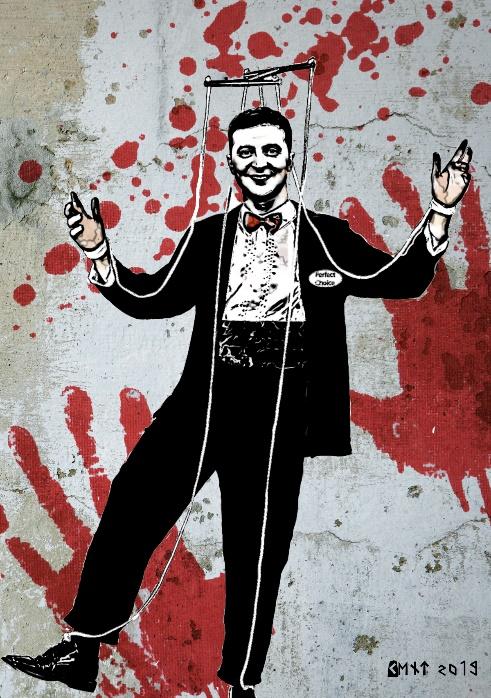 Ukrainian elections, which returned a TV comedian for President, raised as
many questions as eyebrows. The winner, Volodymyr Zelensky, has been said
in many quarters to represent a bright ‘new direction’ for Ukraine, a
‘breaking of the mould’, and a ‘new dawn’, in short, all the usual nonsense
uttered by imperialism when it backs every horse in the race and its young
gelded colt ends up winning.
Far from having any significant impact on underlying antagonisms in
Ukrainian society, Zelensky beat Poroshenko because he polled better (as an
unknown quantity) in the south and east than the incumbent. The Atlantic
Council, a thoroughly disreputable organisation with perfectly bourgeois
credentials, issued its own frank assessment:
“Poroshenko wasn’t able to get more than 15 percent in any of the eight
oblasts that comprise the east and south. By contrast, in the seven western
oblasts—including Transcarpathia and Chernivtsi, which were outliers and
voted like the east and south—he averaged 37 percent of the vote, which was
more than three times greater than his 11 percent in the east and south… in
the core Galician oblasts (Lviv, Ivano-Frankivsk, and Ternopil) Poroshenko
won 51 percent of the vote. Zelensky, meanwhile, scored big in the east and
south (87 percent and 85 percent, respectively), but was less impressive in
the west (60 percent).
“In fact, the results of the first post-election survey in Ukraine show
that the regional disparities have not gone anywhere, and a similar picture
emerges when we disaggregate polling data by ethnicity and language. Asked
to choose between the EU and economic ties with Russia and the other former
Soviet republics (except for the Baltic states), 82 percent in the west
opted for Europe. In the east, only 37 percent favoured the EU; 30 percent
in the government-controlled parts of the Donbas; and 25 percent in the
south. On NATO, 76 percent in the west wanted to join the alliance. In the
east, the Donbas, and the south, the corresponding figures were 32, 21, and
23 percent, respectively. Only 14 percent of western Ukrainians had a
positive view of Russia, while in the south that figure was 74 percent.
Those who had a favourable opinion of Russian President Vladimir Putin
accounted for 2 percent in Western Ukraine; in the Donbas it was 30
percent” (Roman Solchanyk, ‘One Ukraine? Think again’, Atlantic Council, 13
June 2019).
New President calls for deepening sanctions on Russia
Once he was in position Zelensky dismissed the Rada, called for new
elections and headed straight for his campaign headquarters on Boulevard
Leopold III (HQ offices of NATO) and the office of the President of the EU.
In a display of subservience to western imperialism, the young statesman
Zelensky then visited Macron in France and Merkel in Germany. With both
Macron and Merkel he begged for a continuation of sanctions on Russia, and
with Merkel in particular he pleaded for the economic fate of Ukraine,
which now hangs on Nord Stream 2; the soon-to-be completed gas pipeline
from Russia which will completely bypass Ukraine and cost the Ukrainian
state billions in revenue. Such a friend of the Ukrainian people is German
imperialism that Merkel graciously comforted Zelensky by saying,
“I have repeatedly said to the Russian president that for me the issue of
Ukraine being a transit country for gas is essential, so very, very
important and President Putin has always stressed to me that he understands
that” (Reuters, 18 June 2019).
Remarks that must have been anything but reassuring for the new President.
Such is the grip that western imperialism has on the Ukraine that
Zelensky’s behaviour in Europe was nothing short of an outright incitement
to Russia and risks economic suicide for Ukraine. In an interview published
by Germany’s Bild newspaper Zelensky stated that sanctions imposed on
Russia by the European Union in 2014 should be expanded,
“My attitude is simple and clear. Sanctions are the only means to liberate
the occupied region and restore our territorial integrity and sovereignty,
and return them to our people. If this does not work, the mechanism must be
expanded”…
Zelensky also said that Nord Stream 2 threatened “the energy security of
Europe and Ukraine”. (‘US announces $250m in military aid to Ukraine’,
Al-Jazeera, 18 June 2019).
Merkel, whilst giving platitudes on the Donbas and Crimea, essentially did
nothing to rescue Zelensky and the Ukraine from Nord Stream 2, and how
could she when German imperialism is so desperately in need of the Russian
gas? Currently one third of Russian gas exports to the EU cross the
Ukraine, which receives gas transit revenues. Nord Stream 2 will bypass the
Ukraine via the Baltic Sea while TurkStream will offer a route south of
Ukraine through the Black Sea. Ukraine’s best option would be to work for
good relations with Russia, but under the grip of imperialism it looks like
the country is doomed. It has a faltering economy with key industries such
as coal and steel hit hard by the deterioration in relations with Russia.
The potential of a further blow to the gas transit revenues will hit the
country exceedingly hard. Russian President Vladimir Putin, despite the
worst provocations, has promised that Russia will continue to supply gas
through the Ukraine so long as the Ukrainians allow it to remain
economically viable.
Zelensky’s aggressive posturing in Europe will do little to encourage the
Russian side to renegotiate favourably the existing transit arrangements
which run out in December this year. Whilst the Ukraine remains in the
clutches of imperialism it is helpless to re-establish friendly relations
with its most economically important neighbour.
US imperialism offers nothing but war and… a name change
In exchange for keeping the Ukraine in a most unenvious economic and
military position, the United States took measures to satisfy the most
banal Ukrainian chauvinism as a gesture of goodwill. The US Board on
Geographic Names, or BGN, has changed its English spelling of Ukraine’s
capital from Kiev to Kyiv, and the good news was announced by the Embassy
of Ukraine in the US in a statement on June 13:
“This decision is extremely important and gives impetus to also correct the
official name of Ukraine’s capital outside of the United States,” the
statement reads.
The embassy stated that the US BGN had considered changing the English name
in the database after receiving an appeal from Valeriy Chaly, Ukraine’s
Ambassador to the United States (Toma Istomina, ‘Kyiv not Kiev: US changes
spelling of Ukrainian capital’, Kyiv Post, 13 June 2019).
Not to be outdone by the gratuitous display of friendship coming from the
BGN, the Pentagon announced in June that the US would provide Ukraine with
naval training, as well as sniper rifles, rocket-propelled grenade
launchers, radars and night vision equipment. According to the statement,
the amount is part of a series of Pentagon payments totalling $1.5bn to the
country since 2014. These weapons are provided in the hope that Ukrainian
sons and daughters will continue to be well stocked in a war on their
Russian brothers waged on behalf of US imperialism. Lieutenant Colonel
Carla M Gleason a spokesman for the Pentagon said,
“The United States remains committed to helping Ukraine … to strengthen
democratic civilian control of the military, promote command and control
reforms, enhance transparency and accountability in acquisition and
budgeting, and advance defence industry reforms” (‘US announces $250m in
military aid to Ukraine’, ibid.).
In exchange for the blood of Ukrainian children the Pentagon graciously
promises to liberalise the red tape preventing greater spending by the
Ukrainian army on US weapons and hardware. Is there no end to the special
privileges endowed upon the friends of US imperialism?
Three Russians and one Ukrainian to face MH17 murder charges
On 19 June international media reported that four suspects will face murder
charges for the shooting down of Malaysia Airlines flight MH17. Three of
the defendants are Russians, and one is Ukrainian. A sham trial is due to
start next March in the Netherlands, with evidence collected by all the
involved parties excluding Russia.
The suspects were named as Igor Girkin, a former colonel of Russia’s FSB
spy service; Sergey Dubinskiy, employed by Russia’s GRU military
intelligence agency; and Oleg Pulatov, a former soldier with the GRU’s
special forces spetsnaz unit. All were Russian soldiers previously sent
abroad.
Leonid Kharchenko who is a Ukrainian is the fourth man. He is said to have
led a military combat unit in the city of Donetsk as a commander.
Girkin is reported as having been minister of defence in the Donetsk
People’s Republic (DNR) and the commander of the DNR when the plane was
shot down on 17 July 2014. Dubinskiy served as Girkin’s deputy in the DNR,
and Pulatov was Dubinskiy’s deputy. Kharchenko was under their command
according to the Dutch investigators.
The investigators were reported by media as saying that the soldiers
“formed a chain linking the DNR with the Russian Federation”. The Guardian
and others reported that this ‘link‘ was how the separatists obtained heavy
equipment from Russia including a ‘Buk launcher’, which they say was used
to fire at MH17.
Such is the strength of the murder case that the investigators were
reported as having to explain that…”The accused did not ‘push the button’
themselves…”
Reports explained the methods by which these investigators had gathered
enough evidence to bring murder charges, these methods included
“interviewing witnesses, analysing satellite images, and sifting through
phone calls”. Many pages are said to be transcripts taken from online chat
rooms and military enthusiast and military re-enactment websites where some
of the accused are said to have left a trail that leads back to their
guilt! If such evidence was not preposterous enough, it was admitted in
passing that the area of investigation in eastern Ukraine was still
inaccessible to the team, which led to one individual, Mr Westerbeke,
saying such a situation had made “the process difficult…”, although not so
difficult that murder charges cannot be brought against four Aunt Sallys.
POSTSCRIPT – continuing media crackdown
Rabochaya Gazeta (the first issue of which was released in August, 1897) is
a Ukrainian newspaper giving social and political news.
On April 18, 2019, the Kyiv Regional Administrative Court began the lawsuit
of the Ministry of Justice of Ukraine and the Main Directorate of the
Security Service of Ukraine (SSU) in Kiev.
The Ministry of Justice of Ukraine, referring to the Law “On Condemnation
of the Communist and National Socialist (Nazi) Totalitarian Regimes in
Ukraine and the Prohibition of the Promotion of Their Symbols’ accuses the
paper of the publication of articles by politicians quoting the works of VI
Lenin and K Marx, and mentioning the specific achievements of Ukraine
during the Soviet period.
Lalkar and the CPGB-ML sends greetings to all the brave journalists and
progressive political forces associated with this journal and extends our
heartfelt admiration for their determined struggle against the reactionary
forces in Ukraine