Brexit and the Tory leadership race
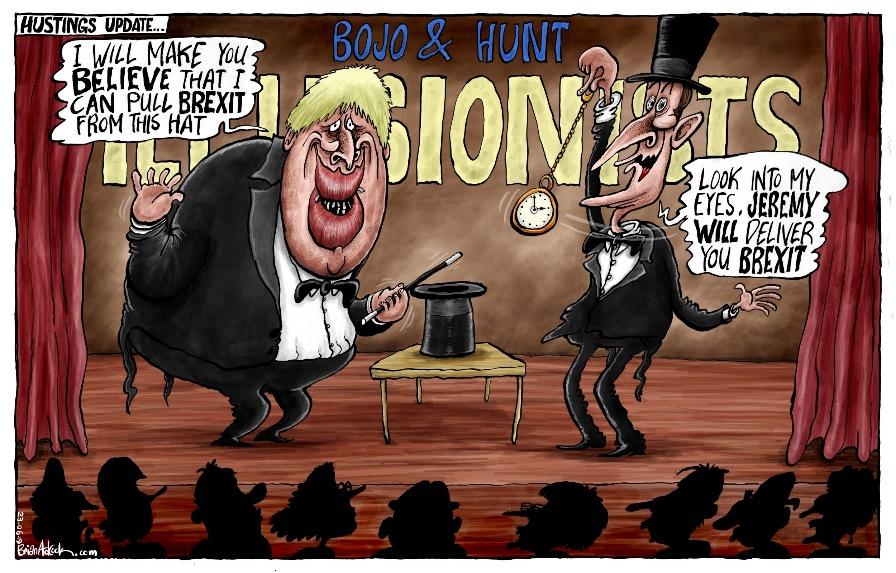
The donkey derby to replace the outgoing Theresa May as British Prime
Minister is fast approaching the final furlong. Only two riders are now
left from an initial pack of thirteen. Before the race even began, three of
the contenders withdrew after failing to receive the requisite support of
even the eight MPs required to enter the race. Another, Matt Hancock, fell
at the first hurdle, leaving the rest of the pack to be whittled down until
only Boris Johnson and Jeremy Hunt remained.
With Johnson and Hunt now fighting it out to be elected as the next British
PM, the race is anything but neck-and-neck. Johnson has dominated this race
from the very beginning. His share of votes among Conservative MPs rose
from 114 in the first ballot to 160 in the fifth and final ballot of Tory
parliamentarians. However, with previous rounds being decided by
parliamentarians, the final round will be decided upon by the wider
membership of the Conservative Party. That said, Boris is far more popular
among the party rank-n-file than Jeremy Hunt, which should ensure his
victory. Additionally, the party membership is overwhelmingly made up of
Brexiteers. Boris led the official Leave campaign in 2016, and Hunt voted
Remain, so a leadership race fought over Brexit undoubtedly favours Boris.
Nonetheless it is worth noting that Boris is viewed by many in the country
at best as a bungling gaffe-prone buffoon and at worst as a toxic figure
and borderline racist. He has defended himself from such accusations as the
grandson of a Muslim migrant, although he is also a descendant of German
royalty, and it is from this tradition that he has previously spoken of
Africans’ “watermelon smiles” and compared Muslim women to letterboxes.
Whilst there are those in the country hypocritically baulking at the idea
of such a man becoming PM, the extent to which such comments will influence
Conservative Party members is another matter altogether.
Foreign Secretary and former Health Secretary Jeremy Hunt, despite holding
one of the great offices of state, is somehow the lower profile candidate
in the race. Typically the Foreign Secretary would be a political
heavyweight, a ‘big beast’ recognisable across the country, and indeed the
world. However, most of the country would struggle to recognise the current
incumbent in a line-up. Those who would recognise the runner from the
Remain camp, junior doctors for instance, do not exactly look upon him
favourably.
Moreover, whilst Boris appeared to display a semblance of integrity in
resigning from the Cabinet last year over the Brexit mishandling by May’s
government, Hunt instead stuck with May until the bitter end. Indeed it was
Johnson’s resignation which facilitated Hunt’s rise to Foreign Secretary.
Therefore, Boris is seen as a break with the previous regime, whilst Hunt
has been called May 2.0 or Theresa May in trousers. Boris is thought to
represent a change in Brexit strategy and Hunt is the continuity candidate.
Media attempts to undermine Johnson
It is of little surprise then that the pro-Remain media have been
conducting an anti-Boris campaign throughout this process. Whilst a
crescendo is yet to be reached, the height of this campaign to date came on
the back of Johnson and Hunt being named as the last two candidates
standing. The height of the media campaign also corresponded with the
Guardian delving into the gutter. On the evening of his reaching the last
two, police were called to Boris Johnson’s girlfriend’s plush South London
pad by nosey neighbours. Police arrived at the scene to find no crime had
been committed in what was a mere domestic argument, albeit undignified as
such things are. Nonetheless, the neighbours who made the call to the
police also recorded the argument through the walls separating their
apartments. Unsurprisingly, the Remainers who reside there chose the
Guardian on to whom to pass on their recording. Whilst the Guardian ran
with the story, it is worth notng that they did not release the recording.
This leaves much room for speculation and casts doubt as to who was the
aggressor in the argument (if there even was one), how both parties
conducted themselves, and shows a hesitancy on the part of the Guardian
with regard to the legality of such a publication and disregard for
privacy. The neighbours who called the police and demanded the police take
the recording as evidence have since come under scrutiny. Attacked by Jacob
Rees Mogg as “Corbynista curtain twitchers”, these neighbours certainly
have a political pro-Remain agenda and unsurprisingly found a willing
conduit for their tittle tattle. As described by the Daily Mail:
“Ms Leigh is the daughter of multi-millionaire musical theatre producer
Mitch Leigh. A successful writer, she was the star of a theatre project
called Brexit Stage Left, which received financial backing from Eurodram, a
cultural campaign funded with Brussels cash…
“Last night he confirmed that he had backed Remain in the EU referendum,
but insisted that had nothing to do with the weekend’s events.
“Ms Leigh was described by one interviewer as an ‘American Leftist Buddhist
Jewish playwright’” (James Gant, Ian Gallagher, Harry Cole, Michael Powell
and Jonathan Bucks, ‘Boris’ girlfriend is “too scared to go home”’, 23 June
2019).
The campaign against Boris is but one small component of the campaign
against Brexit. With Boris the only candidate remotely likely to implement
a proper Brexit (in so much as any candidate even wishes to do so), he is
feeling the wrath of the well organised, well backed, metropolitan Liberal,
pro-Remain elite. Whether these individuals are or are not “Corbynistas”,
Jacob Rees Mogg is quite right to make the comparison, such is Jeremy
Corbyn’s political base.
Moreover, such ‘journalism’ on the part of the Guardian is indicative of
the current bourgeois media trend continually to lower political discourse
away from policy and on to the individual. It is a product of a weak and
decadent, self-absorbed society, bathing in the sewers of individualism. So
the debate shifts from policy to personality. Heaven forbid that in a
so-called democracy the demos may actually be informed. Much better to
reduce debate to personality, lest we expose the real lack of choice
existing within our democratic system.
Sham democracy
On this real lack of choice before us, there is much that could be written.
Firstly and most obviously, the vast majority of people in the country have
absolutely no choice in who will be their next Prime Minister. Instead in
our much vaunted (by our own bourgeoisie only) democratic system, our Prime
Minister will be chosen by around 160,000 Conservative Party members – that
is to say around 0.3% of the total population. Yet we are told it is the
socialist system of the dictatorship of the proletariat which is
undemocratic. We are told it is Venezuela, Russia, DPRK, Syria which are
undemocratic. To compound this, who even got to enter the race was decided
upon by only 313 Members of Parliament. This is sham democracy where the
people have literally no choice in the most significant political matters
affecting them.
The point was not missed by astute Russian President Vladimir Putin:
“’They seem to poke a finger at us all the time over the democratic
processes in Russia, the electoral law and so on and so forth’,” he
reportedly said.
“’But let’s look at the method of bringing actually the country’s top
person, the top person of the executive branch to the supreme power in
Great Britain.
“’Is this done through general elections? No. This is done with the help of
the party’s gathering.’
“’This is, of course, strange for me, honestly speaking. But such is the
British system’, Mr Putin added” (Zamira Rahim, ‘Putin derides ‘strange’
Tory leadership race to choose new PM’. The Independent, 23 June 2019).
The political differences between the candidates may also have been greatly
overplayed. These political differences, the extent to which they may
exist, exist only on the issue of Brexit, which of course is the important
political matter of a generation. That Boris campaigned to Leave the
European Union in 2016 and Hunt campaigned to Remain, on the surface
highlights a tangible difference on attitudes towards Brexit between the
two. That Boris is the man who penned two letters prior to coming out for
the Leave campaign, one announcing his support for Leave, and the other his
support for Remain, highlights that his position was one of political
opportunism rather than conviction. Furthermore, he has secured the support
of both Leavers and Remainers in the Conservative Party, the suggestion
then being that he is promising different things to different parties.
In this regard his promises to the European Research Group may be no less
than a ploy, and his willingness to accept a WTO-terms Brexit deal
meaningless. Indeed in the absence of a general election there may exist a
chance that, even if his promise were genuine, parliamentary arithmetic
could render it meaningless regardless. That parliament has continually
voted against such a ‘no deal’ scenario may mean that unless
parliamentarians are changed then government policy will not be allowed to
change. Even with a new PM, it is the case that a weak government,
dependent on DUP support and everyone obeying the whip in order to scrape
the tiniest of majority, will be in the frailest of positions – so frail
that there is talk of Jeremy Corbyn calling a no confidence vote on day one
of the new PM taking office. A number of Tory rebels, a dozen or so
according to Ken Clarke, are apparently willing to vote against a Johnson
government in any no confidence vote.
For all his verbal commitment to leaving without a deal, there are factors
that may cause Johnson to think again Adding to the insecurity, should
Johnson fail to satisfy the ERG and leave on October 31st with or without a
deal there could be a real political bloodbath in the Conservative Party,
the flavour of which is anticipated by the Daily Telegraph:
“…On paper, installing Britain’s most famous Brexiteer as the new PM is an
extraordinary win for the European Research Group of Leave MPs, led by
Jacob Rees-Mogg…
“The ERG know that nobody symbolises the seething determination and defiant
patriotism of the Brexit project quite like Boris, and at a time when the
public is losing the will to live, they couldn’t ask for a more powerful
poster child for their mission. Leaver MPs also calculate that Boris’s
strong-willed personality will be a massive asset in the next round of
negotiations with Brussels.
“But they are jumpy nonetheless. In recent days they have vacillated
between giving MPs rather desperate ankle-flashes of their ‘spartan’
fundamentalism – tweeting that the backstop isn’t the only thing wrong with
Mrs May’s deal, for example – and falling over themselves to demonstrate
their unwavering devotion to Boris, not least by whipping against tactical
voting in favour of rival candidates during this week’s leadership ballots.
“The latter, in particular, betrays a strategic ineptitude. Once it was
clear that Boris had more than enough support to secure his place in the
final round, the ERG should have shifted votes to one of his pro-Brexit
rivals (Dominic Raab, and if he hit his ceiling, then perhaps Sajid Javid,
who has previously pitched himself as a dependable pair of hands in a
no-deal scenario). This could have engineered a more robust contest, in
which Boris could have been pressurised to properly flesh out his Brexit
plan and reassure Tory members of his unwavering commitment to no deal
should talks with Brussels turn south.
“But the ghastly truth is that the ERG do not trust Boris not to
double-cross them, and they are going about preventing their betrayal in
the worst possible way. They have concluded that the best method for
ensuring that Boris takes Britain out of the EU with or without a deal by
October 31 is to throw the full weight of their support behind him so that
he feels beholden to them. The logic goes that, even if Boris loses his
bottle when Tory Remainers inevitably resume their sabotage of Brexit, he
will remember who put him in power and feel compelled to side with the
Leavers.
“Their strategy is a leap of faith born out of naive desperation. Boris may
well be a true Brexiteer, and consumed by searing desire to ‘get the job
done’. But high power has a habit of ravaging the most honourable
individual’s principles – not least when they are presiding over a minority
government in which implosion has replaced direction, and craven plotting
now fills the chasm of its long-abandoned principles.
“Plus, the Brexit wunderkind will not want to be the movement’s sacrificial
offering. Although he is nothing like Theresa May, Boris might well be
haunted by the way her Cabinet let her dig her own grave, effectively
hiding away for months.
“He will also be keenly aware that even if it is possible to make no deal a
practical success, it will be a torrid battle indeed to execute such an
anti-establishment project and politically survive. When the Remainer
ruling class goes nuclear with anger, colleagues will be only too happy to
have Boris absorb the brunt of the fallout, before ditching him as ‘toxic’
several months down the line.
“That is why the ERG must now move to make sure that it is impossible for
Mr Johnson to betray them. Brexiteers should promise to unite behind the
new PM and shame those in the Government who attempt to hide away in the
event of no deal. But they must also make it clear that there is a new
backstop in town, and it’s called the Brexit Party; if the new leader fails
to negotiate a better deal with the EU, and then falls back on to the
Withdrawal Agreement, there will be mass defections to Nigel Farage’s new
movement” (Sherelle Jacobs, ‘Brexiteers risk a “Boris betrayal” unless they
play a ferocious final hand’, 22 June 2019).
A rising Brexit Party threatens the new PM from the Leave camp. The Remain
camp brings its own threat, the most significant of these being an
‘independent’ Scotland (within the EU) and United Ireland. The further the
crisis deepens, the increasing likelihood of both scenarios. In Scotland,
Nicola Sturgeon threatens a second independence referendum at every
opportunity. As someone so keen on referendums she is yet to accept the
result of one. No doubt, should she finally win one – that will be the
first result she accepts.
The Irish issue has been driven primarily by the backstop put in Theresa
May’s Withdrawal Agreement, or what Nigel Farage more accurately describes
as Mr Barnier’s European Treaty. Whilst both candidates say the backstop
can be got rid of, the veracity of this claim is yet to be proven.
Meanwhile “There has been a welcome in Ireland for the result of a survey
of Britain’s ruling Conservative Party which revealed that most of its
members would be willing to see Irish reunification if it meant that
England could leave the European Union. The poll puts the Tories completely
at odds with their DUP allies in the London government.
“A survey of Conservative Party members found that 59% would prefer to see
Ireland united if it secured Brexit, while an even greater number, 63% or
almost two in three, would be happy to see an independent Scotland if it
meant Brexit would go ahead…
“While both candidates could be tempted to call for an ‘England First’
Brexit in the wake of the YouGov poll, one of the first tasks of the future
Conservative leader and Prime Minister will be to tackle the hardline
unionist DUP, who are keeping the party in government through a
confidence-and-supply arrangement.
“The DUP’s Brexit stance is to remilitarise the border between the north
and south of Ireland by pulling the Six Counties out of the EU, regardless
of the damage to the economy or the wishes of the people in the North, most
of whom want to remain.
“Only a new general election could allow a new parliament to end the DUP’s
blocking tactics, although the strategy of going to the people backfired
spectacularly for Theresa May two years ago, weakening her position and
delaying Brexit.
“Tory MP Daniel Kawczynski, who is supporting Boris Johnson, told BBC Radio
that if Johnson becomes Prime Minister, he has an opportunity to win a
general election to ensure the British government is ‘not at the beck and
call of the DUP’.
“’I have to be careful what I say about the DUP because hitherto if I’ve
been critical of them then noises are made back here at Westminster,’ he
said.
“’We have still not left the European Union, in part because the DUP
absolutely categorically refused to contemplate the Northern Ireland
backstop’…
“Sinn Féin’s John O’Dowd welcomed signs that the Conservative Party were
willing to rethink the partition of Ireland.
“’Clearly, it is now dawning on many Tory Party members that, if they are
to have the kind of hard Brexit they wish to have, then the obvious
solution to the impact of that on Ireland is Irish reunification.
“’It is a conclusion that more and more people are coming to every day
which is why poll after poll is showing greater support for Irish
reunification, particularly in the context of Brexit.
“’Theresa May herself said last year that she would expect an Irish unity
poll to be passed. And with such overwhelming support for reunification
within the self-declared conservative and unionist party, it is obviously
time to begin preparing for an Irish unity referendum’” (Irish Republican
News, ‘Unite Ireland so we can have Brexit, say Tory members’, 22 June
2019).
Whilst there is rationale in this argument, and a united Ireland is the
correct historical position, it remains unlikely that any leader of the
Conservative and Unionist Party would want to go down in history as the
Prime Minister who oversaw the loss of the six counties of Northern
Ireland. Neither would they wish to be the Prime Minister who oversaw the
crumbling of the union of crowns. History is being written today and
whoever the victor will wish to carve out their own ideologically driven
legacy as a Great British statesman. Therefore they are highly unlikely to
simply throw away both regions in order to secure Brexit. Failure to
deliver Brexit may see both these losses thrust upon them through
strengthening the hand of Nigel Farage. Whichever donkey crosses the line
in this not-so-grand, not-so-national election, it could well be the winner
who becomes the loser, and who ends up figuratively shot and put out of
their misery.