Stalin’s Library by Geoffrey Roberts – a resumé and review – Part 9
Masters of war
Stalin had a longstanding interest in details of military matters. Ambassador Averill Harriman observed that Stalin: “had an enormous ability to absorb detail … In our negotiations with him we usually found him extremely well-informed. He had a masterly knowledge of the sort of equipment that was important to him. He knew the calibre of the guns he wanted, the weight of the tanks his roads and bridges would take, and the details of the type of metal he needed to build aircraft” (Roberts p.154).
On another occasion, Averill Harriman, the US ambassador to the Soviet Union during the Second World War, who spent a lot of time with Stalin during that period, observed that to understand and appreciate Stalin’s USSR one needed to know something about Russia’s past: in his view Stalin was a popular war leader; he was the one who held the country together. “So I’d like to emphasise my great admiration for Stalin, the national leader … [at a time of] one of the historic occasions where one man made so much difference”.
Stalin possessed many books on military affairs in his library – books by experts of Tsarist times, and by Genrikh Leer (1829-1904), as well as of Germany, such as Clausewitz, the author of On War. He especially underlined a passage in Leer’s book where he stated that after his defeat by Napoleon at the battle of Borodino in 1812, Russian General Kutuzov was faced with a choice of either saving his army or saving Moscow. In the end he decided to save his army. Kutuzov chose the former and followed it up by conducting a campaign of harassment against Napoleon’s army as it retreated from Moscow.
In October 1941, as the Nazi armies approached Moscow, faced with a similar dilemma, Stalin took the decision to save Moscow as the means of saving his army. So he remained in the capital and organised its defence. On 7 November 1941, the 24th anniversary of the October Revolution, he addressed Soviet troops on their way to the front:
“Remember the year 1918, when we celebrated the first anniversary of the October Revolution. Three-quarters of our country was at that time in the hands of foreign interventionists. The Ukraine, the Caucasus, Central Asia, the Urals, Siberia and the Far East were temporarily lost to us. We had no allies, we had no Red Army—we had only just begun to create it; there was a shortage of food, of armaments, of clothing for the Army. Fourteen states were pressing against our country. But we did not become despondent, we did not lose heart. In the fire of war we forged the Red Army and converted our country into a military camp. The spirit of the great Lenin animated us at that time for the war against the interventionists. And what happened? We routed the interventionists, recovered all our lost territory, and achieved victory” (Roberts, p.156).
He returned to the theme of Soviet patriotism in his peroration:
“A great liberating mission has fallen to your lot. Be worthy of this mission! … Let the manly images of our great ancestors—Alexander Nevsky, Dimitry Donskoy, Kuzma Minin, Dimitry Pozharsky, Alexander Suvorov and Mikhail Kutuzov—inspire you in this war! May the victorious banner of the great Lenin be your lodestar!” (ibid.).
Stalin’s favourite among Soviet theorists was Boris Shaposhnikov, a former Tsarist officer who had joined the Red Army in 1918 and served as Chief of the General Staff (1937-40, 1941-43). Like Stalin he was “an intellectual as well as a practical man of action”. His book Mozg armii (Brain of the army), based on the strategic lessons of the First World War, was a combination of grand strategy and critical organisational detail that were also the hallmarks of Stalin’s military and political leadership. Shaposhnikov’s book included many citations from the works of Marx, Engels and Lenin, beside those from Russian and Western strategic theorists.
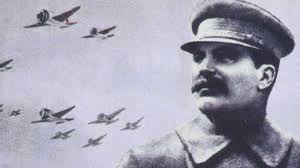
Soviet preparations, contrary to the assertions of bourgeois detractors of the USSR and Stalin, began at the end of the 1920s. During the 1930s, the share of national defence in the budget rose from 10% to 25%. The Red Army’s strength grew from under a million to more than four million. By 1939, the Soviet Union had the largest and most extensively equipped army in the world and was annually producing 10,000 planes, 3,000 tanks, 17,000 artillery pieces and 114,000 machine guns (Roberts, p.157).
Like Clausewitz, it was Shaposhnikov’s belief that war was a continuation of politics and, therefore, the war’s goals and overall direction were the prerogative of the political leadership, while the General Staff needed to grasp the interrelations of domestic, foreign and military affairs, the political leadership needed a good grasp of matters military. “In our times”, wrote Shaposhnikov, “the study and knowledge of war is essential for all state leaders” (ibid).
The idea that Shaposhnikov’s book helped to popularise was that “mobilisation meant war”. This was possibly one of the reasons why the Red Army did not mobilise in the days preceding Hitler’s attack on the USSR, so as not to precipitate the war that Britain and the US were keen on provoking with the aim of weakening their imperialist enemy, Germany, and the hated socialist USSR.
To be continued