Leonardo Conti – the macellaio’s role in connection with the Katyn massacre
‘Macellaio’ is the Italian word for a butcher. It is most appropriately applied to Leonardo Conti, a Swiss-Italian German doctor, who was a member of the top hierarchy in the SS, alongside Bormann, Heydrich and Rudolf Hess, as an SS Obergruppenführer. He was an integral part of the first mass murder enterprise carried out against the mentally and physically handicapped that occurred mostly in Germany during the entirety of WWII (1939-45).
It is estimated that up to 200,000 individuals were gassed and cremated in various facilities across the country, even before the start of the Holocaust. A further 100,000 died abroad in territories occupied by Nazi Germany, mostly Poland. Children and adults were initially murdered collectively in care institutions, allegedly dying under a false diagnosis (e.g., appendicitis or pneumonia). Registers and death certificates were then compiled whilst relatives were provided with an urn containing mixed ashes that were never specifically from the deceased.
Conti was also responsible for forced abortions, sterilisation and medical experiments conducted on humans and, in fact, on anyone unfit for military service and that the Nazi state considered subhuman. A non-vegetative, conscious epileptic would thus be perfectly aware of his fate and surroundings, yet he could still be murdered within the institution.
Villagers in various locations across Germany gradually became aware of the disappearances because of the smell emanating from the chimneys of the crematoriums and of seeing countless military trucks previously filled with people, returning empty. SS officers often wore white overalls to convey an impression of medical care. The evolution of the killing process started from the use of carbon monoxide pumped into sealed trucks, culminating into purpose-built gas chambers and crematoriums. It was a mirror image of what happened during the Holocaust.
Leonardo Conti had emigrated to Germany as a small child and was brought up by his mother as a Nazi, herself becoming an active member of the party in later years. Leonardo qualified as doctor in the early 1920s, getting involved in ultra-nationalist, anti-semitic and anti-communist youth organisations whilst at University and joining the Nazi party in 1927.
He notoriously treated Horst Wessel prior to his death, the composer who wrote all the music for the Nazi parades. The Horst Wessel Lied (song) became the official anthem of the party. After Wessel died aged 22, a month after being shot by communist party members following a dispute, Goebbels, the Nazi minister for propaganda, exploited this death to create a martyr.
Leonardo was placed in charge of all medical matters concerning the Berlin Olympics of 1936. Subsequently he was promoted to the post of Reich health leader (Reichsartzeführer) and health minister.
He is credited with investigating the addiction, and subsequent loss of performance by the German Army, developed from protracted use of Methamphetamine (Pervitin), a substance that advancing troops extensively deployed in the early phases of the Blitzkrieg, to counteract sleep and fatigue.
An exponent of eugenic theories of racial superiority, Leonardo Conti was a promoter of ‘racial hygiene’, forbidding sexual relations and marriages of Aryans with non-Aryans. He carried out experiments exposing victims to extremes of hot and cold temperature to verify what materials could be suited best to extend the survival of German pilots shot down over the English Channel, and also employed vacuum chambers to study the effects of high altitudes on the human brain, again mostly for the benefit of German aviators. Such human experiments were notably also performed by German scientists in Namibia during the Herero and Nama Genocide on the local African population between 1904-08 long before the rise of Hitlerism per se.
The specific programme of extermination, named Aktion T4 after the address of the health department HQ in Berlin (Tiergartenstrasse 4), initially targeted children born with disabilities or Down’s Syndrome. They were injected with phenol, and their deaths were recorded as being due to pneumonia. Simultaneously the German public was bombarded with propaganda, including through films, that highlighted the costs involved in looking after the disabled and terminally ill. Euthanasia was promoted by a 1939 Hitler memo endorsing the Aktion T4 programme, but it was never authorised by parliamentary decree. Any debate on the issue was eradicated following the Reichstag fire of 1933 when all forms of opposition were outlawed, foremost the Communist party.
Leonardo Conti died on 19 May 1945, after capture by the British, finally committing suicide by hanging, prior to his scheduled deposition at the Nuremberg Doctors’ Trial regarding his involvement in Aktion T4.
The Katyn link
German forces occupied the Katyn area (near Smolensk, Russia) from July 1941 until September 1943. In April 1943, the Germans ‘discovered’ at Katyn the mass grave of an estimated 22,000 Polish POW officers who had been allegedly killed in 1940 by the Soviets. They set up the Katyn Commission, which duly attributed the mass murder to the Soviets, allegedly having taken place in 1940. Leonardo Conti as Reichsartzeführer, was the highest representative of the German investigative cohort.
It should be noted the investigation occurred in regions where, for the preceding two years, the Wehrmacht, SS units, Einsatzgruppen and collaborator fascist local militias, mostly from western Ukraine and the Baltics, were committing indescribable crimes, killing vast numbers of innocent Soviet civilians. The WW2 death toll of Soviet civilians amounting to some 20 million, while an extra 7 million died as POWs through starvation and disease, as well as in active combat. Two million civilians alone had been murdered in Belarus.
The German ‘International’ forensic team had its work cut short by the rapid advance of the Red Army. A detailed investigation on such a number of victims normally should have taken at least a decade of forensic analysis to be credible. The team was extremely rushed, for the results were presented to Dr Conti in May 1943, after less than 2 months of investigation.
The diversionary tactic of blaming the Soviet Union for the Katyn massacre was effectively designed to drive a wedge between the Russians and their Western allies contributing to the severance of relations between the Soviets and the Polish government in exile, a wound that has never healed.
However, the Katyn commission experts were themselves extremely suspect individuals, mostly originating from countries under German occupation or collaborationist quisling-style governments where non-cooperation by these experts would have meant an instant loss of profession within the Universities concerned. Worse still, some of the members were active promoters of eugenics in their own countries. One such was the Dutch expert Herman Maximilien de Burley, member of the NSB, National-Socialist movement of the Netherlands, who was also captured by allied troops but later found refuge in Germany, and who was subsequently condemned by a Dutch court in absentia. Many went on to live in the US. The only member of the commission possibly definable as neutral, the Swiss François Neville, was criticised in the parliament of his country for “lack of objectivity“. The CICR (International Red Cross) based in Geneva, refused to support him.
The Soviets, upon the re-capture of Katyn, set up the Burdenko special commission in response, which included the journalist and writer, Alexei Tolstoy (who was closely related to the celebrated literature masters Leo Tolstoy and Ivan Turgenev), alongside academicians and medical experts. This commission denied consistently the accusation by the German Katyn commission, and its view was supported by extensive findings on the victim’s bodies, such as a large range of written evidence and details on the Polish uniform that post-dated the German Operation Barbarossa takeover of the region. There was also a relative state of recent decomposition, proving that bodies had been interred later than July 1941, rather than earlier. It is likely that the German authorities, who were aware of the location, purposely waited two years before initiating the investigation so as to prolong the process of decomposition as much as possible in order to introduce a confounding variable. Then followed the proof of forced testimony on the local Russian witnesses from surrounding collective farms, schools and railway workers that was exacted by life threats, harassment of family members and actual torture from the Nazi occupiers (later confirmed by the witnesses themselves). To conclude, there was the presence of German-made ammunition on the site, 7.65 Gun calibre bullets produced by Gustav Gernschow & Co (Geco for short) which the Nazi and Western countries continue to insist, were given to the Soviets for training prior to 1941, as part of the Molotov-Ribbentrop Pact. Also found were 7.92 calibre bullets compatible with German Mauser rifles. Red Army average ordinance rifle suited 7.62, anything over 7.80 would have been incompatible. Moreover Goebbels in his diary had referred regretfully to the presence of such ammunition at Katyn, proving that he feared it would establish German culpability, but he persisted after all in blaming the Soviets. The constant repetition of a lie, with all its inconsistencies, till it becomes an established truth, was a well-known ploy of his own propaganda machine.
In spite of the split with the London-based Polish government in exile, fostered by Goebbels, several battalions of Polish communists fought all the way to Berlin in May 1945, alongside the Soviets, participating in the final liberation – 13,000 soldiers of the 1st Polish Infantry, with the inclusion of a second army operating in Belarus, and in the Prague offensive. In total these Polish troops numbered approximately 200,000 or up to 10% of Marshal Zhukov’s army.
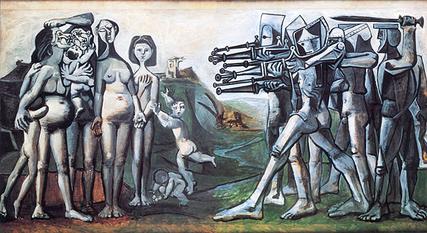
At the height of the Cold War, following the invasion of Korea, the US also decided to set up a commission of investigation in 1951 which unanimously approved the Nazi version of the events at Katyn. Again this happened against the background of several massacres that took place in South Korea at the hands of a puppet army set up by the US, incorporating elements who had previously cooperated with the Japanese. Large scale massacres against civilians occurred at Jeju island in the extreme South (1/5 of inhabitants killed, 80,000 dead in 1948-9), plus the Bodo League Campaign (anti-leftist re-education, a euphemism for butchery), claiming victims across the whole country. In 1950, there were up to 200,000 dead, all assumed to be communists. The war itself cost the life of nearly 4 million Koreans, mostly through aerial bombing and artillery. The US, with boots on the ground, actively participated or acted as observers during those atrocities. These were largely unreported by the West, but Pablo Picasso reacted by producing one of his most politicised paintings (“Massacre in Korea” a permanent exhibit at the Musée National Picasso in Paris – see above), which is universally seen as a condemnation of American warmongering.
In 1990 the Gorbachov government of the Soviet Union, just months away from its dissolution and the installation of the openly anti-communist Yeltsin as Russia’s head of state, started to provide documents from the state archives whose authenticity is today still heavily contested by large sections of lawmakers and the Russian public, which supposedly involve Beria and Stalin in ordering the Katyn massacre and acknowledge ultimate Soviet responsibility for it. This was ratified by the Duma in 2010.
As bullets embedded in the craniums were not so easy to forge as documents are, a rather implausible story had to be constructed, to explain why only a restricted section of the Russian army would have had access to foreign ammunition when large quantities were impossible to obtain. Furthermore why were these German bullets distributed in one specific location instead of the entirety of the Red Army across the Soviet Union?
Gorbachov capitulated over this issue, as he did in many other ways, overseeing the collapse of socialism in his eagerness to restore capitalism and please the West. Thus it is quite obvious that these documents were forgeries. Apparently the orders were stamped as emanating from the CC of the ‘Communist Party’, rather than ‘Bolshevik Party’, as would have been the case had the documents genuinely dated from 1940.The former name was officially adopted on seals and rubber stamps only in 1952!
According to Nazi doctrine, a large section of the population of Poland was selected for liquidation, with only some 2,000,000 remaining to be enslaved. Hitler repeatedly emphasised that the inferior Polish Slavic intelligentsia should have been annihilated, and here lies the admission and real motive for this massacre. These facts emerged at the Nuremberg trial in relation to a letter by Martin Boorman to H. Frank, governor of Poland, expressing the Führer’s wishes.
A similar false-flag pattern took place more recently in Bucha in Ukraine in 2022, and similar inconsistencies were found, proving the similarities of the Nazis’ intent and propaganda, to our own contemporary Western version, which in the case of Katyn, has always been intrinsically linked.
Apart from the obvious diversionary tactics employed by both the German Nazis and the US in trying to cover up massacres on a much larger scale than Katyn (the Ukrainians alone killed 100,000 Poles in Volynia 1941-1944), one of the most important factors to consider, often overlooked in this chain of events, is the Western reliance on a supposed ‘commission of investigation’ that should have long been declared non-valid, devoid of legitimacy, mainly on the basis that it was set up and headed by proven sadistic child killers, proponents of eugenics and war criminals, whilst supported by Nazi collaborationist nations, which the West was only too eager to echo from the outset in its shared war against socialism, in spite of its supposed alliance with the Soviet Union.
The initial acceptance by Poland, the conjoined European fascist bloc plus the US and subsequently the revisionists in Russia, of the veracity of the statements from such a ‘commission’, amounts once again, to a form of rehabilitation of the Nazi mass murderers and a betrayal of the victims, which is also a recurring theme in Europe today. This serves the underlying and fundamental imperialist agenda: the quest to fight the working class and the only path to the latter’s liberation from wage slavery: revolutionary overthrow of capitalism and the establishment of a workers’ state. In a word: Communism.