Fight the dismemberment of Sudan – Part 2
The woman question
Dr Himmat explains: “Historically, the status of women in Sudanese society was very low. They worked in the home and in agriculture. Sudanese communities in all parts of the country were extremely conservative so even in more developed regions, women were rarely given the chance to drive cars, work in the public and private sectors, enter schools and universities, join political parties, or be singers. Most of women just stayed at home occupied with domestic duties.
“When the SCP was established very few women received any formal education and this was limited to the daughters of elites in Khartoum and other major towns in Sudan. As the SCP saw itself as a liberation movement for both men and women, the SCP leadership showed a great deal of interest in recruiting women and girls to its ranks. However, strategies for recruiting women were confronted with many difficulties. First, religion and customs prohibited women from mixing with men. Secondly, a woman’s status at the time was largely confined to household activities. Furthermore, the Sudan was an underdeveloped society where people depended on a subsistence economy, which laid heavy burdens on women.
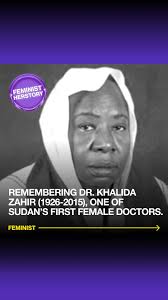
“Despite these difficulties as regards the non-educated classes, the SCP was able to recruit a small number of leading educated women. For example, Dr Khalidah Zahir was the first female medical student, first woman to organise women to participate in politics and trade unions and the first to lead a demonstration in 1940s. Dr Zahir, as a SCP activist, established with other young women a party women’s association and began to recruit girls in secondary schools and at the university to the women’s association. Dr Zahir was also married to the brother of the Secretary General of SCP, which enhanced her status in a male dominated party. Another prominent women leader was Fatima Ahmed Ibrahim. She was a daughter of a religious judge and a sister of prominent communists. Her brother, poet Salah Ahmed, was a leading figure in SCP. Fatima became the Secretary General of the Sudanese Women’s Union, a progressive women’s organisation, which was a coalition between the communists and democratic activists. She was member of the Central Committee of SCP and President of International Women’s Union until 1994. Fatima was married to the Secretary General of the Labour Union Association, Mr Shafie Ahmed Al-Sheikh. As can be seen from these examples, family connections played an important role for aspiring women activists and leaders.
“Both these women held opinions on politics and religion that complemented those of their male counterparts successfully combining Islam and the struggle for socialism in their practice. In an interview Dr Zahir explained: ‘Islam is not against women”.
In fact, the practice of FGM, which is still rampant in Sudan, is prohibited by the Koran itself, but was inherited from pre-Islamic slave society perhaps to discourage promiscuity that might spread disease; but then from female slaves the practice was extended hundreds of years ago to women generally and was absorbed into the practices of the Sufis so that it became accepted as an Islamic duty. So on this question too it is possible for atheists and Muslims fervently to agree. The Sudanese Sufis, who regard religion as a personal matter, generally had less of a problem with supporting communists than the more coercive sects – especially the Muslim Brotherhood!
In anti-imperialist movements where the national bourgeoisie is in de facto alliance with the proletariat against foreign imperialism that is stifling bourgeois ambitions, religion tends to play a large part, as the bourgeoisie relies on it to keep the proletariat under its control. In these cases it is actually the duty of the communists to safeguard the unity of the anti-imperialist movement that would certainly be compromised by atheistic proselytization. Religion must largely be left to ‘wither away’ when people begin to realise for themselves that they have no longer have any need of it.
Restoration of democracy in 1964
Following the resignation of the military regime, elections were held in 1965 in which the PDP and Umma once again emerged victorious, with Muhammad Ahmed Mahjub being appointed President. In the same election, the SCP was able to secure 12 seats out of 233 in the newly elected parliament, a great improvement on the single seat it had been able to secure in the 1950s. Modest though this tally was, it caused great alarm among the reactionary forces, and the Muslim Brotherhood mounted a campaign against the Party claiming that one of its members had insulted the prophet during one of his speeches. Mobs were mobilised to attack the party headquarters and all 12 communist MPs were expelled from parliament and the Party was banned, all of which was egged on by US imperialism through its Voice of America broadcasts.
None of this, of course, alleviated the economic mess in which the new government found itself, or the civil war that was further bankrupting it.
There was no inflow of foreign capital at all between 1964-5, and Mahjub resorted to the Magic Money Tree. He gave generous credit to agriculture, increased development spending, used credit controls and protectionism to try to defend foreign reserves. This caused inflation, which brought about the downfall of Mahjub in 1966.
He was replaced by Sadiq al-Mahdi whose government in turn lasted only a year, and Mahjub was brought back in 1967. But again he had no answer to the country’s severe problems. He did, however, break diplomatic ties with the US and divest from the dollar in protest at Western support for Israel in the 6-day war, even though the resultant withdrawal by the US of promised capital aid added significantly to his economic woes. Nor did he devalue the Sudanese currency as he felt the country could not afford to pay more for essential imports.
Still the protests continued, and in 1969 the army intervened once more to depose the civilian government, putting Jaafar Nimeiry in as President. While Nimeiry and the SCP were initially tactical allies after the 1969 revolution, deep fractures emerged over Sudan’s future. The SCP strongly opposed Nimeiry’s plan to federate Sudan with Egypt and Libya. They feared that joining a union with Muammar Gaddafi (who was virulently anti-communist) and Anwar Sadat would lead to their permanent marginalisation or persecution. The communists pushed for a national democratic revolution with greater autonomy for the South, while Nimeiry’s faction leaned toward Nasserist Arab nationalism and centralised military rule. Nimeiry demanded that the communists should disband their party and join a new one-party set up by him, the Sudanese Socialist Union, which of course the communists refused to do. In February 1971, Nimeiry officially banned all communist-affiliated mass organisations and arrested the party’s central committee.
In response, communists in the Sudanese Army, led by Major General Hashim al-Atta led a coup that ousted Nimeiry, but al-Atta was able to hold on to power for only 4 days. With every support from imperialist interests, and assistance from Egypt and Libya, al-Atta was overthrown and immediately executed along with his supporters. Repression of the communists was stepped up. Thousands were killed and thousands more fled the country.
US and European imperialists were delighted with Nimeiry’s anti-communist crackdown and eagerly stepped in to help his regime with loans and haircuts on existing debts. Flush with imperialist money (albeit that it was repayable with substantial interest) Nimeiri was able to negotiate a peace settlement to end the first Sudanese Civil War in 1972 and establish a federal state.
By 1977, however, Sudan’s external debts had doubled twice since 1972 (from $361m in 1974 to $895 m in 1977. This increase was caused by (1) a fall in world prices of cotton, (2) high interest rates, (3) the oil price shock and (4) expenditure on attempted diversification. The result was that the country in 1979 defaulted on its debts and was forced to turn to the IMF for help, which of course was only available on the basis of a swingeing Structural Adjustment Programme. This involved massive devaluation of the Sudanese currency – a disaster for a country that needs to import technology in order to maintain production – as well as fiscal austerity and reduced subsidies that caused a 1% fall in GDP between 1978 and 1981, leaving the country in constant need for refinancing and totally at the mercy of creditor countries, in particular the US. This meant, for instance, that Sudan could not break off relations with Egypt when in recognised Israel in 1978.
Needless to say, the harsh austerity gave rise to local unrest. To counter this Nimeiry turned to religion, not so much personally but at a state level, in order to co-opt the (Sunni) Muslim Brotherhood in his support as an instrument of coercion. He integrated Sunni Islamists, including their eminence grise Hassan al-Turabi into his regime.
While remaining strongly allied to the United States, he enacted in 1983 what are known as the September Laws that adopted Sharia which included sanctions like public amputations and corporal punishments. The Muslim Brotherhood supported this, aiming for a complete Islamic state.
It turned out to be quite an own goal! The laws were opposed by most other political forces in Sudan, including the Sufi leaning Ansar and Khatmiyya, and they contributed directly to accelerating the start of the Second Sudanese Civil War between the north and the south in 1983.
Fearing the growing power of the Brotherhood, Nimeiry turned on them in 1985, jailing hundreds of members, including Turabi, shortly before his own downfall.
It all came too late. The country was facing economic disaster that led to default on repayments to multilateral lenders (the IMF and World Bank), causing further loans to be denied. In 1985 the US suspended $194 million in aid. USAID forced on Nimeiry a 48% currency devaluation and also mandated the reduction of subsidies for petrol, bread and sugar. The results were predictably mass protests, student protests attacked by troops. Finally senior army officers turned against Nimeiry and deposed him.
Transitional government
From 6 April 1985 the country came under a Transitional Government led by General Abd al-Rahman Sawar al-Dahab. Its debts now stood at $8.6bn, and the cost of servicing them was spiralling with the addition of fees and interest charges. The country had no money to pay for the importation of essential spare parts for its productive machinery and other production related imports. It was totally dependent on ‘aid’ from imperialism, that rose from $116m p.a. (1979-84) to $331m p.a. (1985-7), which in turn was dependent on total servility to imperialism.
Return to civilian government
What a poisoned chalice faced the next elected government chosen in elections that took place in April 1986! The leading contenders at this election were the Umma Party, the Democratic Union Party (principally consisting of the re-constituted unity of the NUP and the PDP, with the addition of Ismail al-Azhari’s urban nationalist Ashigga Party) and the National Islamic Foundation (i.e., the Muslim Brotherhood). Once again the Umma emerged in first place, but formed a government on the basis of a coalition with the DUP. Two years later the NIF was brought into the coalition as well, but was pretty soon ejected. The leader of the Umma party, Sadiq al-Mahdi, became president.
The dire economic situation, the continued protests of the masses, the persistent demands of the IMF for subsidy reductions, the negative effects of being required to reduce the exchange rate of the Sudanese pound from 2.50 to 4.50 to the dollar, were simply impossible to deal with. Dependent on Western ‘aid’, al Mahdi was bought and paid for. He tried to negotiate peace with the southern rebels in order to gain some economic respite, but this annoyed the army which rebelled and overthrew him on 30 June 1989.
The military government of Umar al-Bashir
Bashir was a member of the Muslim Brotherhood firmly committed to the principle of aligning political Islam with state power – in other words use of religion to secure political coercion. He favoured the one-party state and was, of course, virulently anti-communist. He set up the Revolutionary Command Council for National Salvation (RCCNS) immediately following the 1989 coup, suspending all other political parties until it was dissolved in 1993. He was a fervent nationalist and in that capacity he initially took an anti-imperialist position on a number of issues. The downside of this nationalism was refusal to countenance any compromise that might put an end to the civil war with the South. But his government had an independent foreign policy: opposed Western intervention in Iraq, supported Palestine, and supported anti-imperialist movements including Hamas, Hezbollah, al-Jamaa al-Islamiya (Egypt) and Front Islamique (Algeria). It offered shelter to individuals on imperialism’s hit list, including Bin Laden and Carlos the Jackal (a PFLP Marxist-Leninist).
However, the continuing civil war kept draining the coffers while his anti-imperialist positions ensured that Western funding dried up, forcing him into imposing ever greater austerity on the masses, leading first to protests and then to savage repression of the protesters.
In 1993 the US listed Sudan as a state sponsor of terrorism (SST) on the basis that it was providing a safe haven for terror groups. The designation automatically gave rise to sanctions, thereby frightening off potential investors. With Bashir by now desperate for sanctions relief, Carlos the Jackal, Osama Bin Laden and various anti-imperialist organisations were expelled from the country – but all to no avail. In 1995 an attempted assassination took place of Egyptian president Hosni Mubarak, in which various Sudanese individuals appeared to be implicated, giving the excuse to impose further sanctions on the government. In 1996 the UN Security Council passed Resolution 1044 which condemned Sudan for its role in the attempt and demanding the extradition of three suspects believed to be hiding in the country. Sudan failed to comply and in 1997 the US imposed further unilateral sanctions. In 1998 it went even further and bombed the newly built al-Shifa pharmaceuticals factory. This was a further deterrent to foreign investment in Sudan, making sure that it stood no chance of ever building up its economy sufficiently to have the means of working towards ending its debt servitude.
In 1998 Bashir was ready to ditch the policy of providing a safe haven to anti-imperialists, bringing him into conflict with Hassan al-Turabi, his Brotherhood mentor, whom he removed from office and put in prison. The economic situation being totally out of control, he tried to make plans for a return to civilian rule.
With this purpose in mind, in 1998 he founded the National Congress Party (NCP) which was the dominant and often sole legal political party during his rule until it was banned in 2019. Under al-Bashir’s leadership, the NCP maintained a supermajority in parliament, winning heavily criticised elections in 2000, 2010, and 2015.
In 2003 Bashir’s government was faced with the rebellion in Darfur, sparked by legitimate grievances of the local non-Arab population whipped up by el-Turabi through the Justice and Equality Movement in which he was influential, but magnified by imperialism seeking to make use of these grievances to support a separatist agenda that would facilitate imperialism taking effective control of Darfur’s oil. The rebellion was put down, but at great cost. Especially significant was the creation and deployment of the Rapid Supply Force in the conflict. The RSF was put together from local pro-government militias tasked with trying to enforce peace. In lieu of paying the troops, the local gold mining business was handed over to it – which ultimately turned out to be a disastrous decision. The RSF leader Dagalo, the uncouth son of local camel traders, regularly evaded his obligations to the Sudanese state and built up an economic empire of his own within Sudan, trading gold to foreign markets.
In 2005 peace was finally concluded in the civil war with south Sudan. It was agreed that income from the oil fields would be split 50:50, that there would be a referendum on secession in 2011, and in the meantime the south would have a high degree of autonomy. In 2011 the south voted to secede and the separate state of South Sudan was set up.
The peace agreement nevertheless meant that there was a big drop in Sudan’s oil income necessitating … austerity. Then in 2013 civil war broke out within South Sudan, bringing oil production, and Sudan’s oil income, to a halt. The further austerity measures this necessitated led to big demonstrations against that were violently suppressed, with hundreds arrested, especially CP members.
Locked out of commerce with the West, Bashir turned towards Iran and China. Back in 1999 the Chinese had bought a stake in a company building a pipeline from southern Sudan to the Red Sea for the transportation of Sudanese oil. France also engaged in some sanctions busting.
Two decades of US sanctions effectively isolated Sudan from Western markets, allowing China to become Sudan’s most influential economic and political partner. By 2017, China had invested nearly $6 billion in the country and dominated its oil and infrastructure sectors. Moreover, Sudan’s location on the Red Sea made it a vital part of global trade routes. The US became concerned that continued isolation would allow China further to solidify its Belt and Road Initiative footprint in the region, particularly regarding port development. The consequence of this was that first under Obama’s presidency and subsequently under Donald Trump, the US finally decided that Sudan had done enough in terms of countering terrorism, etc., for sanctions to be eased significantly, though it was still designated as an SST. That label remained in place until 2020 when Sudan was strongarmed into recognising Israel.
Following the easing of sanctions, the IMF issued a report as part of its Article IV Consultation, a mandatory annual ‘health check’ for all member countries. This created a ‘unique opportunity’ for the country to re-engage with the global economy. It was, of course, all about what imperialism could now get out of Sudan, not really how Sudan could recover from its economic failure. The report claimed that Sudan’s financial problems were largely caused by subsidies for wheat and fuel, and made any financial support conditional on their removal. The IMF’s austerity recommendations when implemented made the economic situation far worse, as did the currency devaluations that it mandated. Huge protests ensued spearheaded by the SCP. Demonstrators began demanding political as well as economic reform.
“In the run up to the revolution, Sudan’s youth leaders linked up with the unions of physicians, pharmacists, lawyers and secondary school teachers. The Sudanese Professional Association (SPA)—a network of parallel (or unofficial) trade and professional unions composed of doctors, engineers and lawyers among others—took the lead in organizing and scheduling the protests. In late December 2018, they called for a march to the parliament in Khartoum, demanding the government raise public sector wages and legalize the informal professional and trade unions. After security forces used violence against peaceful protests, their demands escalated into the call for the removal of the ruling National Congress Party (NCP), the structural transformation of governance in Sudan and a transition to democracy.
“Their demands echoed those of previous popular protests, including in 2011, 2012 and 2013. But the 2018–19 protests were unprecedented in terms of their length and geographic breadth. They also followed a remarkably new, innovative and sustained process. Demonstrators learned from the mistakes of previous protests, which were highly centralized, mostly limited to middle class Sudanese and lacking in strategies for confronting the state’s ubiquitous security forces.
“Led by the SPA and organized at the level of the street by youth-led neighborhood resistance committees (NRCs), the demonstrations were coordinated, scheduled and essentially designed to emphasize sustainability over sheer numbers. The protests were also spread throughout middle class, working class and poor neighborhoods, and there was coordination with protestors in regions far from Khartoum, including the states on the Red Sea, to the east, and Darfur, to the far west of the country.
“Beyond the regional scale, the protests were also distinguished by never-before-seen levels of solidarity across class and ethnic lines. Youth activists and members of professional associations not only challenged the political discourse of the Islamist state, they played a significant role in engineering cross-class alliances in the context of these demonstrations. The slogans they used were designed to resonate and mobilize support across ethnic, racial and regional divides.
“Over the course of the six-month long protests, strikes, work stoppages and sit-ins were held, not only on university campuses and secondary schools, but also among private sector and public sector workers. Among the most important examples were the strikes by workers of Port Sudan on the Red Sea, demanding the nullification of the sale of the southern Port to a foreign company, and several work stoppages and protests led by employees of some of the country’s most important banks, telecom providers and other private firms” (Khalid Mustafa Medani, ‘The struggle for Sudan’, Middle East Research and Information Project, 16 April 2024).
Controlling the demonstrations required mobilising the army. But the army refused orders to fire on protestors. Instead in April 2019 it deposed Bashir.
Reflecting on Bashir’s time in office, it certainly established that the Muslim Brotherhood, even though nationalist, cannot effectively lead an anti-imperialist struggle. At the heart of this inability lies its implacable hatred of communism as the representative of the interests of the working class and oppressed. The Muslim Brotherhood’s purpose from its very inception was to counter the rise of communism. It is a bourgeois organisation that is totally unwilling to make any significant concessions to the interests of the labouring masses beyond charitable works. It works on the principle that by religious and physical coercion, and even the availability of charity, the masses must do as they are told. It is a recipe that collapsed in disaster with Bashir’s gradual surrender to imperialism ending in his downfall. Where the proletariat is not strong enough to take the leadership in a country’s anti-imperialist struggle, and that leadership is therefore in the hands of the bourgeoisie, the latter must nevertheless be prepared to make sufficient not just economic but also political concessions to the interests of the toiling masses, to maintain their support. This the Muslim Brotherhood entirely failed to do.