The Battle of Walkley, Sheffield 1922
Its summer 1922, the post war recession is biting hard in Sheffield with 49,000 on unemployment benefit and thousands more having exhausted this and scraping along on poor relief, the working class are under tremendous pressure from all directions
Harold Cundy was one such man. Laid off in 1921, he lived with his wife and two children at 8 Court, Providence Road, Walkley. In the spring of 1922 their landlady started proceedings to get them evicted claiming rent arrears. Both their children were suffering from measles, so a friendly doctor helped obtain a postponement over the Whitsun holidays, but on the morning of Wednesday 7 June a PC Tippitt arrived with bailiffs to remove their very few possessions which was completed in minutes.
In shock at this happening the Cundy’s took stock of their situation, Annie, his wife took off to find alternative housing while Harold went to find Arthur Butcher, an unemployed engineering worker and newly elected Labour councillor. He was also a supporter of the CPGB (Communist Party of Great Britain – Britain’s original communist organisation) and their unemployed union, the NUWM (National Unemployed Workers Movement). The established policy of the NUWM was in such cases to oppose by direct action such evictions by taking control of the street and moving the evicted belongings back into their abode. Speaking outside Crookesmoor vestry hall to a growing crowd Butcher said;
“This is dirty work. We have a big unemployed organisation here in Sheffield. We are not going to allow the authorities to turn a man out into the street who is unemployed. We are going to march from here to West Bar. We shall pick up more on the way. We are going to protest to the authorities against turning a man out of his house. If they don’t let this man, his wife, family and goods go back into the house, I for one will put them back in defiance of the authorities”
Eventually 300 men set off to West Bar, on the way several hundred more joined from the Kelvin area. They were joined by laid off workers/CPGB members including Alfred Haydock and Albert Smith. On Tay street once more Butcher spoke to the crowd, by now nearly a thousand strong;
“I have a matter to bring forward to you. It relates to a man named Cundy who has been ejected from a house at Walkley. This could have occurred to any one of us. I feel so strongly on this point. I suggest we march in a body to Walkey and put the furniture back”.
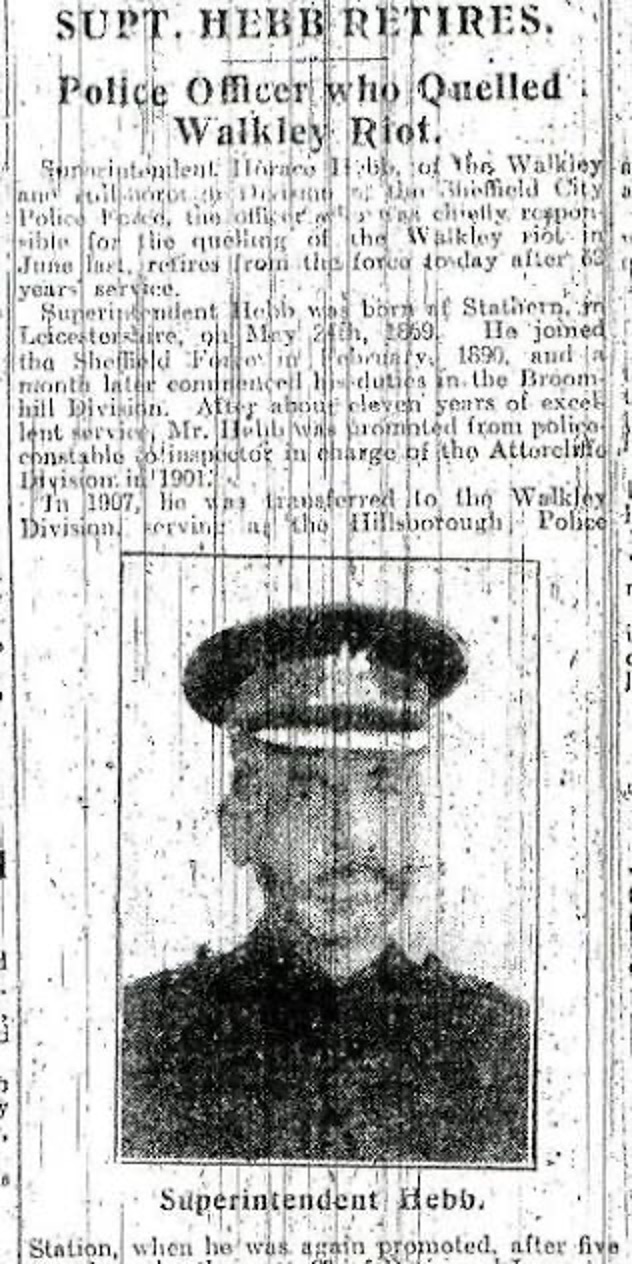
Off they marched, eventually arriving back on South Road. An eyewitness described a human tide of angry men, five or six abreast surging down Providence Road to 8 Court, There however waited a Superintendent Hebb and an advanced party of police to uphold bourgeois property rights – or should that be exploitation rights? Sheer weight of numbers however made theirs an impossible task, as soon nearly 300 men were in the yard area alone. Superintendent Hebb reminded the crowd of the ‘illegality’ of their interference. The men took no notice, the police were asked to leave. Butcher again:
“Now men, you know what you are here for. We are going to put this man back in his house. You have fought and bled in this war. This might happen to all of us. You know what happened. This man, his wife and family have been turned out of their home. They have got to get it back. I asked the Superintendent to take his men away and we will see no violence is used. He does not agree. If it means fight, we are going to fight”
A way was made through the crowd, two of the NUWM leaders Frank Horsefield and Charles Baker started the process of securing the house and moving the furniture back in. Horsefield once again reminded the police they were not wanted in the yard. At around this time the two Cundy children were brought forward on a mattress, at the same time another 16 police arrived some on horseback. Tensions were at boiling point. It seems initially there may have been a little pushing and shoving, with the police determined that any working class resistance had to be dealt with very harshly.
They advanced truncheons flying, followed by those on horseback with their typical ferocity that would still be recognised today. A dozen police were badly hurt, as well as at least 60 of the unemployed with four of them taken to hospital.
By early evening a calm of sorts had descended upon Providence Road. There were left upon the street stones, rocks, blood and the Cundy’s smashed furniture. The following day arrests started. The first man arraigned was George Grantham, an unemployed miner who was charged with riot. He was soon joined by twelve others. There was still anger and tension in the air. At every court sitting the police had to keep large crowds at bay, but on some occasions they gained entrance to the courtrooms and stopped proceedings.
Two days after the above hearing John Williams Baker died from injuries received at Providence Road, almost certainly from a heavy beating from a truncheon. He quickly became a political symbol and a martyr. It should be noted throughout all this the official Labour group either appealed for calm or asked for an enquiry!
The funeral of Baker was set for 29 June. It provided an opportunity for a mass demonstration of feeling. It was the largest political funeral seen in Sheffield since Chartist times. It began by the gathering of workers in the vicinity of his house at 183 Penistone Road. Fred Hollingsworth, a young moulder at Osborns foundry, described the scene,
“I saw the procession assembling at the bottom of Gilpin Street and saw it move off. It was led by Tom Pickering, the unemployed padre. He was in his vestments…Never has there been in Sheffield a procession of any dignity to compare with what that boy was getting. It was completely in dignity with what it was about, although of course it was used as a means of demonstrating the unemployed’s problems”
On an overcast summer’s day 2000 people set off in the procession bound for the cemetery. At the front was a cross bearing the words “in loving memory” was carried by members of the Attercliffe Unemployed Organisation. Prominent at the front of the entourage were many leading local members of the NUWM and the CPGB. By the time it reached City Road cemetery the march was joined by people along the way, it was around 2 miles long.
After the funeral there was a brief lull in court proceedings. Three men were convicted of riot serving either 1 or 2 months. Ruling class ‘justice’ had prevailed but, in what seems a calculated move to suppress any further conflict, charges against all the others were dropped.
Little is known of what happened to many of the people involved in the rent riot: some of the leaders such as Baker, Horsefield and Butcher stayed in politics, in the Trade unions, in the CPGB, some were later involved in the Labour party. Many years later an interview was made of the Cundy daughter. They later got a house on Douglas Terrace and her father returned to work.
Bill Moore, a local labour historian later wrote in a pamphlet for the Holberry society (from which much of this narrative has come). He said than in reconstructing the story of Providence Road we have recounted a story of defeat. That is undeniable; inspiring but undeniable. However, a year later the Workers Weekly carried a report of an attempt to evict a man with three daughters and a disabled son. The man was on a three-day week and the rent had gone from 6 shillings and sixpence to eight and six. He lived in one of the ‘huts’ on Tyler Street in Brightside, an area of great hardship where three quarters of the 760 tenants were on benefit or relief. The Communist party with the Provisional Unemployed Committee organised the tenants who forced the door of the’hut’ and replaced all the furniture. An evening rally the same day declared a rent strike. The agents backed off and came to an agreement.
So here is recounted a now virtually unknown glimpse of the brutal times the working class faced in the 1920s. One point to take from this is the influence and organisation of the CPGB and the NUWM. Despite its later trajectory, the CPGB at this time seemed to be aiming to be a party of and amongst the people.
Fast forward 100 years. Today the welfare state is being dismantled as is the NHS. Jobs are low paid and precarious. More people than ever today are at the mercy of private parasitic landlords. Labour Party Social democracy and the class peace of Keynesianism is a sham (and only introduced post 1945 owing to specific historical conditions); the Labour party is simply an arm of the state (always was) and needs to be destroyed. In some aspects of social affairs we are closer now to the 1920s than what we are to the 1960s. There is growing anger and restlessness, this needs to be harnessed and directed to those who truly wield the power in Britain today
“Let the ruling classes tremble at a communistic revolution. The proletarians have nothing to lose but their chains. They have a world to win. Workers of all countries unite!”