The ongoing Pakistan-Afghanistan war
Whilst most Western observers have remained focused on the US-Israeli imperialist war on Iran and its increasing consequences for the global economy, little attention has been paid to another ongoing war that broke out at around the same time, i.e., towards the end of February this year – the war between Afghanistan and Pakistan.
It is a war about which virtually nothing is reported in the British media, despite having given rise already to hundreds of civilian deaths and the displacement of thousands from their homes – on both sides of the border. In this war, the Pakistani side has the backing of US imperialism that is still licking its wounds from having been defeated militarily and driven out of Afghanistan by the Taliban. Most other countries, including China and Russia, are calling for a ceasefire and for peace talks to mediate the causes of conflict between the two sides.
Pakistan and Afghanistan have a few things in common: they are both conservative, near-exclusively Muslim nations in central/southern Asia. Arguably they both also share a somewhat uncalled-for highly negative reputation in the UK – in Afghanistan’s case this is due to years of chauvinist media propaganda designed to justify the 20-year US-UK occupation of Afghanistan, whilst in Pakistan’s case the negative portrayal stems from racist propaganda against the large Pakistani ethnic minority that call this country home.
However, despite frequently being lumped together by chauvinists as ‘Muslim terrorist countries’, in reality these two states have very different histories and societies. Afghanistan’s history is closely linked to central Asia and it consists of a myriad of different ethnic groups, the largest being the Pashtuns, closely followed by Tajiks.
The region was only briefly formally colonised by the British Empire (1839-1842) and fought a number of wars with the British successfully to retain a de-facto independence throughout the 19th century, although its rulers were forced to accept significant British influence over the government until 1919 when it secured full independence under a monarchical regime.
The monarchy lasted until 1973, when it was overthrown by an internal coup and a republican system was declared. In 1978, a Marxist-Leninist uprising led by the PDPA-Khalq took over the country and declared a socialist state aligned with the Soviet Union. A massive social upheaval followed and a counter-revolution quickly broke out at the instance of exploiter elements in the countryside opposed to socialist land reform aimed at distributing land to the peasants and outlawing usury. The exploiters were able to mobilise the deeply religious rural masses against what they presented to them as the rapid secularisation of the country. At the invitation of the elected Afghan government, the Soviet Union intervened militarily in 1979, replacing the PDPA-Khalq with the PDPA-Parcham (an opposing faction of Afghan communists that were more moderate/revisionist than the Khalq), whilst US imperialism seized the advantage and turned the rebel ‘mujahideen’ (Islamic religious warriors) into a cause-celebre, funnelling huge amounts of weapons and fighters into the conflict to try to overthrow the communists.
Throughout the ten-year conflict, the originally staunch Marxist-Leninist principles of the original 1978 revolution were gradually diluted as the government struggled to find a way of ending the civil war through compromise with its enemies. The Soviet army withdrew in 1989, having failed to defeat the rebellion, whilst the government abandoned all remaining references to Marxism in 1990. Following the dissolution of the USSR at the end of 1991, the socialist government finally collapsed and infighting between rival warlords wracked the country until the ultra-conservative Muslim ‘Taliban’ movement took control in 1996. The Taliban, while initially prepared to make deals with the United States, proved not pliant enough for Washington and were overthrown in the US imperialist-led invasion of 2001 and went on to fight a 20-year guerrilla war against the imperialist occupation, in which they ultimately emerged victorious following the final departure of imperialist troops in 2021. The United States spent $3 trillion fighting a protracted conflict in pursuit of its geostrategic aims. Afghanistan’s importance was both its geographical location as the lynchpin of the central Asian states which Zbigniew Brzezinsky referred to as the ‘Central Asian Balkans’ that he considered pivotal to the domination of the entire region. Its proximity to Russia, China and the central Asian republics and the oil-rich Caspian region gave it an importance out of all proportion to the seeming poverty of its people and apparent size of its economy. Mohammed Karzai, the puppet installed by the United States, was notorious for his corruption, as the proxy of the US army of occupation. The atrocities of the US and Nato forces were heinous and the only lasting legacy, aside from the astronomic profits of the military-industrial complex and the foreign debt of the US, has been under a deepening impoverishment of the Afghani people. Since 2021, Afghanistan has been run effectively as an Islamic theocracy led by the Taliban.
Pakistan, by contrast, is a very new south Asian country consisting of Muslims from across the former British Raj of India who were encouraged by imperialism to split off violently from India in 1947 and form their own Muslim-majority country. Despite the near-constant political tension with India, from a cultural, historical and linguistic perspective Pakistanis are much more similar to Indians than to any of their other neighbours.
In contrast to the tumultuous politics of its northwestern neighbour, Pakistan has retained the veneer of a relatively stable republican system since its inception in 1947. In reality, underlying this, there a de facto military dictatorship which has ruled the country from the day of its Independence to the present and dominates every aspect even of the civil economy. When the civilian administration step out of line, the apparent democracy is regularly punctuated by military coups. When Imran Khan made excessively anti-imperialist statements concerning the independence of Pakistan from Anglo-American imperialism, he was unconstitutionally removed from power, his party prevented from standing in elections which it surely would have won, and to this day he himself remains languishing in prison. The relative stability of Pakistan, aside from its status as a nuclear-armed regional power, is in all likelihood derived from the fact it has an elite class who are closely and comfortably intertwined with Washington, and this has been the case for most of the country’s existence. Pakistan consistently aligned with US imperialism during the Cold War and was the primary conduit for the weapons and fighters being sent to the mujahideen rebellion in Afghanistan during the 1980s.
Afghanistan’s strategic location, lying across key trade routes at the heart of central Asia and its rebellious and fiercely patriotic population, make it imperative for imperialism that the country remain in a constant state of disorder and turmoil, so that imperialism can continue to benefit from untrammelled access to the Afghan people’s land and resources.
It is worth noting also that the Afghan-Pakistan border (known as the Durand Line), like so many borders drawn up by imperialism in the late 19th and early 20th centuries, was deliberately designed to provoke future division and conflict by cutting Pashtun tribal lands in half, separating people from their families and ancestral lands. Successive Afghan governments have protested this issue and requested a review of the border, but all attempts have been stonewalled by the international courts, who insist that the lop-sided agreements forced upon the 19th century Afghan rulers by the British Empire must remain in force. This issue remains a further thorn in Afghanistan’s relations with its south-eastern neighbour.
In essence, Pakistan serves as a regional enforcer for Anglo-American imperialism, similar to the role played by some African countries like Rwanda, Kenya or Nigeria. Indeed, being a country whose very existence was essentially the result of a British imperialist plot to divide and weaken South Asian resistance to imperialism, it was perhaps inevitable that Pakistan would adopt such a role.
Understanding this role of Pakistan sheds a new light on the current situation. In February 2026, Pakistan launched large-scale strikes on supposed ‘militant camps’ in Afghanistan, claiming self-defence against an alleged terror threat from anti-Pakistan jihadist militants said to be attacking from bases in Afghanistan. Reports from Afghanistan suggested that a number of civilian targets were hit, and the Afghan military responded with tit-for-tat strikes against Pakistani military installations.
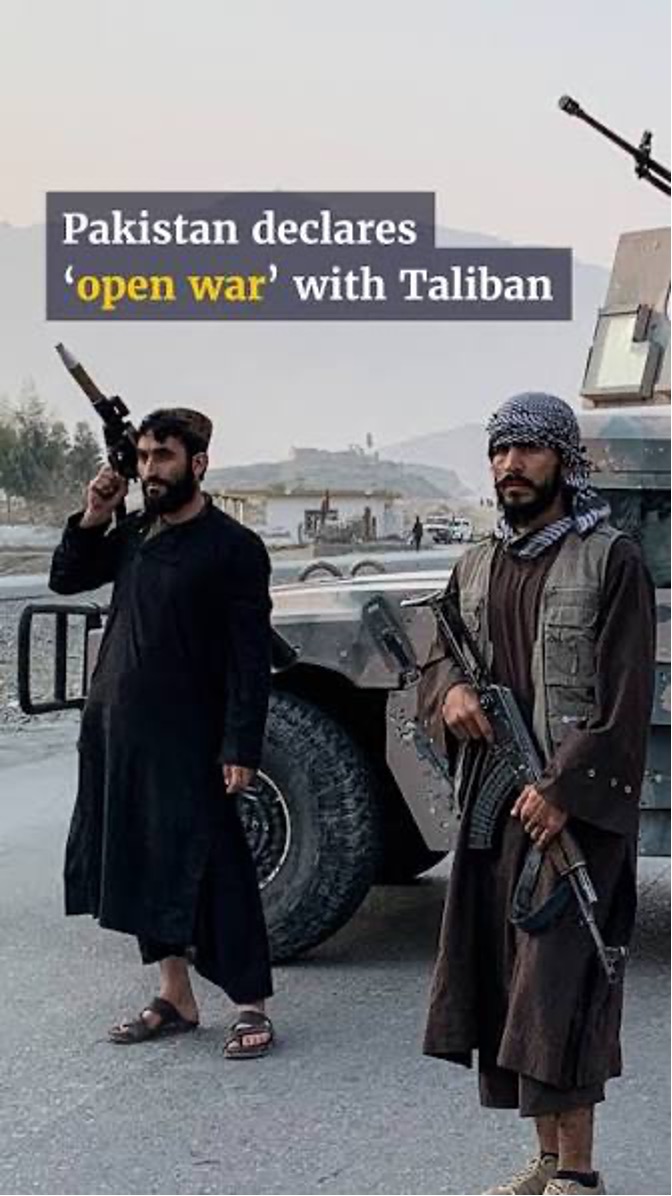
Fighting has since escalated, with Pakistan declaring ‘open war’ against the Taliban government. Since then, Pakistan has been launching near-continuous air strikes on Afghan soil, whilst Afghanistan hits back with drone and artillery attacks.
Whilst no Western country has openly backed Pakistan in the conflict, it is clear from reading between the lines that Pakistan has imperialism’s blessing in its bid to punish Afghanistan – a sovereign, fully independent nation run by a patriotic government that, whatever one may think of its ideology, did successfully inflict a humiliating defeat on the imperialists that the latter are thirsty to avenge.
The EU issued a statement calling for “de-escalation” from all sides, whilst specifically calling on Afghanistan to “to take effective action against all terrorist groups operating in or from Afghanistan” – in essence repeating Islamabad’s position on the conflict.
What little Western media coverage has been devoted to the conflict is noticeably slanted in favour of Pakistan. The Afghan side is routinely delegitimised and referred to merely as ‘the Taliban’, as if it is a mere rebel group rather than a sovereign national government (not unlike the delegitimisation of the Yemeni government as ‘Houthi rebels’). Little effort is made to search for the truth when Pakistani claims of striking ‘terrorist camps’ collide with Afghan insistence that mosques and civilian homes are being hit, whilst there is unanimous condemnation of supposed Afghan human rights violations like ‘forced recruitment by the Taliban’ – i.e., military conscription by a national government when the country is under attack, a policy that dozens of countries practise, including many European ones.
In a chilling resemblance to the Zionists’ actions in Gaza, a Pakistani air strike on 16 March struck a hospital and killed at least 269 people, according to the UN. Whilst receiving some limited coverage in the Western press owing to the sheer scale of the massacre, there was virtually no Western condemnation of Pakistan for committing such a savage war crime – a clear signal that this ‘Pakistani’ war is really an imperialist war outsourced to a regional lackey, much like the so-called ‘Saudi’ war on independent Yemen.
Another feature that characterises this war is the presence of non-state actors on both sides, particularly the Afghan side. Being an isolated and sanctioned country, Afghanistan cannot match the conventional firepower of imperialist-backed Pakistan. However, owing to the shared religious and ethnic bonds with devout Muslims in Pakistan, particularly from the Pashtun minority, many militant groups in Pakistan have actively taken up arms against their own country’s military in defence of the Afghan people.
Complicating the situation further, some of these groups are indeed groups that are historically associated with violent Takfiri ideology – one of the most prominent of these appears to be the Tehrik-e-Taliban Pakistan (TTP), a group historically associated with brutal mass-casualty terrorist attacks against civilians such as the infamous 2014 attack on a school in Peshawar – although some sources suggest the group may have moved away from such tactics following years of factional infighting and leadership changes.
On the other hand, Afghanistan’s various rump factions of imperialist-backed ‘freedom fighters’ led by apparatchiks from the former US occupation regime have refused to back the Taliban government in the face of the aggression, blaming the government for supposedly provoking the conflict. In addition, whilst no longer the major threat that it was a few years ago, the US-backed ISIS-K Takfiri terrorist group remains in the shadows, ready to be re-activated by its imperialist patrons whenever it is deemed necessary.
It is clear that the war between Afghanistan and Pakistan is incapable of benefiting either of them. Pakistan started the war but financing it will undoubtedly increase Pakistan’s debt bondage to its lenders, which even before the war was lying heavily and unsustainably on its economy. Although Afghanistan is better able to minimise its military expenditure, the wealth so squandered would be put to much better use improving the standard of living of its people. In the circumstances one cannot but conclude that Pakistan is being used as an instrument for US imperialism to wreak its revenge on an Afghan government that humiliated it.