Fight the dismemberment of Sudan – Part 3
The interregnum
Bashir was replaced by his Vice President General Ahmad ibn Auf who resigned after one day and was replaced by General Abd al-Fatah al-Burhan. The army set up a ‘Transitional National Council’ (TNC) on which the protestors were loosely represented by the ‘Forces for Freedom and Change’ (FFC), which comprised Umma, the Unionist Party, the communists, the Ba’athists and various social organisations. The FFC and the Military Council began negotiations. Meanwhile street protests continued apace and continued to be violently suppressed.
Negotiations led to setting up the ‘Transitional Sovereignty Council’ to govern the country until elections were held in 2022. Its executive body was the Cabinet of Ministers. All ministers were civilians except Defence and the Interior. The economic technocrat Abdalla Hamdok was appointed prime minister and fellow economic technocrat Ibrahim Elbedawi (ex World Bank) was appointed Minister of Finance.
General Abd al-Fattah al Burhan was appointed president, with Dagalo as de facto deputy.
It quickly became apparent that economic chaos could not be tackled without ‘reforms’ that would not be popular with the electorate, which caused both pro-Western and secularist civilians (the anti-Bashir faction) and the military to be less than keen on having elections as planned in 2022. They felt that elections would unduly favour the Muslim Brotherhood.
In the meantime, under the supposedly ‘civilian’ government, the economy was going from bad to worse. Early in 2020 in IMF Debt Sustainability Analysis calculated that Sudan’s debts stood at 200% of GDP, which IMF considered ‘unsustainable’. 86% of the debts had been contracted before 1984 and were no longer serviced. The remaining 14% had been just about manageable but that ceased to be the case after the IMF austerity measures were implemented.
The economic technocrats tried various measures to rescue the economy.
In June 2020 numerous state-owned companies were privatised and the state monopoly in the mining and export of gold (that was Hemedti’s source of power) was thrown open. This was dressed up as a measure against ‘corrupt’ state officials. Privatisation always favours the wealthy, in this case very much the all-powerful comprador DAL group that even Bashir had been forced to tolerate. DAL was close to the UAE.
In September 2020 Hamdok inaugurated a National Economic Conference to try to get consensus for austerity. He failed but went ahead to abolish fuel subsidies altogether, giving rise to a 400% increase in petrol prices and 500% in energy prices! The Economic Committee of the FFC drew up an alternative economic plan involving commercial and capital controls, price controls and increased regulation of foreign trade. It was simply ignored.
In return for being relieved of its State Sponsor of Terrorism (SST) status on 14 December 2020, Sudan joined the UAE, Bahrain and Morocco in recognising Israel – BUT in return Sudan had to agree to pay $335 million into a US Victims of SST fund for attacks on US embassies in East Africa in 1998 (perpetrated by Al Qaeda) – a third of Sudan’s banked external reserves. Needless to say there was no compensation by the US for the bombing of al Shifa.
Galloping inflation, bread shortage, a collapsing exchange rate. In January 2021, public spending slashed 24% while doubling defence expenditure, vertiginous devaluation of currency from 55 to 375 to the dollar! All in pursuit of debt relief! Protests grew in Khartoum but now they were supported by the military.
Finally, on 25 October 2021 the Transitional Government agreement was overthrown. Military officers arrested Hamdok and several members of the civilian government. Hamdok was briefly reinstated in November after protests ensued, but then resigned in January 2022. Throughout 2022 civilian participation in government was effectively at an end.
The Burhan/Dagalo regime and the end game
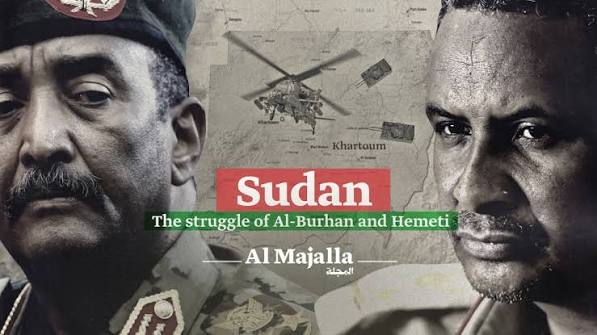
Within a short time of directly taking over the government in 2022, General Abdel Fattah el-Burhan, the new President, and Muhammad Hamdan Dagalo, his deputy and chief of the RSF, had fallen out with each other. Burhan was anxious for the RSF to be absorbed into the regular army under a single command, but Dagalo adamantly refused.
On 15 April 2023 the RSF and the Sudanese army came to blows and a brutal civil war ensued which continues to this day, and the consequences of which are tragic in the extreme. Not only have there been hundreds of thousands killed in the fighting, but millions have been displaced, and 25 million people are suffering from severe food insecurity. 4 million children are acutely malnourished, including 770,000 at imminent risk of death.
The stages of the conflict can be categorised as follows:
Heavy fighting began in Khartoum and Darfur on April 15, 2023. The RSF rapidly deployed throughout the capital, taking control of key infrastructure and residential areas.
The conflict escalated significantly beyond the capital, with rising violence in Darfur and the assassination of the non-Arab West Darfur governor Khamis Abakar by RSF militants in June 2023. The SPLM-N (al-Hilu) – a rebel organisation based in the Nuba mountains – became involved in clashes on the side of the RSF, and the conflict grew into a major humanitarian crisis. In July it seized several army garrisons and an oil field in South Kordofan and attacked Kurmuk.
However, the SAF secured the support of its former opponents in Darfur, Sudan Liberation Movement and the Justice and Equality Movement, because of their opposition to the RSF that had been responsible for massacres of the local non-Arab Darfuris during the earlier Darfuri uprising. For them the SAF was quite definitely the lesser evil.
Between October 2023–December 2023), the RSF made major gains, taking control of most of Darfur and crossing the Nile, while the SAF’s positions in the western region collapsed.
From January 2024 to March 2025, however, the SAF regained momentum, successfully retaking key neighbourhoods in Omdurman in early 2024. Throughout 2024, the army launched offensives in Kordofan and along the Nile, and by early 2025, they had retaken part of the capital and significant infrastructure, including the Al-Jaili oil refinery.
Despite SAF gains in the capital, the RSF captured the strategic city of El Fasher in Darfur in October 2025 after a long siege. As the citizens of El Fasher, members of the non-Arab Fur, Masalit and Zaghawa communities, have been deadly opposed to the RSF, the latter on taking the city engaged in a genocidal frenzy, killing at least an estimated 60,000 people. Analysis of satellite photographs suggests a figure of up to 150,000.
By early 2026, the war remained in a brutal stalemate, with intense fighting in the Kordofan region and widespread famine, displacing over 12 million people.
It will be noted that, despite strong opposition from the local communities, the RSF has been focusing heavily on taking control of Darfur. Why?
An Al Jazeera opinion piece from Mini Arko Minawi, the governor of the Darfur Region, entitled ‘A truce of separation’, published on 17 January 2026 is instructive. It was written in response to a US imperialist call for a ceasefire after the RSF had successfully captured el Fasher, the last holdout city in Darfur, and ethnically cleansed it of the communities most likely to continue to resist. The RSF, and its allies in the UAE and Libya were equally keen on a ceasefire, while the Sudanese government said it would continue to fight until the RSF was disarmed. Given the terrible suffering in the country, should the government be condemned?
When it is understood that the UAE and the RSF are fundamentally tools of US imperialism in its ongoing project of seizing control of Darfur’s oil production, with the added bonus of its gold mines, then it is clear that anti-imperialism demands resistance, which is what the Sudanese government and the SAF are providing. The aim of a ceasefire is to facilitate a division of the country, by carving out a US-controlled entity run by the RSF in all the best wealth producing areas of the country. Sudan would be left with just its enormous debts, the means of repaying them simply confiscated. The new entity would inherit all its most productive facilities. Genius!
As Minawi says:
“Modern history is full of examples where humanitarian ceasefires transformed from de-escalation tools to preludes to fragmentation and secession. In Western Sahara, Libya, Somalia, Yemen, and South Sudan, ceasefires were not always bridges to peace; more often, they were transitional stages towards the division of states and the erosion of sovereignty.
“In the Sudanese context, specifically, Operation Lifeline Sudan launched by the UN in 1989 stands as a stark example of how humanitarian action was employed as a political entry point, eventually culminating in the secession of South Sudan through a referendum that followed a long process of normalising division.
“The current situation, however, is far more dangerous and complex. It does not involve a government negotiating with a political movement holding national demands, but rather an unprecedented scenario in which two parties both claim to represent ‘the government’ within a single state: The legitimate government of Sudan, on the one hand, and the RSF, seeking to establish a parallel entity, on the other.
“The trap of disguised political recognition
“Negotiation between ‘two governments’ within one state is not only unprecedented in Sudan; it represents a grave political trap aimed at extracting recognition of a de facto force under a ceasefire umbrella…
“A comprehensive reading of events suggests that this ceasefire is more likely to be an entry point for dismantling the Sudanese state than a bridge to saving it. It may lead to the entrenchment of division: Zones of influence, multiple armies, different currencies, parallel central banks, competing foreign ministries, and conflicting passports – a state without a state, and sovereignty without sovereignty”.
We would go further and suggest not that it MAY lead to entrenchment of division but that this would be its very purpose.
We have no choice but to call for victory to the Sudanese government given this scenario. There have in any event been many indications that the Sudanese military would like to return the country to civilian rule, but the most important thing is that there should be an undivided country to which civilian rule can be returned. Whatever the nature of the government of that country, however, the question of debt servitude to imperialism remains to be solved, which is one that requires the resolute unity of the anti-imperialist forces, something that to date has never been achieved in Sudan but the experience of other countries suggests can and must be achieved.