India’s cockroach revolt: from spontaneous anger to organised class struggle
By Carlos Martinez
On 15 May 2026, while hearing a case concerning fraudulent legal credentials, India’s Chief Justice Surya Kant remarked from the bench that “there are youngsters like cockroaches, who don’t get any employment and don’t have a place in a profession”. He backtracked the next day, insisting he meant only people practising law with fake qualifications. By then, however, the remark had earned wide notoriety on social media, where it was widely interpreted as a slur against India’s unemployed youth.
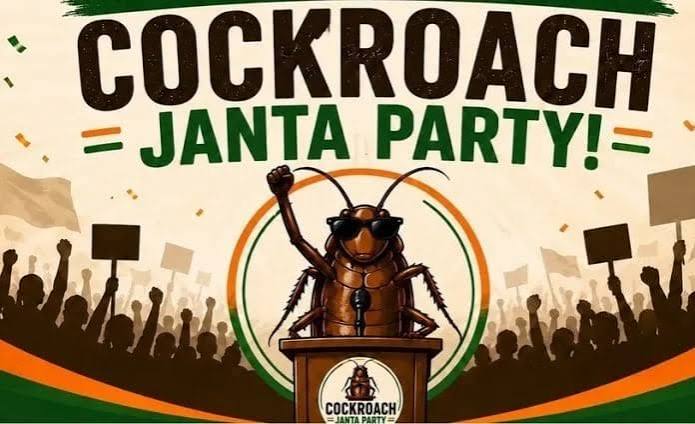
Abhijeet Dipke, a 30-year-old graduate born into a Dalit family, asked online: “What if all cockroaches came together?” Within 24 hours there was an Instagram page, a website and a manifesto. Ten weeks later, Minister of Education Dharmendra Pradhan resigned – the first cabinet minister forced out of Narendra Modi’s government in 12 years.
From meme to mass movement
The insult landed amid a major examination scandal. On 3 May, more than 2.2 million candidates had sat NEET-UG, the national medical entrance examination, competing for roughly 129,000 places (a ratio of 1:17). A chemistry teacher in Sikar compared a ‘guess paper’ circulating on WhatsApp with the examination and found around 140 matching questions. The test was cancelled and re-run. Investigators subsequently uncovered coaching operations charging between 200,000 rupees and 1 million rupees (i.e., between £2,000 and £10,000) for leaked material, along with evidence that the previous year’s examination had also been compromised.
Dipke’s page became the Cockroach Janta Party (CJP), whose name mocked the ruling Bharatiya Janata Party (BJP) and whose self-description – “Secular, Socialist, Democratic, and Lazy” – mocked the constitutional formula describing India as a sovereign socialist secular democratic republic. Membership was open to anyone unemployed “by force, by choice, or by principle”. Within days, its social media following overtook the BJP’s official account; by late July, it exceeded 20 million. The government responded on 21 May by ordering its account on X restricted on national security grounds.
Soon the Cockroach movement expanded beyond the internet. A mass protest at Jantar Mantar in Delhi on 6 June was followed by mobilisations in Pune, Lucknow, Bengaluru, Mumbai and Hyderabad. The Students’ Federation of India (SFI), which had been protesting since 12 May, helped carry the struggle into 23 states while advancing the wider demands to disband the National Testing Agency and scrap the National Education Policy 2020. The Centre of Indian Trade Unions and All India Kisan Sabha (peasant association) also sent delegations to the Delhi encampment.
Sonam Wangchuk, a Ladakhi engineer whom the government had previously detained for six months under the National Security Act, began a hunger strike on 28 June. Police removed him from the protest site on 18 July. Two days later, tens of thousands attempted to march on parliament. They were met with barricades, tear gas and baton charges. Protesters reported injuries from pellets. Mobile internet was shut down in central Delhi; when protesters moved to a Bluetooth mesh-messaging application, the Home Ministry secured its removal from the open source GitHub website within three hours.
By the evening, the crowds had regrouped amid the remains of the destroyed encampment. Five days later, the education minister was gone.
‘Gen Z protest’?
Much of the corporate media has described this as a “Gen Z revolt”, as though its politics could be explained by TikTok, memes and the particular psychology of people born after 1997.
Vijay Prashad observes that “Gen Z is a marketing category masquerading as sociology”, grouping together the daughter of an agricultural labourer and the son of a billionaire simply because they were born during the same period. “Generations do not sit for examinations, search for jobs, deliver food, or borrow money for coaching fees, but social classes do. The decisive question is not when these young people were born, but what kind of economic order they have inherited and what place, if any, that order has prepared for them” (‘The generation that refuses to crawl: Gen Z is a class struggle’, Aliran, 25 July 2026).
The movement has emerged from a stratum of young people that Indian capitalism has educated and then rendered surplus. The ILO India Employment Report recorded unemployment among graduates aged 15 to 29 at 29.1 percent – nine times higher than for those unable to read or write. Only 23.6 percent of Indian workers have a regular wage or salary; the rest are self-employed or engaged in casual labour. And a regular wage is not the same thing as a secure one: almost 90 percent of the workforce is informally employed, with no written contract and no social security. Meanwhile, real wages for regular workers stagnated or declined during the decade to 2022.
For educated young people, the labour market increasingly resembles a lottery with a huge entry fee. The Staff Selection Commission’s graduate examination in 2025 attracted 2.8 million applicants for 14,582 vacancies in the public sector: 192 candidates for each post. This competition for gainful employment has fuelled an exam coaching industry projected to be worth $23–26 billion by 2030. Working class and peasant families sell assets and mortgage land to meet the fees.
A leaked question paper is therefore not simply an administrative inconvenience. It can destroy an entire family’s plans and render its sacrifices meaningless. At least 13 students are documented to have taken their own lives following the leak; the CPI(M) puts the number at 22.
Meanwhile, India spends just 2.7 percent of GDP on education, against the 6 percent target set by the Kothari Commission in the 1960s and reaffirmed in the government’s own National Education Policy. (China, by comparison, spends 4 percent of GDP on education, and its GDP is almost five times higher than India’s).
The problem is not a lack of resources. The top 1 percent receive 23.3 percent of national income and own 40.1 percent of the country’s wealth – the highest concentration recorded since the series began in 1922. Corporate tax was cut from 30 to 22 percent in 2019; over the following five years, government revenue from individual taxpayers rose by 76 percent while revenue from companies rose by only 24 percent.
The exam leak scandal did not create this crisis, but it crystallised it.
A minister, not a policy
The students’ victory should not be minimised. For 12 years the Modi government had absorbed the protests of the movement against the flagrantly islamophobic Citizenship Amendment Act (CAA), the wrestlers’ protests and the 13-month farmers’ occupation of Delhi’s borders without losing a single cabinet minister. As CPI(M) general secretary MA Baby observed of the student protests, “the biggest takeaway from this struggle is the loss of fear. The GenZ has shown that the time to be afraid and shun away from struggles is over.”
Its loosely organised character made the movement difficult for the BJP to decapitate. Prabhat Patnaik notes that the ruling party is adept at isolating, buying, threatening and defaming leaders, but in this case there were few recognised leaders to target. Just as importantly, Jantar Mantar became something the BJP-aligned Hindu nationalist paramilitary groups have worked so hard to prevent: a site of common struggle among Hindus, Muslims, Christians, Sikhs and Buddhists, across lines of caste and region.
Achievements notwithstanding, however, what the government conceded was a head, not a policy. The education minister’s resignation was a tactical retreat, not a strategic shift. The government did not agree to dissolve the National Testing Agency, establish an independent ombudsman or judicial inquiry, apologise for the violence of 20 July, or withdraw the National Education Policy.
The promised compensation to bereaved families was reduced far below the 10 million rupees demanded, and remained unpaid at the time of writing in mid-August. An oral undertaking to withdraw cases against protesters was broken almost immediately: some 335 people were arrested in Bihar, more than a thousand were booked in Mumbai, and 14 were arrested in Kolkata – nearly all of them Muslim – on assorted trumped-up charges including attempted murder and “promoting secessionist feelings”, all of which is reminisccent of the charges laid by the British Raj against the nationalist movement before Independence.
Patnaik makes an important distinction between the cockroach revolt and the massive wave of farmers’ protests in 2020-21. The latter was an agitation by a specific social class in defence of its material interests, with demands that were necessarily institutional and concrete. The students’ movement was framed principally as a demand for honesty, fairness and accountability. Its programme was broad enough to spread with extraordinary speed, but too narrow to consolidate around specific objectives. Moreover it lacked a firm anti-capitalist understanding or a socialist programme.
Thus the revolt’s central contradiction: the problems it addresses are part of a class crisis, but its demands have not yet become a class programme.
A government of the ultra-rich
Modi’s treatment of young people cannot be separated from his government’s attacks on organised labour. In November 2025 it brought into force the four labour codes, aimed at weakening trade unions and diluting collective bargaining rights. The four codes were vehemently opposed by all major unions other than the Bharatiya Mazdoor Sangh – the primary trade union affiliated with the far-right Rashtriya Swayamsevak Sangh (RSS) paramilitary group. Meanwhile the central trade unions, backed by peasant organisations and the three main communist parties, called a general strike on 12 February 2026, with an estimated 300 million participants.
In every sphere, the trajectory has been to transfer wealth and power from labour, as well as the small and middle peasantry, to capital.
Furthermore, the BJP government has, for the most part, integrated itself into a Trumpian geopolitical agenda. After imposing punitive tariffs, the Trump administration secured major Indian concessions on Russian oil and purchases of US goods, then moved in July to dismiss the criminal case against the Adani group – doing a considerable favour for Modi’s closest corporate ally. And while countries around the world are distancing themselves from the genocidal Zionist regime, India has strengthened its ties with Israel, with Modi visiting Israel in February this year.
The need for militant class unity
The student movement, the labour movement and the peasant movement are aspects of the same struggle against brutal neoliberalism and capitalism in general. The unemployed graduate and the contract worker are frequently the same person at two moments of one life. The family mortgaging its land to pay coaching fees is a peasant family whose ability to pay depends on the price received for its crop. The lack of secure employment and the attack on employment rights both reflect Indian capital’s inability or unwillingness to provide dignified work.
The organisational bridges between these movements already exist. The Samyukta Kisan Morcha – a coalition of over 400 farmers’ unions, formed in 2020 – has called nationwide mobilisations from 26 November, calling for rejection and repeal of free trade agreements, including the proposed India-US trade deal; opposing electricity privatisation; opposing the four labour codes; demanding a legal minimum support price for government crop procurement; and backing student demands calling for accountability in national testing, compensation for affected student families, and changes to central education policies.
In July, the CPI, CPI(M) and CPI(ML) Liberation agreed to deepen coordination across the trade union, peasant, rural-labour and women’s movements. Student and unemployed youth should be drawn into such an approach.
It is inevitable that the Hindutva forces will attempt to divide this nascent mass movement along caste and religious lines. A united front proclaiming “we are all cockroaches” must be able to answer the attempt to turn upper-caste students against Dalits and other oppressed groups. It must defend reservations (setting aside a specific percentage of seats in government jobs, public universities and legislative bodies for historically disadvantaged and marginalised groups), resist the communal targeting of Muslims, and incorporate the demands of working women. Otherwise the social unity produced by a common grievance will be broken by the political machinery of Hindutva.
India’s young rebels have discovered their power. They have also discovered that a resignation is not a transformation. As Atul Chandra of Tricontinental writes: “Anger can remove a ruler, but only organised workers and students can decide what comes after… The cockroaches have learned to march; they must now learn to organise and rule” (‘The cockroaches have learned to march’, 12 August 2026).
Conclusion
What is needed is a stable and class-based alliance of workers and peasants, a socialist programme and a Marxist leadership. Every concrete step in this direction taken by the Indian masses is to be welcomed. The outmoded capitalist integument has kept India backward and poor for far too long. The creative genius of its people can only be released and deployed for the common good by following the socialist road.