Suspect wafer-thin majorities bring far right to power in Andean countries
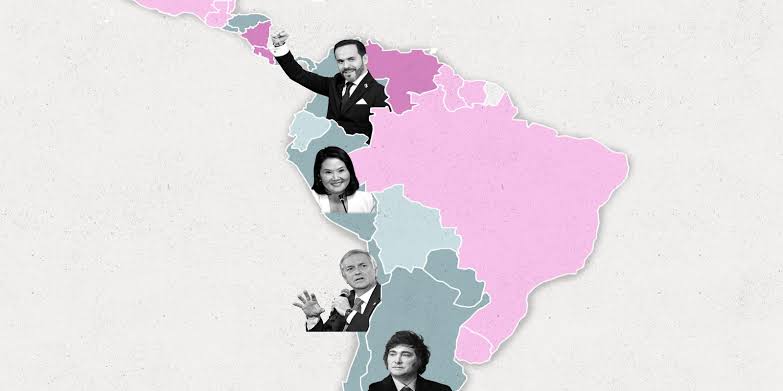
It was an outcome that working-class Peruvians found intensely difficult to stomach: in July, when at her fourth attempt, Keiko Fujimori, daughter of the late dictator imprisoned for crimes against his people, was elected president of the country.
Not by the 18 million voters living in Peru, however. There she lost by a mere 20,000 votes to her rival in the election run-off, Roberto Sánchez, leader of the social-democratic coalition, Juntos por el Perú (Together for Peru). But as luck would have it, she received the great majority – a highly unlikely eventuality – of the 70,000 votes cast by Peruvians living abroad and spirited back to Lima in diplomatic bags. Surely they couldn’t have been tampered with?
As The Times saw the inauguration of Peru’s tenth president in a decade:
“Fujimori’s victory marks the return of a polarising political dynasty. Although a four-time presidential candidate and long-time senator, she has repeatedly stressed that she is not simply her father’s daughter.
“Alberto Fujimori, who governed from 1990 to 2000, was a controversial figure. His supporters credit him with crushing the Maoist ‘Shining Path’ insurgency and implementing a thriving capitalist economy. His critics regard him as a tyrant. In 2009 he was sentenced to 25 years for human rights abuses, including authorising death-squad killings and kidnappings. He was released in December 2023 and died the following year, at the age of 86.
“His daughter has drawn on some nostalgia for the economic and security gains of the 1990s while distancing herself from the worst excesses of his regime, describing them as ‘errors’. She enters office with significant legislative leverage. Her Fuerza Popular (Popular Force) party is expected to hold the largest minority bloc in a newly bicameral congress. That foothold may offer greater room for manoeuvre, and less risk of impeachment, than her recent predecessors experienced” (Stephen Gibbs, ‘Peru joins Latin America’s shift to right as Keiko Fujimori wins power’, The Times, 28 July 2026).
The election campaign had been beset by allegations of vote-rigging, and Sánchez, the defeated candidate, was quick to contest the veracity of the result, refusing to recognise it but stating his willingness to engage in dialogue with the new president: “I am capable of meeting with any devil, as long as we achieve justice for our people, and if now is the time, so be it.”
Sánchez and other members of Congress from the Juntos por el Perú coalition had held up photographs of people who died in protests during the administration – from 2022 to 2025 – of unelected president Dina Boluarte, and walked out of the chamber before Fujimori’s inauguration speech.
“The country’s last general elections in 2021 resulted in the election of left-wing leader Pedro Castillo, who was arrested and imprisoned by the Peruvian National Police shortly thereafter with the diplomatic support of the US and its regional vassals…
“Earlier in July, a United Nations Working Group concluded that Castillo’s detention was arbitrary, finding multiple violations of his due process rights. Castillo is a left-wing former rural schoolteacher and union leader. Before being removed from power in December 2022, he promised to rewrite the Constitution to ensure that all Peruvians shared in the profits from the nation’s mineral wealth.
“Fujimori, in contrast, has been consistently backed by the leading imperialist power of the United States and its vassals, including Israel and Canada.
“Prior to her swearing-in, Fujimori held a video call with Israeli President Isaac Herzog, with whom she discussed strengthening bilateral co-operation. The Peruvian president had already received a call from Zionist war-enabling Foreign Minister Gideon Sa’ar” (‘Amid protests in streets and in congress, Keiko Fujimori assumes Presidency of Peru’ Orinoco Tribune, 30 July 2026).
While Castillo still languishes in jail, protesters gathered outside Congress to express their disgust at the rigged election result and Fujimori’s inauguration. There were clashes with police in Lima’s central Plaza San Martín – a familiar and recurring sight throughout Peru since Castillo’s abduction and imprisonment.
“This square belongs to the people!” they shouted, with an anger and defiance that has been constantly in evidence among workers and peasants since Castillo was deposed. As Fujimori intoned the neo-liberal canon about the importance of the free market, armed forces and the Catholic church, many of them would recall her father’s brutal repression of the Sendero Luminoso (Shining Path) guerrilla movement, and such policies as his campaign of forced sterilisation of campesinas in the Peruvian countryside.
A striking parallel
June also saw the election of the far-right Abelardo de la Espriella in Colombia’s presidential elections. The 48-year-old businessman – effusively endorsed by US president Donald Trump – defeated his leftist rival, Iván Cepeda, by just 250,000 votes, and his victory threatens to bring an end to the progressive, environmentally conscious reform programme of the outgoing president, Gustavo Petro.
De la Espriella, leader of the ‘Defenders of the Homeland’ party, secured 49.7 per cent of the vote in the run-off with Cepeda, the candidate for Petro’s Historic Pact party, who clocked up 48.7 per cent. Petro immediately called fraud, insisting that any declaration of victory by the right was “wishful thinking”, and suggesting that Israel had tampered with election machine software.
“At a press conference on August 3, Petro charged that more than 120,000 handwritten electoral documents sent to national electoral officials from 1,350 polling stations had been altered. Each polling station creates and fills out one such from, the so-called E-14 form, as a record of votes cast at each polling table.
“Petro indicated that he was relying on investigations carried out at the polling stations by 70,000 individuals with the assistance of 1,000 computer experts.
“The investigators allegedly discovered that individual votes had been changed at the polling stations, supposedly by partisans of De la Espriella officiating there.
“They found that out of 350,000 E-14 forms that were examined and scanned, more than 122,000 of them had had been ‘systematically re-processed, stripping them of their meta-data and digital security seals – the hash locks’ …
“According to Petro, the investigators discovered altered electoral rolls showing municipalities claiming more voters than residents. These were located in Boyaca, Santander, Antioquia and Cundinamarca departments, and also in the ‘coffee-growing axis’. These were precisely the regions that gave De la Espriella his lead of 251,000 votes…
“The former president suggested that Israeli cyber-intelligence firm BlackCore had carried out the electronic manipulation. He had earlier accused that firm of having ‘deployed 500,000 bots – fake profiles – to manipulate the Colombian electorate’” (WT Whitney Jnr., ‘Dark days for Colombia as Bogota turns hard right’, Morning Star, 15 August 2026).
The outgoing president maintained that the logistics and financing of this fraud involved foreign interests and resources, and that Colombia’s National Electoral Council lacked the technical tools to identify such anomalies in the software.
So enter Abelardo de la Espriella, who says he wants to reduce the state sector of Colombia’s economy by 40 percent over the next four years. His manifesto called for a ‘great revolution of de-regulation’ and promised to slash taxes, make Colombia a ‘country of homeowners’, attract more foreign investment to exploit its natural resources (oil, gas, minerals, water), and even replace the Colombian peso with the dollar.
But just a moment – is this the same Abelardo de la Espriella who is a citizen of the US, Colombia and Italy, who lived in Miami for ten years and only moved back to Colombia early in 2026? Who, as a lawyer, defended right-wing Colombian paramilitaries and politicians accused of corruption? Who donated to Donald Trump’s last presidential campaign and was an honoured guest at Trump’s residence in Mar-a-Lago?
More ominously for Colombians, De la Espriella is a lifelong friend and associate of a notorious right-wing paramilitary leader, Salvatore Mancuso, commander of the gun-toting United Self-Defence Forces of Colombia (AUC), and has close personal and political ties with the unsavoury Álvaro Uribe, Colombian president from 2002 to 2012, whose hands are steeped in blood from involvement with drug-trafficking and right-wing paramilitary violence.
So an absentee multi-millionaire who has never held public office is eased into the presidency, which by rights should have been claimed by Iván Cepeda, the Historic Pact’s candidate, a prominent socialist senator and campaigner for justice, and the son of Manuel Cepeda, general secretary of the Colombian Communist Party, murdered by paramilitaries in 1994. His would have been the task of consolidating the social gains achieved under the Petro presidency – Colombia’s first ever left-wing government – in the face of obstructive right-wing tactics in Congress. As well as having been subjected to the customary plethora of death threats during the campaign, it would appear that the left-wing presidential candidate was cheated at the ballot box too.
De la Espriella’s inauguration was warmly welcomed by Donald Trump, and the new president dutifully declared his loyalty, saying: “I want a Plan Colombia 2, and I want the US bases back”, referring to the plan which, on the pretext of a war on drugs, enabled Washington to station US troops in the country from 2000 to 2015, notably to combat guerrilla fighters. During his election campaign, De la Espriella promised to rebuild Colombia’s armed forces, destroy coca plantations and crush armed groups and cartels with the help of the US and Israel. He aimed to put an end to his predecessor’s strategy of ‘total peace’.
De la Espriella’s response to a severe earthquake on 10 August which left more than 300 people dead in Chocó province, including the cities of Cali and Pereira, was telling. He only accepted aid from the like-minded governments of El Salvador, Ecuador, the US and Israel.
He is also threatening trumped-up ‘corruption’ investigations against Gustavo Petro and Iván Cepeda, and is closing down institutions created to further the historic peace agreement reached between the Colombian government and the Fuerzas Armadas Revolucionarias de Colombia (FARC), the main popular guerrilla movement fighting for the rights of the Colombian people, in 2016. A taste, no doubt, of things to come.
The people hit back
Less than six months after Bolivia elected a right-wing president, Rodrigo Paz, ending twenty years of rule by the Movement for Socialism (MAS), the country’s capital, La Paz, was brought to a halt in April by an indefinite general strike called by the Bolivian Workers’ Federation (COB), which represents most of the country’s trade unions, with the support of various rural campesino groups. The capital was effectively cut off and under siege for two months, with workers and peasants demanding the resignation of Paz, whose electoral promises of social reform had predictably given way to the dominance of business interests.
“Having emerged from being a non-starter initially, he won the elections with the support of voters who had previously backed the MAS. He also benefited from the popularity of his vice-presidential candidate, Edman Lara, a former police officer who had come out against corruption in the force. The pair campaigned on seeking solutions to economic problems locally rather than incurring loans from abroad; a ‘capitalism for all’ designed to improve the lot of ordinary people; doing away with what they called the ‘obstructive state’ (Estado tranca); giving greater autonomy to local government, allotting them 50% of tax income; and opening up the country to foreign investment…
“Large-scale street protest has forced the government to backtrack on important matters on two occasions. First, the COB and campesino confederation (CSUTCB) came out in protest against Decree 5503. They forced the government to withdraw a package of proposals that, amongst other things, offered preferential terms to foreign investors as well as withdrawing fuel subsidies. Although the withdrawal of fuel subsidies was eventually accepted, the rest of the package was withdrawn. Second, under pressure from campesinos, a law, making small land holdings credit worthy (with their land as guarantee in case of not being able to pay), was repealed…
“Rapprochement with the United States has done little to enhance its [the government’s] popularity, particularly Paz’s presence at President Donald Trump’s Shield of the Americas meeting in Miami, at which far-right governments lined up to endorse Trump’s professed stand against organised crime and drugs trafficking. Bolivia also signed an agreement on critical minerals with the United States, including lithium. Under American influence, Bolivia has also not only recognised Israel, but is siding with it in votes in the United Nations” (Bolivia Information Forum, Bulletin no. 66, 19 June 2026).
Faced with a working-class mutiny which had severed supplies of food, fuel and transport links to the capital, Paz declared a state of emergency in late June, and succeeded in dissipating the protests which had come close to ousting him from power. Some leaders of the uprising were imprisoned or murdered – others were bought off.
The popular movement thought it expedient, given the climate of intimidation, to re-group and wait until the state of emergency expires in October before making another push for workers’ power.
An extraordinary event in late August is symptomatic of the government’s ruthless approach – Fernando Cerimedo, an Argentine advisor to President Paz who had formerly fulfilled the same role for his own extreme right-wing president, Javier Milei, was arrested and imprisoned in Bolivia on charges of trying to murder his estranged partner, Nadia Beller, a lawyer and activist, in order to silence her. Two would-be assassins had left her for dead, but she survived, and from her hospital bed she spilled the beans about a high-level plan involving Rodrigo Paz and his wife to plunder the coffers of the Bolivian state. A search of Cerimedo’s residence in Bolivia revealed a centre for producing bots to manipulate public opinion, and an extravagant stash of money. Corruption, and acquiescence to the dictates of the US government, would clearly appear to be the driving forces behind Bolivia’s current administration.
Meanwhile, the country’s indigenous former president, Evo Morales, remains holed up in the central Chapare region under the protection of his former trade union comrades. (Morales originally came to prominence as leader of the country’s coca-growing union – chewing coca leaves is a historic, almost hallowed, cultural tradition in Bolivia, and does not have connotations of growing the plant for producing cocaine). His supporters have no doubt that the government and its American paymasters would like to detain or assassinate him, but he continues to give weekly broadcasts on a local radio channel, and to defy the neo-liberal assault on the Latin American populace.
Although Morales parted company with MAS, the party he founded, after his three terms of office – from 2006 to 2019 – a recent Congress held in Chapare drew up to 50,000 people to a large stadium to create a new party, Evo Pueblo (Evo for the People) – a measure of his ongoing political strength. “The name reflects an obedience to the will of the people,” one Bolivian activist confided to Lalkar. “The people woke up politically with the governments of Evo Morales. If he was allowed to stand for president, he’d win with 60 per cent of the vote.”
The Bolivian authorities, and their American puppeteers, have been at pains to disqualify Morales from being a candidate for presidential campaigns in which they fear he would wipe the board.
At the end of July it was announced that the Bolivian government had reached a preliminary agreement with the International Monetary Fund (IMF) to launch a three-year economic programme backed by approximately $1.9 billion in loans. It raises concerns about possible cuts to public spending, the sale of strategic assets to multinational corporations, and prioritising the payment of external debt over investments in development.
It’s a powder keg for a country in turmoil, and whether President Paz will retain the political credibility to carry it through remains to be seen.
The conclusion from all of these events, especially when combined with the extraordinary kidnapping of President Maduro and coercion applied to Mexico and Venezuela to stop all oil deals with Cuba, as well as US Defence Secretary Hesgeth’s visit to Guantánamo bay to deliver a message that the Monroe Doctrine, the Truman doctrine and the Roosevelt Corollary are “in effect and stronger than ever”, are all signs that the USA is stepping up its colonial pressure, political and military stranglehold of the Americas. The ongoing spirit of revolt of the mass of Latin American people is also “in effect and stronger than ever”, and we shall not equate the fall of social-democratic governments to fascistic US puppets as the final victory of the US imperialists. Quite the reverse in fact.