Shifting sands in the Middle East
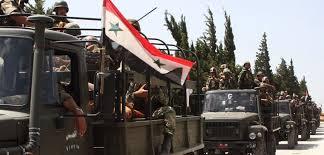
With jihadists and their imperialist backers holed up in Idlib province
there was a wave of media coverage in June as the Syrian Arab Army moved to
liberate the area. British and US diplomats and politicians along with the
corporate media were keen to frame the story as being one of a civilian
population under bombardment, with hospitals and so-called ‘de-confliction’
sites targeted by Russia. The reality, of course, is quite different, as
the beleaguered people of the area were stuck with jihadists and occupying
forces in their midst, who refused to withdraw as agreed.
On the ground
According to the western narrative, parts of Aleppo, Hama and Idlib are
supposed to be protected from a massive ‘regime’ offensive by a buffer zone
deal that Russia and Turkey signed in September. French broadcaster News 24
reported,
“[The Russian–Turkish buffer] was never fully implemented as jihadists
refused to withdraw from a planned demilitarised zone.
“In January, jihadist group Hayat Tahrir al-Sham (HTS) – led by a former
Al-Qaeda affiliate – extended its administrative control over the region.
“The Syrian government and Russia have upped their bombardment of the
region in Syria’s northwest since late April.
“’Over the last six weeks, the conduct of hostilities has resulted in more
than 230 civilian deaths, including 69 women and 81 children. Hundreds more
have been injured,’ according to Mark Lowcock, the UN’s humanitarian chief,
adding that an estimated 330,000 have been forced to flee their homes and
move toward Turkey since early last month.”
The Financial Times wrote,
“While the deconfliction list is meant to avoid civilian infrastructure
being hit in bombing campaigns, activists are concerned that providing
coordinates makes it easier for the regime to target hospitals. Mohamad
Katoub, advocacy manager for the Syrian American Medical Society, also said
that six hospitals whose coordinates had been shared were among those hit.
He added that medics had been reluctant to send their coordinates but had
eventually been persuaded.
“Russia’s defence ministry did not respond to a request for comment from
the ‘Financial Times’ on the air strikes and whether or not the hospitals
were on a list shared with Moscow. Russian military reports confirmed a
surge in fighting in May, which Moscow blames on militants. ‘We refuse to
consider terrorists untouchable and will continue to fight them, despite
the wailing of some of our partners,’ Vasily Nebenzya, Russia’s permanent
UN representative, said this month. ‘We categorically reject accusations of
violating international humanitarian law’” (Chloe Cornish, Asser Khattab
and Henry Foy, ‘Syrian regime and Russian allies accused of targeting
hospitals’, 29 May 2019).
Turkey and Russia
According to Newsweek, Turkey asked Russia for assistance in mid-June,
after a group of militants began shelling a Turkish observation outpost in
the Syrian province of Idlib.
The move reflects the fact that control on the ground is in the hands of
the Russians and Syrians, and that the initiative is not with the jihadists
or the US. For many commentators it was significant that the call for help
came as Turkey’s relationship with the US and NATO deteriorates and
Ankara’s military cooperation with Russia deepens,
“’Given the lethal threat to its personnel, the Turkish command turned to
the Russian Center for Reconciliation of the Opposing Sides, requesting
assistance in ensuring the security of its military and carrying out
strikes against the terrorists’ positions,’ Russia’s Ministry of Defense
said in a statement.
“Turkey and Russia have not always seen eye-to-eye in regards to Syria
policy, but the relationship between the two countries appears to have been
bolstered by Turkey’s controversial decision to purchase an S-400 missile
defence system from Russia. The US and Turkey’s NATO allies have
consistently argued that the system is incompatible with NATO weapons
systems. The US has threatened to stop selling F-35 fighter jets to Turkey
in response to the sale, and it is possible that Turkey could be subject to
sanctions for having purchased Russian military equipment.
“’As soon as Russia is ready to deliver them to us, we will be ready to
accept them,’ Turkish Foreign Minister Mevlut Cavusoglu told reporters
about the missile defence system during a press conference late last month”
(Cristina Maza, ‘Turkey turns to Russia and not US or NATO for help in
Syria’, Newsweek, 13 June 2019).
Responding to questions from the TASS news agency US officials were
reported to be looking at ways of ‘minimising’ the consequences of the
deal, a new emphasis on a deal which the US has consistently threatened
Turkey over completing. According to TASS (‘US ready to discuss minimising
consequences of Turkey’s cancellation of S-400 deal’, 19 June 2019):
“The USA is ready to discuss the ways to minimise any consequences that may
potentially ensue from Turkey’s exit from the S-400 deal with Russia, a
senior US administration official informed TASS on Wednesday, commenting on
Bloomberg’s report on Washington considering three packages of sanctions
against Turkey in case it acquires the S-400 missile defence systems.
“’Turkey’s planned acquisition of the Russian S-400 air defence system will
have severe consequences on the US relationship with Turkey. It is the
strong desire of the United States to forego these steps, but it requires a
willingness by Turkey to engage in a meaningful way about cancelling the
S-400 purchase. The United States stands ready to discuss how to minimise
any consequences that may ensue from such cancellation,’ she stated.
“’The United States has gone to great lengths to warn Turkey that
acquisition of the Russian S-400 system is unacceptable and could trigger
the Countering America’s Adversaries Through Sanctions Act (CAATSA). In
January 2019, the United States made our strongest possible offer on the
PATRIOT air and missile defence system, a viable alternative to the S-400,’
the official noted.
“The US official deemed the S-400 system ‘a Russian intelligence gathering
platform that risks the safety of our [US] aircraft and pilots.’ ‘Should
Turkey procure the S-400, its continued participation in the F-35 [fighter
jet] programme will not be possible,’ she stressed.
“The senior administration official admitted that Washington’s measures in
response to Turkey’s acquisition of S-400 would not be beneficial to the
USA. ‘The steps we will be forced to take should Turkey acquire the S-400
will be painful and expensive for the United States, but we cannot endanger
our people,’ she said.
“According to the Bloomberg agency, the USA considers introducing sanctions
against several companies in Turkey’s military-industrial complex. These
restrictions may be applied in July, the agency reported.”
What Russian deal then?
With the end in sight the race seems to be on to take the initiative in any
political deal, with the US and Britain falling behind as the policy
pursued by Russia gathers momentum. On 19 June US media were reporting
that:
“Russia has secured the support of two more regional allies in its efforts
to end the eight-year civil war in Syria as the United States’ own approach
has increasingly come under scrutiny.
“Speaking Wednesday to the state-run ‘Tass’ Russian News Agency, Russian
special envoy to Syria Alexander Lavrentyev described recent talks with
Lebanon and Iraq as having ‘been held in a benevolent and friendly
atmosphere.’ He said that both countries ‘commend the efforts made by
Russia in recent years to maintain the unity of Syria, their neighbour
country’ and ‘have reaffirmed their interest in the continued Russian
efforts on Syrian regulation.’
“’The attitude of both countries’ leadership regarding Russia is very
positive. At the same time, as it was stated during the talks, both Beirut
and Baghdad want to maintain their partnership with the USA and the West,
without undermining their relations with Russia,’ Lavrentyev added.
“Furthermore, he revealed that leaders from both Arab countries bordering
Syria ‘stated that they would send representative delegations to
Kazakhstan’s capital, where an international meeting on Syria will be held
in late July.’ The news was confirmed in separate readouts released by the
Iraqi and Lebanese governments.
“Lebanese President Michel Aoun ‘thanked Russian President Vladimir Putin
for his interest in Lebanon’ and noted that Beirut’s participation did not
preclude independent talks with Damascus in resettling over a million
Syrian refugees currently in Lebanon, according to his office. Meanwhile,
Iraqi Prime Minister Adil Abdul-Mahdi ‘expressed his thanks and
appreciation for the positions of President Putin in support of Iraq and
his pride in the development of relations and satisfaction of the common
desire to expand them in all fields,’ as cited by his own office” (Tom
O’Connor, ‘Russia gets two more allies in its plan for Syria as US strategy
increasingly questioned’, Newsweek, 19 June 2019).
Such a situation leaves US interests increasingly isolated, leading to
desperate pleas at the UN by British and US diplomats. The British side now
complain that the bombing of terrorist forces can only lead to a stalemate,
that there is no military advantage to the Russian and Syrian forces in
clearing Idlib and that no military solution could possibly exist.
Ambassador Karen Pierce, UK Permanent Representative to the UN, whined at
the Security Council that:
“As the Under-Secretary General said, the damage that is being done to
Idlib and its civilians far outstrips any degradation or necessity in
respect of terrorist forces like HTS and I think she referred to a
pointless stalemate and that’s exactly what it is, Mr President. People are
being killed but no advantage is being gained at all militarily. And other
speakers have drawn attention to the fact that there is no military
solution. I agree very much with my American colleague on that”.
The progress made by the SAA and Russia brought one journalist to ask
President Putin whether there would be a ‘grand deal’ with the US on Syria
as the country begins to recover from hostilities and an end seems in
sight. President Putin replied,
“What do you mean ‘a grand deal’? Sounds like some commercial act. No. We
don’t sell out our allies, our interests or our principles.”
He said that Russia is willing to negotiate a political transition in Syria
with various stakeholders. “Can it be done? I believe it can, provided
there is the goodwill of everyone involved in the conflict.” (‘We won’t
sell out our allies or principles to strike Syria deal with US, says
Putin’, RT, 20 June 2019).